{"title":"Ceramic fused filament fabrication (CF3) of alumina: Influence of powder particle morphology on processing and microstructure","authors":"Kameswara Pavan Kumar Ajjarapu, Srimanta Barui, Kavish Sudan, Saleh Khanjar, Kunal Kate","doi":"10.1016/j.oceram.2024.100631","DOIUrl":null,"url":null,"abstract":"<div><p>This study investigates ceramic fused filament fabrication (CF<sup>3</sup>) 3D printing of alumina with an emphasis on the impact of particle morphology on feedstock preparation and printability. Spherical powder displayed superior flow with higher apparent density, tap density, and powder packing fraction compared to irregular powder. A 55 vol % powder loading was chosen to ensure good flowability during printing. Irregular powder-based feedstocks had 40X higher viscosity than spherical powder feedstocks at 400 s<sup>−1</sup> shear rate, posing potential printing challenges. Slow printing speed maintained low feed-rates for consistent material flow. The debinding and sintering process produced macroscopically defect-free alumina components with relative densities above 89 % for both powder morphologies. The focus of the work is on comparing two different powder particle morphologies influencing feedstock behavior, printing fidelity, and sintered part properties.</p></div>","PeriodicalId":34140,"journal":{"name":"Open Ceramics","volume":"19 ","pages":"Article 100631"},"PeriodicalIF":2.8000,"publicationDate":"2024-09-01","publicationTypes":"Journal Article","fieldsOfStudy":null,"isOpenAccess":false,"openAccessPdf":"https://www.sciencedirect.com/science/article/pii/S2666539524000956/pdfft?md5=70146338c9e39e7c3c9143ea5f9f898e&pid=1-s2.0-S2666539524000956-main.pdf","citationCount":"0","resultStr":null,"platform":"Semanticscholar","paperid":null,"PeriodicalName":"Open Ceramics","FirstCategoryId":"1085","ListUrlMain":"https://www.sciencedirect.com/science/article/pii/S2666539524000956","RegionNum":0,"RegionCategory":null,"ArticlePicture":[],"TitleCN":null,"AbstractTextCN":null,"PMCID":null,"EPubDate":"2024/6/27 0:00:00","PubModel":"Epub","JCR":"Q1","JCRName":"MATERIALS SCIENCE, CERAMICS","Score":null,"Total":0}
引用次数: 0
Abstract
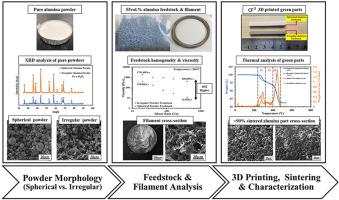
This study investigates ceramic fused filament fabrication (CF3) 3D printing of alumina with an emphasis on the impact of particle morphology on feedstock preparation and printability. Spherical powder displayed superior flow with higher apparent density, tap density, and powder packing fraction compared to irregular powder. A 55 vol % powder loading was chosen to ensure good flowability during printing. Irregular powder-based feedstocks had 40X higher viscosity than spherical powder feedstocks at 400 s−1 shear rate, posing potential printing challenges. Slow printing speed maintained low feed-rates for consistent material flow. The debinding and sintering process produced macroscopically defect-free alumina components with relative densities above 89 % for both powder morphologies. The focus of the work is on comparing two different powder particle morphologies influencing feedstock behavior, printing fidelity, and sintered part properties.



 京公网安备 11010802042870号
京ICP备2023020795号-1
京公网安备 11010802042870号
京ICP备2023020795号-1

 分享
分享
 求助内容:
求助内容: 应助结果提醒方式:
 扫码关注我们
