Mark Berney, Ellen M. Fay, William Doherty, John J. Deering, Eva-Maria Dürr, Steven Ferguson, Joanna F. McGouran
{"title":"Zinc-Binding Oligonucleotide Backbone Modifications for Targeting a DNA-Processing Metalloenzyme","authors":"Mark Berney, Ellen M. Fay, William Doherty, John J. Deering, Eva-Maria Dürr, Steven Ferguson, Joanna F. McGouran","doi":"10.1002/cbic.202400528","DOIUrl":null,"url":null,"abstract":"<p>A series of chemically-modified oligonucleotides for targeting the DNA repair nuclease SNM1A have been designed and synthesised. Each oligonucleotide contains a modified internucleotide linkage designed to both mimic the native phosphodiester backbone and chelate to the catalytic zinc ion(s) in the SNM1A active site. Dinucleoside phosphoramidites containing urea, squaramide, sulfanylacetamide, and sulfinylacetamide linkages were prepared and employed successfully in solid-phase oligonucleotide synthesis. All the modified oligonucleotides were found to interact with SNM1A in a gel electrophoresis-based assay, demonstrating the first examples of inhibition of DNA damage repair enzymes for many of these groups in oligonucleotides. One strand containing a sulfinylacetamide-linkage was found to have the strongest interaction with SNM1A and was further tested in a real-time fluorescence assay. This allowed an IC<sub>50</sub> value of 231 nM to be determined, significantly lower than previously reported substrate-mimics targeting this enzyme. It is expected that these modified oligonucleotides will serve as a scaffold for the future development of fluorescent or biotin-labelled probes for the <i>in vivo</i> study of DNA repair processes.</p>","PeriodicalId":140,"journal":{"name":"ChemBioChem","volume":"25 21","pages":""},"PeriodicalIF":2.8000,"publicationDate":"2024-07-18","publicationTypes":"Journal Article","fieldsOfStudy":null,"isOpenAccess":false,"openAccessPdf":"https://onlinelibrary.wiley.com/doi/epdf/10.1002/cbic.202400528","citationCount":"0","resultStr":null,"platform":"Semanticscholar","paperid":null,"PeriodicalName":"ChemBioChem","FirstCategoryId":"99","ListUrlMain":"https://chemistry-europe.onlinelibrary.wiley.com/doi/10.1002/cbic.202400528","RegionNum":4,"RegionCategory":"生物学","ArticlePicture":[],"TitleCN":null,"AbstractTextCN":null,"PMCID":null,"EPubDate":"","PubModel":"","JCR":"Q3","JCRName":"BIOCHEMISTRY & MOLECULAR BIOLOGY","Score":null,"Total":0}
引用次数: 0
Abstract
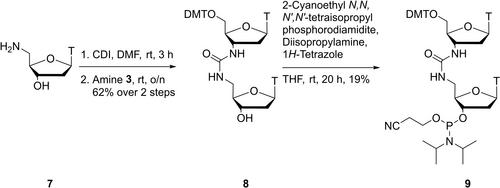
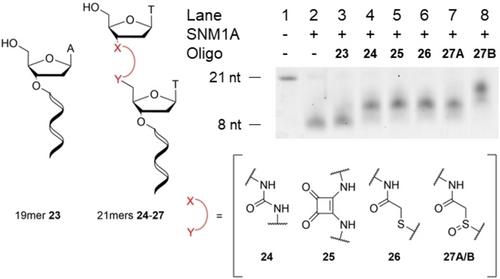
A series of chemically-modified oligonucleotides for targeting the DNA repair nuclease SNM1A have been designed and synthesised. Each oligonucleotide contains a modified internucleotide linkage designed to both mimic the native phosphodiester backbone and chelate to the catalytic zinc ion(s) in the SNM1A active site. Dinucleoside phosphoramidites containing urea, squaramide, sulfanylacetamide, and sulfinylacetamide linkages were prepared and employed successfully in solid-phase oligonucleotide synthesis. All the modified oligonucleotides were found to interact with SNM1A in a gel electrophoresis-based assay, demonstrating the first examples of inhibition of DNA damage repair enzymes for many of these groups in oligonucleotides. One strand containing a sulfinylacetamide-linkage was found to have the strongest interaction with SNM1A and was further tested in a real-time fluorescence assay. This allowed an IC50 value of 231 nM to be determined, significantly lower than previously reported substrate-mimics targeting this enzyme. It is expected that these modified oligonucleotides will serve as a scaffold for the future development of fluorescent or biotin-labelled probes for the in vivo study of DNA repair processes.
期刊介绍:
ChemBioChem (Impact Factor 2018: 2.641) publishes important breakthroughs across all areas at the interface of chemistry and biology, including the fields of chemical biology, bioorganic chemistry, bioinorganic chemistry, synthetic biology, biocatalysis, bionanotechnology, and biomaterials. It is published on behalf of Chemistry Europe, an association of 16 European chemical societies, and supported by the Asian Chemical Editorial Society (ACES).



 京公网安备 11010802042870号
京ICP备2023020795号-1
京公网安备 11010802042870号
京ICP备2023020795号-1

 分享
分享
 求助内容:
求助内容: 应助结果提醒方式:
 扫码关注我们
