{"title":"Effects of nonlinearities and geometric imperfections on multistability and deformation localization in wrinkling films on planar substrates","authors":"Jan Zavodnik, Miha Brojan","doi":"10.1016/j.jmps.2024.105774","DOIUrl":null,"url":null,"abstract":"<div><p>Compressed elastic films on soft substrates release part of their strain energy by wrinkling, which represents a loss of symmetry, characterized by a pitchfork bifurcation. Its development is well understood at the onset of supercritical bifurcation, but not beyond, or in the case of subcritical bifurcation. This is mainly due to nonlinearities and the extreme imperfection sensitivity. In both types of bifurcations, the energy–displacement diagrams that can characterize an energy landscape are non-convex, which is notoriously difficult to determine numerically or experimentally, let alone analytically. To gain an elementary understanding of such potential energy landscapes, we take a thin beam theory suitable for analyzing large displacements under small strains and significantly reduce its complexity by reformulating it in terms of the tangent rotation angle. This enables a comprehensive analytical and numerical analysis of wrinkling elastic films on planar substrates, which are effective stiffening and/or softening due to either geometric or material nonlinearities. We also validate our findings experimentally. We explicitly show how effective stiffening nonlinear behavior (e.g., due to substrate or membrane deformations) leads to a supercritical post-bifurcation response, makes the energy landscape non-convex through energy barriers causing multistability, which is extremely problematic for numerical computation. Moreover, this type of nonlinearity promotes uni-modal, uniformly distributed, periodic deformation patterns. In contrast, nonlinear effective softening behavior leads to subcritical post-bifurcation behavior, similarly divides the energy landscape by energy barriers and conversely promotes localization of deformations. With our theoretical model we can thus explain an experimentally observed phenomenon that in structures with effective softening followed by an effective stiffening behavior, the symmetry is initially broken by localizing the deformation and later restored by forming periodic, distributed deformation patterns as the load is increased. Finally, we show that initial imperfections can significantly alter the local or global energy-minimizing deformation pattern and completely remove some energy barriers. We envision that this knowledge can be extrapolated and exploited to convexify extremely divergent energy landscapes of more sophisticated systems, such as wrinkling compressed films on curved substrates (e.g., on cylinders and spheres) and that it will enable elementary analysis and the development of specialized numerical tools.</p></div>","PeriodicalId":17331,"journal":{"name":"Journal of The Mechanics and Physics of Solids","volume":"191 ","pages":"Article 105774"},"PeriodicalIF":6.0000,"publicationDate":"2024-10-01","publicationTypes":"Journal Article","fieldsOfStudy":null,"isOpenAccess":false,"openAccessPdf":"https://www.sciencedirect.com/science/article/pii/S0022509624002400/pdfft?md5=480a8025e39753a1ffe41a914966e4be&pid=1-s2.0-S0022509624002400-main.pdf","citationCount":"0","resultStr":null,"platform":"Semanticscholar","paperid":null,"PeriodicalName":"Journal of The Mechanics and Physics of Solids","FirstCategoryId":"5","ListUrlMain":"https://www.sciencedirect.com/science/article/pii/S0022509624002400","RegionNum":2,"RegionCategory":"工程技术","ArticlePicture":[],"TitleCN":null,"AbstractTextCN":null,"PMCID":null,"EPubDate":"2024/7/10 0:00:00","PubModel":"Epub","JCR":"Q2","JCRName":"MATERIALS SCIENCE, MULTIDISCIPLINARY","Score":null,"Total":0}
引用次数: 0
Abstract
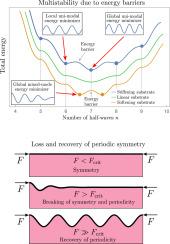
Compressed elastic films on soft substrates release part of their strain energy by wrinkling, which represents a loss of symmetry, characterized by a pitchfork bifurcation. Its development is well understood at the onset of supercritical bifurcation, but not beyond, or in the case of subcritical bifurcation. This is mainly due to nonlinearities and the extreme imperfection sensitivity. In both types of bifurcations, the energy–displacement diagrams that can characterize an energy landscape are non-convex, which is notoriously difficult to determine numerically or experimentally, let alone analytically. To gain an elementary understanding of such potential energy landscapes, we take a thin beam theory suitable for analyzing large displacements under small strains and significantly reduce its complexity by reformulating it in terms of the tangent rotation angle. This enables a comprehensive analytical and numerical analysis of wrinkling elastic films on planar substrates, which are effective stiffening and/or softening due to either geometric or material nonlinearities. We also validate our findings experimentally. We explicitly show how effective stiffening nonlinear behavior (e.g., due to substrate or membrane deformations) leads to a supercritical post-bifurcation response, makes the energy landscape non-convex through energy barriers causing multistability, which is extremely problematic for numerical computation. Moreover, this type of nonlinearity promotes uni-modal, uniformly distributed, periodic deformation patterns. In contrast, nonlinear effective softening behavior leads to subcritical post-bifurcation behavior, similarly divides the energy landscape by energy barriers and conversely promotes localization of deformations. With our theoretical model we can thus explain an experimentally observed phenomenon that in structures with effective softening followed by an effective stiffening behavior, the symmetry is initially broken by localizing the deformation and later restored by forming periodic, distributed deformation patterns as the load is increased. Finally, we show that initial imperfections can significantly alter the local or global energy-minimizing deformation pattern and completely remove some energy barriers. We envision that this knowledge can be extrapolated and exploited to convexify extremely divergent energy landscapes of more sophisticated systems, such as wrinkling compressed films on curved substrates (e.g., on cylinders and spheres) and that it will enable elementary analysis and the development of specialized numerical tools.
期刊介绍:
The aim of Journal of The Mechanics and Physics of Solids is to publish research of the highest quality and of lasting significance on the mechanics of solids. The scope is broad, from fundamental concepts in mechanics to the analysis of novel phenomena and applications. Solids are interpreted broadly to include both hard and soft materials as well as natural and synthetic structures. The approach can be theoretical, experimental or computational.This research activity sits within engineering science and the allied areas of applied mathematics, materials science, bio-mechanics, applied physics, and geophysics.
The Journal was founded in 1952 by Rodney Hill, who was its Editor-in-Chief until 1968. The topics of interest to the Journal evolve with developments in the subject but its basic ethos remains the same: to publish research of the highest quality relating to the mechanics of solids. Thus, emphasis is placed on the development of fundamental concepts of mechanics and novel applications of these concepts based on theoretical, experimental or computational approaches, drawing upon the various branches of engineering science and the allied areas within applied mathematics, materials science, structural engineering, applied physics, and geophysics.
The main purpose of the Journal is to foster scientific understanding of the processes of deformation and mechanical failure of all solid materials, both technological and natural, and the connections between these processes and their underlying physical mechanisms. In this sense, the content of the Journal should reflect the current state of the discipline in analysis, experimental observation, and numerical simulation. In the interest of achieving this goal, authors are encouraged to consider the significance of their contributions for the field of mechanics and the implications of their results, in addition to describing the details of their work.



 京公网安备 11010802042870号
京ICP备2023020795号-1
京公网安备 11010802042870号
京ICP备2023020795号-1

 分享
分享
 求助内容:
求助内容: 应助结果提醒方式:
 扫码关注我们
