Qin Yang, Peng Guo, Pengkun Lei, Qiaolin Yang, Yuchun Liu, Ya Tian, Wen Shi, Chunxiao Zhu, Min Lei, Rui Zeng, Chen Zhang, Yan Qu
{"title":"Dissolvable Microneedles Loaded Ginsenoside Rg3 liposome: A Transdermal Delivery Approach for Alopecia Treatment","authors":"Qin Yang, Peng Guo, Pengkun Lei, Qiaolin Yang, Yuchun Liu, Ya Tian, Wen Shi, Chunxiao Zhu, Min Lei, Rui Zeng, Chen Zhang, Yan Qu","doi":"10.1093/rb/rbae086","DOIUrl":null,"url":null,"abstract":"\n The skin stratum corneum (SC) barrier function will interfere with the absorption of topical treatment and reduce the drug's therapeutic effect on alopecia. Microneedles (MNs) can penetrate the skin barrier and deliver drugs to the dermis. Furthermore, MNs can mechanically stimulate the skin, which promotes hair growth. Thus, we designed a green and dissolvable composite microneedle made of hyaluronic acid (HA) and Bletilla striata polysaccharide (BSP) to encapsulate cholesterol-free ginsenoside Rg3 liposomes (Rg3-LPs) to avoid cholesterol metabolism-producing testosterone to inhibit hair regeneration and minimize the effect of the SC barrier on liposomes absorption. HA and BSP can enhance the mechanical strength of Rg3-MNs to ensure the transport of liposomes to the hair follicle region (HF) while causing minimal skin irritation and guaranteeing cell compatibility. In addition, HA increased hair density and was more conducive to hair regeneration. In telogen effluvium (TE) and testosterone-induced androgenetic alopecia (AGA) animals, Rg3-MNs achieved comparable efficacy to minoxidil with low-frequency treatment, and the quality of regenerated hair was higher. Furthermore, quantitative characterization and transcriptome sequencing results showed that Rg3-MNs promoted hair regeneration by promoting the expression of Wnt3a and Wnt10b genes, activating the Wnt/β-catenin pathway. Therefore, Rg3-MNs present broad prospects in the treatment of alopecia.","PeriodicalId":5,"journal":{"name":"ACS Applied Materials & Interfaces","volume":"80 12","pages":""},"PeriodicalIF":8.2000,"publicationDate":"2024-07-16","publicationTypes":"Journal Article","fieldsOfStudy":null,"isOpenAccess":false,"openAccessPdf":"","citationCount":"0","resultStr":null,"platform":"Semanticscholar","paperid":null,"PeriodicalName":"ACS Applied Materials & Interfaces","FirstCategoryId":"5","ListUrlMain":"https://doi.org/10.1093/rb/rbae086","RegionNum":2,"RegionCategory":"材料科学","ArticlePicture":[],"TitleCN":null,"AbstractTextCN":null,"PMCID":null,"EPubDate":"","PubModel":"","JCR":"Q1","JCRName":"MATERIALS SCIENCE, MULTIDISCIPLINARY","Score":null,"Total":0}
引用次数: 0
Abstract
The skin stratum corneum (SC) barrier function will interfere with the absorption of topical treatment and reduce the drug's therapeutic effect on alopecia. Microneedles (MNs) can penetrate the skin barrier and deliver drugs to the dermis. Furthermore, MNs can mechanically stimulate the skin, which promotes hair growth. Thus, we designed a green and dissolvable composite microneedle made of hyaluronic acid (HA) and Bletilla striata polysaccharide (BSP) to encapsulate cholesterol-free ginsenoside Rg3 liposomes (Rg3-LPs) to avoid cholesterol metabolism-producing testosterone to inhibit hair regeneration and minimize the effect of the SC barrier on liposomes absorption. HA and BSP can enhance the mechanical strength of Rg3-MNs to ensure the transport of liposomes to the hair follicle region (HF) while causing minimal skin irritation and guaranteeing cell compatibility. In addition, HA increased hair density and was more conducive to hair regeneration. In telogen effluvium (TE) and testosterone-induced androgenetic alopecia (AGA) animals, Rg3-MNs achieved comparable efficacy to minoxidil with low-frequency treatment, and the quality of regenerated hair was higher. Furthermore, quantitative characterization and transcriptome sequencing results showed that Rg3-MNs promoted hair regeneration by promoting the expression of Wnt3a and Wnt10b genes, activating the Wnt/β-catenin pathway. Therefore, Rg3-MNs present broad prospects in the treatment of alopecia.
期刊介绍:
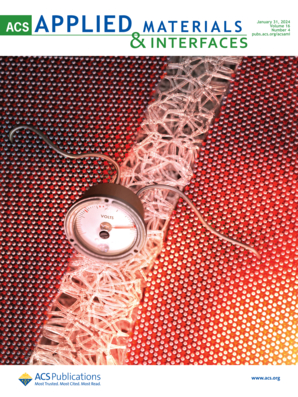
ACS Applied Materials & Interfaces is a leading interdisciplinary journal that brings together chemists, engineers, physicists, and biologists to explore the development and utilization of newly-discovered materials and interfacial processes for specific applications. Our journal has experienced remarkable growth since its establishment in 2009, both in terms of the number of articles published and the impact of the research showcased. We are proud to foster a truly global community, with the majority of published articles originating from outside the United States, reflecting the rapid growth of applied research worldwide.



 京公网安备 11010802042870号
京ICP备2023020795号-1
京公网安备 11010802042870号
京ICP备2023020795号-1

 分享
分享
 求助内容:
求助内容: 应助结果提醒方式:
 扫码关注我们
