{"title":"Non-firing Synthesis for Oxides: From Natural to Synthetic Forms with Energy-Efficient and Sustainable Processes","authors":"Liping Zhao, Jinyun Xu, Yu Zhang, Ziqi Zhang, Ming Li, Hongze Li, Shijie Shang, Xiaoqing Wang, Xudong Hu, Xiaojun Zhang, Wenju Zhu, Chunming Zheng, Xiaohong Sun","doi":"10.1007/s11665-024-09781-0","DOIUrl":null,"url":null,"abstract":"<div><p>Non-firing functional oxide materials are attracting significant interest due to their suitability for a wide range of applications, particularly in thermal, electrical, and architectural fields. These materials, which range from natural to synthetic forms, offer a diverse range of properties. While oxides are generally known for their high mechanical strength, temperature resistance, and cost-effectiveness, traditional oxide processing often requires energy-intensive and environmentally unfriendly high-temperature sintering. Therefore, the investigation of energy-efficient non-firing mechanisms for oxides is not only beneficial but crucial. This paper reviews the advancements in non-firing mechanisms, with a focus on material selection, synthesis processes, and potential applications. Special attention is given to non-firing forms such as silica-based and geopolymer materials, which are prepared using low-energy acid-base reactions with either natural or synthetic silica-alumina sources. The review also encapsulates the challenges and solutions associated with these sustainable, non-firing oxide materials.</p><h3>Graphical Abstract</h3><div><figure><div><div><picture><source><img></source></picture></div></div></figure></div></div>","PeriodicalId":644,"journal":{"name":"Journal of Materials Engineering and Performance","volume":"33 21","pages":"11411 - 11437"},"PeriodicalIF":2.0000,"publicationDate":"2024-07-15","publicationTypes":"Journal Article","fieldsOfStudy":null,"isOpenAccess":false,"openAccessPdf":"","citationCount":"0","resultStr":null,"platform":"Semanticscholar","paperid":null,"PeriodicalName":"Journal of Materials Engineering and Performance","FirstCategoryId":"88","ListUrlMain":"https://link.springer.com/article/10.1007/s11665-024-09781-0","RegionNum":4,"RegionCategory":"材料科学","ArticlePicture":[],"TitleCN":null,"AbstractTextCN":null,"PMCID":null,"EPubDate":"","PubModel":"","JCR":"Q3","JCRName":"MATERIALS SCIENCE, MULTIDISCIPLINARY","Score":null,"Total":0}
引用次数: 0
Abstract
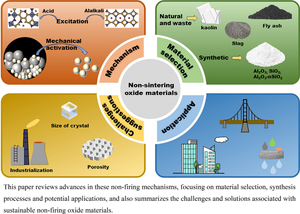
Non-firing functional oxide materials are attracting significant interest due to their suitability for a wide range of applications, particularly in thermal, electrical, and architectural fields. These materials, which range from natural to synthetic forms, offer a diverse range of properties. While oxides are generally known for their high mechanical strength, temperature resistance, and cost-effectiveness, traditional oxide processing often requires energy-intensive and environmentally unfriendly high-temperature sintering. Therefore, the investigation of energy-efficient non-firing mechanisms for oxides is not only beneficial but crucial. This paper reviews the advancements in non-firing mechanisms, with a focus on material selection, synthesis processes, and potential applications. Special attention is given to non-firing forms such as silica-based and geopolymer materials, which are prepared using low-energy acid-base reactions with either natural or synthetic silica-alumina sources. The review also encapsulates the challenges and solutions associated with these sustainable, non-firing oxide materials.
期刊介绍:
ASM International''s Journal of Materials Engineering and Performance focuses on solving day-to-day engineering challenges, particularly those involving components for larger systems. The journal presents a clear understanding of relationships between materials selection, processing, applications and performance.
The Journal of Materials Engineering covers all aspects of materials selection, design, processing, characterization and evaluation, including how to improve materials properties through processes and process control of casting, forming, heat treating, surface modification and coating, and fabrication.
Testing and characterization (including mechanical and physical tests, NDE, metallography, failure analysis, corrosion resistance, chemical analysis, surface characterization, and microanalysis of surfaces, features and fractures), and industrial performance measurement are also covered




 京公网安备 11010802042870号
京ICP备2023020795号-1
京公网安备 11010802042870号
京ICP备2023020795号-1

 分享
分享
 求助内容:
求助内容: 应助结果提醒方式:
 扫码关注我们
