{"title":"The Impact of Interfacial Recombination on Hysteresis in Back-Contact Perovskite Solar Cells","authors":"Peidong Tian, Yanyan Chang, Shulong Lu, Lian Ji","doi":"10.1007/s11664-024-11308-1","DOIUrl":null,"url":null,"abstract":"<div><p>A back-contact perovskite solar cell (BC-PSC) has been simulated. The J–V curves were calculated with different degrees of the interfacial recombination, and the characteristics of basic physical phenomena inside the device, including carrier concentration distribution, ion concentration distribution, electric potential change, and carrier recombination rate, have also been investigated. It was found that the effect of the perovskite layer’s upper surface (US) interfacial recombination on the hysteresis phenomenon is greater than that of the perovskite layer’s lower surface (LS) interfacial recombination. In addition, it has been found that the inverted hysteresis phenomenon occurs in the BC-PSC with the LS interfacial recombination. Moreover, the hysteresis loops corresponding to the US interfacial recombination of the perovskite layer were close to the short-circuit current side, and the hysteresis loops corresponding to the LS interfacial recombination of the perovskite layer were close to the open-circuit voltage side. These results indicate that both of the US and LS interface recombinations in the BC-PSC play a crucial role in the hysteresis phenomenon.</p></div>","PeriodicalId":626,"journal":{"name":"Journal of Electronic Materials","volume":"53 10","pages":"6003 - 6011"},"PeriodicalIF":2.5000,"publicationDate":"2024-07-15","publicationTypes":"Journal Article","fieldsOfStudy":null,"isOpenAccess":false,"openAccessPdf":"","citationCount":"0","resultStr":null,"platform":"Semanticscholar","paperid":null,"PeriodicalName":"Journal of Electronic Materials","FirstCategoryId":"5","ListUrlMain":"https://link.springer.com/article/10.1007/s11664-024-11308-1","RegionNum":4,"RegionCategory":"工程技术","ArticlePicture":[],"TitleCN":null,"AbstractTextCN":null,"PMCID":null,"EPubDate":"","PubModel":"","JCR":"Q3","JCRName":"ENGINEERING, ELECTRICAL & ELECTRONIC","Score":null,"Total":0}
引用次数: 0
Abstract
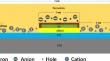
A back-contact perovskite solar cell (BC-PSC) has been simulated. The J–V curves were calculated with different degrees of the interfacial recombination, and the characteristics of basic physical phenomena inside the device, including carrier concentration distribution, ion concentration distribution, electric potential change, and carrier recombination rate, have also been investigated. It was found that the effect of the perovskite layer’s upper surface (US) interfacial recombination on the hysteresis phenomenon is greater than that of the perovskite layer’s lower surface (LS) interfacial recombination. In addition, it has been found that the inverted hysteresis phenomenon occurs in the BC-PSC with the LS interfacial recombination. Moreover, the hysteresis loops corresponding to the US interfacial recombination of the perovskite layer were close to the short-circuit current side, and the hysteresis loops corresponding to the LS interfacial recombination of the perovskite layer were close to the open-circuit voltage side. These results indicate that both of the US and LS interface recombinations in the BC-PSC play a crucial role in the hysteresis phenomenon.
期刊介绍:
The Journal of Electronic Materials (JEM) reports monthly on the science and technology of electronic materials, while examining new applications for semiconductors, magnetic alloys, dielectrics, nanoscale materials, and photonic materials. The journal welcomes articles on methods for preparing and evaluating the chemical, physical, electronic, and optical properties of these materials. Specific areas of interest are materials for state-of-the-art transistors, nanotechnology, electronic packaging, detectors, emitters, metallization, superconductivity, and energy applications.
Review papers on current topics enable individuals in the field of electronics to keep abreast of activities in areas peripheral to their own. JEM also selects papers from conferences such as the Electronic Materials Conference, the U.S. Workshop on the Physics and Chemistry of II-VI Materials, and the International Conference on Thermoelectrics. It benefits both specialists and non-specialists in the electronic materials field.
A journal of The Minerals, Metals & Materials Society.



 京公网安备 11010802042870号
京ICP备2023020795号-1
京公网安备 11010802042870号
京ICP备2023020795号-1

 分享
分享
 求助内容:
求助内容: 应助结果提醒方式:
 扫码关注我们
