Parastoo Jafarzadeh, F. Ensan, Mahdiyar Ali Akbar Alavi, Fattane Zarrinkalam
{"title":"A Knowledge Graph Embedding Model for Answering Factoid Entity Questions","authors":"Parastoo Jafarzadeh, F. Ensan, Mahdiyar Ali Akbar Alavi, Fattane Zarrinkalam","doi":"10.1145/3678003","DOIUrl":null,"url":null,"abstract":"Factoid entity questions (FEQ), which seek answers in the form of a single entity from knowledge sources such as DBpedia and Wikidata, constitute a substantial portion of user queries in search engines. This paper introduces the Knowledge Graph Embedding model for Factoid Entity Question answering (KGE-FEQ). Leveraging a textual knowledge graph derived from extensive text collections, KGE-FEQ encodes textual relationships between entities. The model employs a two-step process: (1) Triple Retrieval, where relevant triples are retrieved from the textual knowledge graph based on semantic similarities to the question, and (2) Answer Selection, where a knowledge graph embedding approach is utilized for answering the question. This involves positioning the embedding for the answer entity close to the embedding of the question entity, incorporating a vector representing the question and textual relations between entities. Extensive experiments evaluate the performance of the proposed approach, comparing KGE-FEQ to state-of-the-art baselines in factoid entity question answering and the most advanced open-domain question answering techniques applied to FEQs. The results show that KGE-FEQ outperforms existing methods across different datasets. Ablation studies highlights the effectiveness of KGE-FEQ when both the question and textual relations between entities are considered for answering questions.","PeriodicalId":5,"journal":{"name":"ACS Applied Materials & Interfaces","volume":"118 19","pages":""},"PeriodicalIF":8.2000,"publicationDate":"2024-07-15","publicationTypes":"Journal Article","fieldsOfStudy":null,"isOpenAccess":false,"openAccessPdf":"","citationCount":"0","resultStr":null,"platform":"Semanticscholar","paperid":null,"PeriodicalName":"ACS Applied Materials & Interfaces","FirstCategoryId":"94","ListUrlMain":"https://doi.org/10.1145/3678003","RegionNum":2,"RegionCategory":"材料科学","ArticlePicture":[],"TitleCN":null,"AbstractTextCN":null,"PMCID":null,"EPubDate":"","PubModel":"","JCR":"Q1","JCRName":"MATERIALS SCIENCE, MULTIDISCIPLINARY","Score":null,"Total":0}
引用次数: 0
Abstract
Factoid entity questions (FEQ), which seek answers in the form of a single entity from knowledge sources such as DBpedia and Wikidata, constitute a substantial portion of user queries in search engines. This paper introduces the Knowledge Graph Embedding model for Factoid Entity Question answering (KGE-FEQ). Leveraging a textual knowledge graph derived from extensive text collections, KGE-FEQ encodes textual relationships between entities. The model employs a two-step process: (1) Triple Retrieval, where relevant triples are retrieved from the textual knowledge graph based on semantic similarities to the question, and (2) Answer Selection, where a knowledge graph embedding approach is utilized for answering the question. This involves positioning the embedding for the answer entity close to the embedding of the question entity, incorporating a vector representing the question and textual relations between entities. Extensive experiments evaluate the performance of the proposed approach, comparing KGE-FEQ to state-of-the-art baselines in factoid entity question answering and the most advanced open-domain question answering techniques applied to FEQs. The results show that KGE-FEQ outperforms existing methods across different datasets. Ablation studies highlights the effectiveness of KGE-FEQ when both the question and textual relations between entities are considered for answering questions.
期刊介绍:
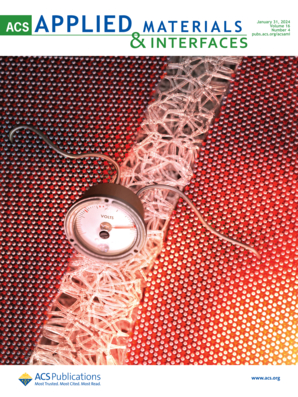
ACS Applied Materials & Interfaces is a leading interdisciplinary journal that brings together chemists, engineers, physicists, and biologists to explore the development and utilization of newly-discovered materials and interfacial processes for specific applications. Our journal has experienced remarkable growth since its establishment in 2009, both in terms of the number of articles published and the impact of the research showcased. We are proud to foster a truly global community, with the majority of published articles originating from outside the United States, reflecting the rapid growth of applied research worldwide.



 京公网安备 11010802042870号
京ICP备2023020795号-1
京公网安备 11010802042870号
京ICP备2023020795号-1

 分享
分享
 求助内容:
求助内容: 应助结果提醒方式:
 扫码关注我们
