M. Selvakumar, S. Maruthamuthu, E. Vijayakumar, B. Saravanakumar, A. Tony Dhiwahar
{"title":"Electrochemical Investigation of Magnesium-Doped Copper Ferrite Nanostructures for Asymmetric Supercapacitor Applications","authors":"M. Selvakumar, S. Maruthamuthu, E. Vijayakumar, B. Saravanakumar, A. Tony Dhiwahar","doi":"10.1007/s11664-024-11293-5","DOIUrl":null,"url":null,"abstract":"<div><p>In this study, the synthesis of magnesium-doped copper ferrite, namely Cu<sub><i>x</i></sub>Mg<sub>1−<i>x</i></sub>Fe<sub>2</sub>O<sub>4</sub> (<i>x</i> = 1, 0.9, 0.7, and 0.5), is achieved using a facile microwave route, and the cubic crystalline structure, functional group, and nanostructured materials are discussed. The electrochemical studies of the magnesium-doped copper ferrite (MCF) are carried out by assembling a three-electrode conventional electrochemical cell with MCF samples as working electrode, a platinum wire as counter electrode, a silver (Ag)/silver chloride (AgCl) as reference electrode, and 2 M KOH aqueous solution as electrolyte. The study of the electrochemical performance of Mg-doped and undoped copper ferrite electrodes reveals that they show battery-type behavior with the transfer of two electrons (Mg to Mg<sup>2+</sup>) in 2 M KOH electrolyte in the potential window of 0.45 V to 0.35 V. Further, un-oxidized MgO oxidizes, leading to a quasi-conversion reaction. Additionally, the electrode (MCF) exhibits a greater specific capacity of 737.5 F g<sup>−1</sup> at 1 A g<sup>−1</sup>. It is found that the MCF3 electrode retains 70% of its initial capacitance, which is higher than the CF electrode (33%), after 4000 continuous galvanostatic charge/discharge (GCD) cycles. An asymmetric supercapacitor cell is fabricated using MCF as the positive electrode, activated carbon (AC) as the negative electrode, 2 M KOH as the electrolyte, and polypropylene as the separator. The fabricated MCF//AC supercapacitor yields maximum specific energy of 62.61 W h kg<sup>−1</sup> at specific power of 1168 W kg<sup>−1</sup>. These electrochemical features suggest that MCF is a feasible candidate material for developing supercapacitor electrodes.</p></div>","PeriodicalId":626,"journal":{"name":"Journal of Electronic Materials","volume":"53 10","pages":"6023 - 6035"},"PeriodicalIF":2.8000,"publicationDate":"2024-07-15","publicationTypes":"Journal Article","fieldsOfStudy":null,"isOpenAccess":false,"openAccessPdf":"","citationCount":"0","resultStr":null,"platform":"Semanticscholar","paperid":null,"PeriodicalName":"Journal of Electronic Materials","FirstCategoryId":"5","ListUrlMain":"https://link.springer.com/article/10.1007/s11664-024-11293-5","RegionNum":4,"RegionCategory":"工程技术","ArticlePicture":[],"TitleCN":null,"AbstractTextCN":null,"PMCID":null,"EPubDate":"","PubModel":"","JCR":"Q3","JCRName":"ENGINEERING, ELECTRICAL & ELECTRONIC","Score":null,"Total":0}
引用次数: 0
Abstract
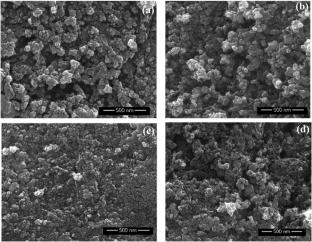
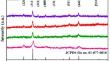
In this study, the synthesis of magnesium-doped copper ferrite, namely CuxMg1−xFe2O4 (x = 1, 0.9, 0.7, and 0.5), is achieved using a facile microwave route, and the cubic crystalline structure, functional group, and nanostructured materials are discussed. The electrochemical studies of the magnesium-doped copper ferrite (MCF) are carried out by assembling a three-electrode conventional electrochemical cell with MCF samples as working electrode, a platinum wire as counter electrode, a silver (Ag)/silver chloride (AgCl) as reference electrode, and 2 M KOH aqueous solution as electrolyte. The study of the electrochemical performance of Mg-doped and undoped copper ferrite electrodes reveals that they show battery-type behavior with the transfer of two electrons (Mg to Mg2+) in 2 M KOH electrolyte in the potential window of 0.45 V to 0.35 V. Further, un-oxidized MgO oxidizes, leading to a quasi-conversion reaction. Additionally, the electrode (MCF) exhibits a greater specific capacity of 737.5 F g−1 at 1 A g−1. It is found that the MCF3 electrode retains 70% of its initial capacitance, which is higher than the CF electrode (33%), after 4000 continuous galvanostatic charge/discharge (GCD) cycles. An asymmetric supercapacitor cell is fabricated using MCF as the positive electrode, activated carbon (AC) as the negative electrode, 2 M KOH as the electrolyte, and polypropylene as the separator. The fabricated MCF//AC supercapacitor yields maximum specific energy of 62.61 W h kg−1 at specific power of 1168 W kg−1. These electrochemical features suggest that MCF is a feasible candidate material for developing supercapacitor electrodes.
在本研究中,采用简易微波路径合成了掺镁铁氧体铜CuxMg1−xFe2O4 (x = 1,0.9, 0.7, 0.5),并对其立方晶结构、官能团和纳米结构材料进行了讨论。采用三电极常规电化学电池,以掺杂镁铁氧体铜为工作电极,铂丝为反电极,银(Ag)/氯化银(AgCl)为参比电极,2m KOH水溶液为电解质,对掺杂镁铁氧体铜(MCF)进行了电化学研究。对镁掺杂和未掺杂铜铁氧体电极的电化学性能研究表明,在0.45 V ~ 0.35 V的电位窗口内,在2 M KOH电解质中,两个电子(Mg)向Mg2+转移,表现出电池式的行为。此外,未氧化的MgO氧化,导致准转化反应。此外,该电极(MCF)在1ag−1时的比容量为737.5 F g−1。研究发现,在连续4000次恒流充放电(GCD)循环后,MCF3电极保持了70%的初始电容,高于CF电极的33%。以MCF为正极,活性炭(AC)为负极,2m KOH为电解液,聚丙烯为分离器制备了非对称超级电容器电池。所制备的MCF//AC超级电容器在比功率为1168 W kg - 1时的最大比能量为62.61 W h kg - 1。这些电化学特性表明MCF是开发超级电容器电极的可行候选材料。
期刊介绍:
The Journal of Electronic Materials (JEM) reports monthly on the science and technology of electronic materials, while examining new applications for semiconductors, magnetic alloys, dielectrics, nanoscale materials, and photonic materials. The journal welcomes articles on methods for preparing and evaluating the chemical, physical, electronic, and optical properties of these materials. Specific areas of interest are materials for state-of-the-art transistors, nanotechnology, electronic packaging, detectors, emitters, metallization, superconductivity, and energy applications.
Review papers on current topics enable individuals in the field of electronics to keep abreast of activities in areas peripheral to their own. JEM also selects papers from conferences such as the Electronic Materials Conference, the U.S. Workshop on the Physics and Chemistry of II-VI Materials, and the International Conference on Thermoelectrics. It benefits both specialists and non-specialists in the electronic materials field.
A journal of The Minerals, Metals & Materials Society.




 京公网安备 11010802042870号
京ICP备2023020795号-1
京公网安备 11010802042870号
京ICP备2023020795号-1

 分享
分享
 求助内容:
求助内容: 应助结果提醒方式:
 扫码关注我们
