Evaluation of Dye Loading on Photoanodes of Dye-Sensitized Solar Cells Utilizing a Mixture of TiO2 and Magnesium/Aluminum Layered Double Hydroxide (LDH)
{"title":"Evaluation of Dye Loading on Photoanodes of Dye-Sensitized Solar Cells Utilizing a Mixture of TiO2 and Magnesium/Aluminum Layered Double Hydroxide (LDH)","authors":"Kareem Jumaah Jibrael Al-Salihi","doi":"10.1007/s11664-024-11211-9","DOIUrl":null,"url":null,"abstract":"<div><p>This research focused on developing photoanodes for dye-sensitized solar cells (DSSCs) by combining titanium dioxide (TiO<sub>2</sub>), layered double hydroxide (LDH), and TiO<sub>2</sub>-LDH composites. DSSCs were fabricated using different photoanode materials, including TiO<sub>2</sub>, LDH, and various TiO<sub>2</sub>-LDH ratios sensitized with N719 dye and employing an iodide/triiodide redox couple electrolyte. Under simulated sunlight, TiO<sub>2</sub>-based DSSCs achieved an impressive 4.57% energy conversion efficiency, while LDH-based devices only reached 0.62%. DSSCs with varying TiO<sub>2</sub>-LDH ratios demonstrated efficiencies of 2.4%, 3.2%, and 3.3% for 1:1, 1:3, and 1:5 ratios, respectively. The superior performance of TiO<sub>2</sub>-based DSSCs was attributed to higher electron transfer efficiency. Dye loading analysis revealed that TiO<sub>2</sub> had the highest dye loading due to its extensive surface area, while LDH had the lowest loading. Adsorption kinetics of N719 dye on TiO<sub>2</sub> and LDH films indicated a pseudo-second-order model, suggesting chemical interactions between dye molecules and surface sites.</p><h3>Graphical Abstract</h3>\n<div><figure><div><div><picture><source><img></source></picture></div></div></figure></div></div>","PeriodicalId":626,"journal":{"name":"Journal of Electronic Materials","volume":"53 10","pages":"6012 - 6022"},"PeriodicalIF":2.5000,"publicationDate":"2024-07-15","publicationTypes":"Journal Article","fieldsOfStudy":null,"isOpenAccess":false,"openAccessPdf":"","citationCount":"0","resultStr":null,"platform":"Semanticscholar","paperid":null,"PeriodicalName":"Journal of Electronic Materials","FirstCategoryId":"5","ListUrlMain":"https://link.springer.com/article/10.1007/s11664-024-11211-9","RegionNum":4,"RegionCategory":"工程技术","ArticlePicture":[],"TitleCN":null,"AbstractTextCN":null,"PMCID":null,"EPubDate":"","PubModel":"","JCR":"Q3","JCRName":"ENGINEERING, ELECTRICAL & ELECTRONIC","Score":null,"Total":0}
引用次数: 0
Abstract
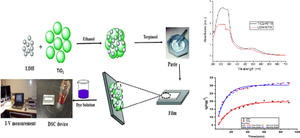
This research focused on developing photoanodes for dye-sensitized solar cells (DSSCs) by combining titanium dioxide (TiO2), layered double hydroxide (LDH), and TiO2-LDH composites. DSSCs were fabricated using different photoanode materials, including TiO2, LDH, and various TiO2-LDH ratios sensitized with N719 dye and employing an iodide/triiodide redox couple electrolyte. Under simulated sunlight, TiO2-based DSSCs achieved an impressive 4.57% energy conversion efficiency, while LDH-based devices only reached 0.62%. DSSCs with varying TiO2-LDH ratios demonstrated efficiencies of 2.4%, 3.2%, and 3.3% for 1:1, 1:3, and 1:5 ratios, respectively. The superior performance of TiO2-based DSSCs was attributed to higher electron transfer efficiency. Dye loading analysis revealed that TiO2 had the highest dye loading due to its extensive surface area, while LDH had the lowest loading. Adsorption kinetics of N719 dye on TiO2 and LDH films indicated a pseudo-second-order model, suggesting chemical interactions between dye molecules and surface sites.
期刊介绍:
The Journal of Electronic Materials (JEM) reports monthly on the science and technology of electronic materials, while examining new applications for semiconductors, magnetic alloys, dielectrics, nanoscale materials, and photonic materials. The journal welcomes articles on methods for preparing and evaluating the chemical, physical, electronic, and optical properties of these materials. Specific areas of interest are materials for state-of-the-art transistors, nanotechnology, electronic packaging, detectors, emitters, metallization, superconductivity, and energy applications.
Review papers on current topics enable individuals in the field of electronics to keep abreast of activities in areas peripheral to their own. JEM also selects papers from conferences such as the Electronic Materials Conference, the U.S. Workshop on the Physics and Chemistry of II-VI Materials, and the International Conference on Thermoelectrics. It benefits both specialists and non-specialists in the electronic materials field.
A journal of The Minerals, Metals & Materials Society.



 京公网安备 11010802042870号
京ICP备2023020795号-1
京公网安备 11010802042870号
京ICP备2023020795号-1

 分享
分享
 求助内容:
求助内容: 应助结果提醒方式:
 扫码关注我们
