{"title":"Gate driver, snubber and circuit design considerations for fast-switching series-connected SiC MOSFETs","authors":"Tobias Nieckula Ubostad, Dimosthenis Peftitsis","doi":"10.1049/pel2.12744","DOIUrl":null,"url":null,"abstract":"<p>Series connection of Silicon Carbide (SiC) Metal-Oxide-Semiconductor Field-Effect Transistors (MOSFETs) is an interesting solution to design switches for voltages that are not yet commercially available or limited for single-die devices. However, inherent static and dynamic voltage balancing must be achieved. Voltage imbalance is caused by the device parameters spread, whose impact is pronounced in low-inductive circuit layouts. This study investigates the optimal design and tuning limits of resistor-capacitor (RC)-snubber circuits and non-adaptive, standard, voltage-source gate drivers for achieving the best balancing in transient and steady-state voltage distributions among series-connected discrete SiC MOSFETs operating at speeds up to <span></span><math>\n <semantics>\n <mrow>\n <mn>90</mn>\n <mspace></mspace>\n <mi>k</mi>\n <mi>V</mi>\n <mo>/</mo>\n <mi>μ</mi>\n <mi>s</mi>\n </mrow>\n <annotation>$90 \\,\\mathrm{k}\\mathrm{V}/{\\umu }\\mathrm{s}$</annotation>\n </semantics></math>. It has been shown that a larger parameter mismatch will lead to uneven switching energy losses and larger voltage imbalances. It was also experimentally shown that increasing the gate resistor to slow down the devices will not always improve balancing when their parameter spread is large. Thus, tuning recommendations for the RC-snubber circuit and gate driver were developed based on these findings.</p>","PeriodicalId":56302,"journal":{"name":"IET Power Electronics","volume":"17 14","pages":"1867-1881"},"PeriodicalIF":1.9000,"publicationDate":"2024-07-05","publicationTypes":"Journal Article","fieldsOfStudy":null,"isOpenAccess":false,"openAccessPdf":"https://onlinelibrary.wiley.com/doi/epdf/10.1049/pel2.12744","citationCount":"0","resultStr":null,"platform":"Semanticscholar","paperid":null,"PeriodicalName":"IET Power Electronics","FirstCategoryId":"5","ListUrlMain":"https://ietresearch.onlinelibrary.wiley.com/doi/10.1049/pel2.12744","RegionNum":4,"RegionCategory":"工程技术","ArticlePicture":[],"TitleCN":null,"AbstractTextCN":null,"PMCID":null,"EPubDate":"","PubModel":"","JCR":"Q3","JCRName":"ENGINEERING, ELECTRICAL & ELECTRONIC","Score":null,"Total":0}
引用次数: 0
Abstract
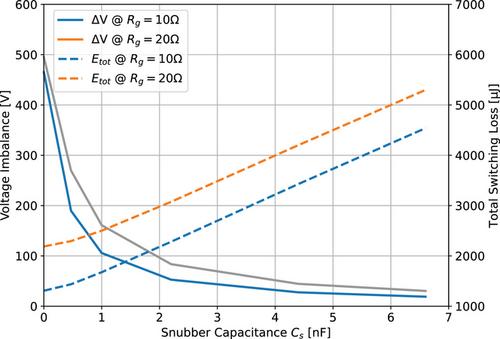
Series connection of Silicon Carbide (SiC) Metal-Oxide-Semiconductor Field-Effect Transistors (MOSFETs) is an interesting solution to design switches for voltages that are not yet commercially available or limited for single-die devices. However, inherent static and dynamic voltage balancing must be achieved. Voltage imbalance is caused by the device parameters spread, whose impact is pronounced in low-inductive circuit layouts. This study investigates the optimal design and tuning limits of resistor-capacitor (RC)-snubber circuits and non-adaptive, standard, voltage-source gate drivers for achieving the best balancing in transient and steady-state voltage distributions among series-connected discrete SiC MOSFETs operating at speeds up to . It has been shown that a larger parameter mismatch will lead to uneven switching energy losses and larger voltage imbalances. It was also experimentally shown that increasing the gate resistor to slow down the devices will not always improve balancing when their parameter spread is large. Thus, tuning recommendations for the RC-snubber circuit and gate driver were developed based on these findings.
期刊介绍:
IET Power Electronics aims to attract original research papers, short communications, review articles and power electronics related educational studies. The scope covers applications and technologies in the field of power electronics with special focus on cost-effective, efficient, power dense, environmental friendly and robust solutions, which includes:
Applications:
Electric drives/generators, renewable energy, industrial and consumable applications (including lighting, welding, heating, sub-sea applications, drilling and others), medical and military apparatus, utility applications, transport and space application, energy harvesting, telecommunications, energy storage management systems, home appliances.
Technologies:
Circuits: all type of converter topologies for low and high power applications including but not limited to: inverter, rectifier, dc/dc converter, power supplies, UPS, ac/ac converter, resonant converter, high frequency converter, hybrid converter, multilevel converter, power factor correction circuits and other advanced topologies.
Components and Materials: switching devices and their control, inductors, sensors, transformers, capacitors, resistors, thermal management, filters, fuses and protection elements and other novel low-cost efficient components/materials.
Control: techniques for controlling, analysing, modelling and/or simulation of power electronics circuits and complete power electronics systems.
Design/Manufacturing/Testing: new multi-domain modelling, assembling and packaging technologies, advanced testing techniques.
Environmental Impact: Electromagnetic Interference (EMI) reduction techniques, Electromagnetic Compatibility (EMC), limiting acoustic noise and vibration, recycling techniques, use of non-rare material.
Education: teaching methods, programme and course design, use of technology in power electronics teaching, virtual laboratory and e-learning and fields within the scope of interest.
Special Issues. Current Call for papers:
Harmonic Mitigation Techniques and Grid Robustness in Power Electronic-Based Power Systems - https://digital-library.theiet.org/files/IET_PEL_CFP_HMTGRPEPS.pdf




 京公网安备 11010802042870号
京ICP备2023020795号-1
京公网安备 11010802042870号
京ICP备2023020795号-1

 分享
分享
 求助内容:
求助内容: 应助结果提醒方式:
 扫码关注我们
