Jiayu Li , Binli Wang , Yu Luo , Hongyu Wang , Lei Zhang
{"title":"The double-sided roles of difluorooxalatoborate contained electrolyte salts in electrochemical energy storage devices: A review","authors":"Jiayu Li , Binli Wang , Yu Luo , Hongyu Wang , Lei Zhang","doi":"10.1016/j.cclet.2024.110220","DOIUrl":null,"url":null,"abstract":"<div><div>In the realm of advanced electrochemical energy storage, the study of diverse electrolyte salts as integral components of electrolyte engineering has garnered immense attention. Notably, lithium di(fluoro)oxalateborate (LiDFOB) as the representative DFOB<sup>−</sup> contained electrolyte salts, which possesses structural attributes resembling both lithium bis(oxalate)borate (LiBOB) and lithium tetrafluoroborate (LiBF<sub>4</sub>), has garnered significant attention initially as a classical additive for the formation of solid electrolyte interface (SEI) films in graphite anodes. However, its unique properties have also piqued interest in other battery components, encompassing current collectors, capacity-enhanced cathodes or anodes, polymer solid-state electrolytes, and the full batteries. The introduction of LiDFOB or NaDFOB into these batteries exhibits a dual-faceted effect, with the beneficial aspect outweighing the potential drawbacks. Herein, we present a comprehensive overview of the research advancements surrounding LiDFOB, including the synthesis techniques of LiDFOB, the inherent properties of LiDFOB and LiDFOB-based electrolyte solutions, and the impact of LiDFOB on the performance of traditional graphite anodes, capacity-enlarged anodes, various classic cathodes, and the full batteries. And sectional content is about the usage of NaDFOB in Na-ion batteries. This review aims to aid readers in understanding the pivotal role of LiDFOB and NaDFOB as a constituent of electrolytes and how its utilization can influence electrode materials and other components, ultimately altering the electrochemical energy storage device's performance.</div></div>","PeriodicalId":10088,"journal":{"name":"Chinese Chemical Letters","volume":"36 8","pages":"Article 110220"},"PeriodicalIF":8.9000,"publicationDate":"2024-07-05","publicationTypes":"Journal Article","fieldsOfStudy":null,"isOpenAccess":false,"openAccessPdf":"","citationCount":"0","resultStr":null,"platform":"Semanticscholar","paperid":null,"PeriodicalName":"Chinese Chemical Letters","FirstCategoryId":"92","ListUrlMain":"https://www.sciencedirect.com/science/article/pii/S1001841724007393","RegionNum":1,"RegionCategory":"化学","ArticlePicture":[],"TitleCN":null,"AbstractTextCN":null,"PMCID":null,"EPubDate":"","PubModel":"","JCR":"Q1","JCRName":"CHEMISTRY, MULTIDISCIPLINARY","Score":null,"Total":0}
引用次数: 0
Abstract
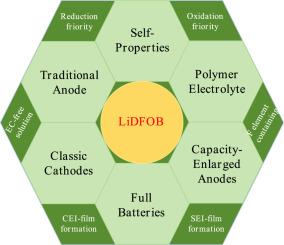
In the realm of advanced electrochemical energy storage, the study of diverse electrolyte salts as integral components of electrolyte engineering has garnered immense attention. Notably, lithium di(fluoro)oxalateborate (LiDFOB) as the representative DFOB− contained electrolyte salts, which possesses structural attributes resembling both lithium bis(oxalate)borate (LiBOB) and lithium tetrafluoroborate (LiBF4), has garnered significant attention initially as a classical additive for the formation of solid electrolyte interface (SEI) films in graphite anodes. However, its unique properties have also piqued interest in other battery components, encompassing current collectors, capacity-enhanced cathodes or anodes, polymer solid-state electrolytes, and the full batteries. The introduction of LiDFOB or NaDFOB into these batteries exhibits a dual-faceted effect, with the beneficial aspect outweighing the potential drawbacks. Herein, we present a comprehensive overview of the research advancements surrounding LiDFOB, including the synthesis techniques of LiDFOB, the inherent properties of LiDFOB and LiDFOB-based electrolyte solutions, and the impact of LiDFOB on the performance of traditional graphite anodes, capacity-enlarged anodes, various classic cathodes, and the full batteries. And sectional content is about the usage of NaDFOB in Na-ion batteries. This review aims to aid readers in understanding the pivotal role of LiDFOB and NaDFOB as a constituent of electrolytes and how its utilization can influence electrode materials and other components, ultimately altering the electrochemical energy storage device's performance.
期刊介绍:
Chinese Chemical Letters (CCL) (ISSN 1001-8417) was founded in July 1990. The journal publishes preliminary accounts in the whole field of chemistry, including inorganic chemistry, organic chemistry, analytical chemistry, physical chemistry, polymer chemistry, applied chemistry, etc.Chinese Chemical Letters does not accept articles previously published or scheduled to be published. To verify originality, your article may be checked by the originality detection service CrossCheck.



 京公网安备 11010802042870号
京ICP备2023020795号-1
京公网安备 11010802042870号
京ICP备2023020795号-1

 分享
分享
 求助内容:
求助内容: 应助结果提醒方式:
 扫码关注我们
