Nanomedicine-based targeting delivery systems for peritoneal cavity localized therapy: A promising treatment of ovarian cancer and its peritoneal metastasis
Boyuan Liu , Zixu Liu , Ping Wang , Yu Zhang , Haibing He , Tian Yin , Jingxin Gou , Xing Tang
{"title":"Nanomedicine-based targeting delivery systems for peritoneal cavity localized therapy: A promising treatment of ovarian cancer and its peritoneal metastasis","authors":"Boyuan Liu , Zixu Liu , Ping Wang , Yu Zhang , Haibing He , Tian Yin , Jingxin Gou , Xing Tang","doi":"10.1016/j.cclet.2024.110229","DOIUrl":null,"url":null,"abstract":"<div><div>As one of the most common gynecological malignancies, peritoneal metastasis is a common feature and cause of high mortality in ovarian cancer (OC). Currently, the standard treatment for OC and its peritoneal metastasis is maximal cytoreductive surgery (CRS) combined with platinum-based chemotherapy. Compared with intravenous chemotherapy, traditional intraperitoneal (IP) chemotherapy exhibits obvious pharmacokinetic (PK) advantages and systemic safety and has shown significant survival benefits in several clinical studies of OC patients. However, there remain several challenges in traditional IP chemotherapy, such as insufficient drug retention, a lack of tumor targeting, inadequate drug penetration, gastrointestinal toxicity, and limited inhibition of tumor metastasis and chemoresistance. Nanomedicine-based IP targeting delivery systems, through specific drug carrier design with tumor cells and tumor environment (TME) targeting, make it possible to overcome these challenges and maximize local therapy efficacy while reducing side effects. In this review article, the rationale and challenges of nanomedicine-based IP chemotherapies, as well as their <em>in vivo</em> fate after IP administration, which are crucial for their rational design and clinical translation, are firstly discussed. Then, current strategies for nanomedicine-based targeting delivery systems and the relevant clinical trials in IP chemotherapy are summarized. Finally, the future directions of the nanomedicine-based IP targeting delivery system for OC and its peritoneal metastasis are proposed, expecting to improve the clinical development of IP chemotherapy.</div></div>","PeriodicalId":10088,"journal":{"name":"Chinese Chemical Letters","volume":"36 6","pages":"Article 110229"},"PeriodicalIF":8.9000,"publicationDate":"2025-06-01","publicationTypes":"Journal Article","fieldsOfStudy":null,"isOpenAccess":false,"openAccessPdf":"","citationCount":"0","resultStr":null,"platform":"Semanticscholar","paperid":null,"PeriodicalName":"Chinese Chemical Letters","FirstCategoryId":"92","ListUrlMain":"https://www.sciencedirect.com/science/article/pii/S1001841724007484","RegionNum":1,"RegionCategory":"化学","ArticlePicture":[],"TitleCN":null,"AbstractTextCN":null,"PMCID":null,"EPubDate":"2024/7/8 0:00:00","PubModel":"Epub","JCR":"Q1","JCRName":"CHEMISTRY, MULTIDISCIPLINARY","Score":null,"Total":0}
引用次数: 0
Abstract
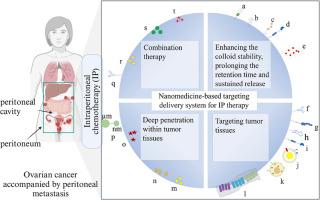
As one of the most common gynecological malignancies, peritoneal metastasis is a common feature and cause of high mortality in ovarian cancer (OC). Currently, the standard treatment for OC and its peritoneal metastasis is maximal cytoreductive surgery (CRS) combined with platinum-based chemotherapy. Compared with intravenous chemotherapy, traditional intraperitoneal (IP) chemotherapy exhibits obvious pharmacokinetic (PK) advantages and systemic safety and has shown significant survival benefits in several clinical studies of OC patients. However, there remain several challenges in traditional IP chemotherapy, such as insufficient drug retention, a lack of tumor targeting, inadequate drug penetration, gastrointestinal toxicity, and limited inhibition of tumor metastasis and chemoresistance. Nanomedicine-based IP targeting delivery systems, through specific drug carrier design with tumor cells and tumor environment (TME) targeting, make it possible to overcome these challenges and maximize local therapy efficacy while reducing side effects. In this review article, the rationale and challenges of nanomedicine-based IP chemotherapies, as well as their in vivo fate after IP administration, which are crucial for their rational design and clinical translation, are firstly discussed. Then, current strategies for nanomedicine-based targeting delivery systems and the relevant clinical trials in IP chemotherapy are summarized. Finally, the future directions of the nanomedicine-based IP targeting delivery system for OC and its peritoneal metastasis are proposed, expecting to improve the clinical development of IP chemotherapy.
期刊介绍:
Chinese Chemical Letters (CCL) (ISSN 1001-8417) was founded in July 1990. The journal publishes preliminary accounts in the whole field of chemistry, including inorganic chemistry, organic chemistry, analytical chemistry, physical chemistry, polymer chemistry, applied chemistry, etc.Chinese Chemical Letters does not accept articles previously published or scheduled to be published. To verify originality, your article may be checked by the originality detection service CrossCheck.




 京公网安备 11010802042870号
京ICP备2023020795号-1
京公网安备 11010802042870号
京ICP备2023020795号-1

 分享
分享
 求助内容:
求助内容: 应助结果提醒方式:
 扫码关注我们
