Qian Liu , Fujia Li , Suocheng Dong , Hao Cheng , Longwu Liang , Bing Xia
{"title":"Spatial-temporal heterogeneity of sustainable development goals and their interactions and linkages in the Eurasian continent","authors":"Qian Liu , Fujia Li , Suocheng Dong , Hao Cheng , Longwu Liang , Bing Xia","doi":"10.1016/j.spc.2024.06.007","DOIUrl":null,"url":null,"abstract":"<div><div>Comprehending the complex interactions and linkages among Sustainable Development Goals (SDGs) is fundamental to prioritizing and advancing progress. However, studies on the regional-scale SDGs and their interactions and linkages are limited. Here, an aggregated approach would allow for progress, trade-offs, synergies, modularity, and prioritization to reveal the relationship between different SDGs. And then, homogeneity and heterogeneity were considered from a comparative regional perspective, that means we used homogeneity and heterogeneity to analyze differences between regions. The results highlight that the synergistic effect among the Eurasian SDGs was greater than the trade-offs. The trade-offs were concentrated in SDG12(Responsible Consumption and Production) and SDG13(Climate Action). As for linkages, between 2000 and 2010, the modularity of the Eurasian SDGs increased from 0.2095 to 0.2189, indicating a weakening of inter-module linkages and a strengthening of intra-module linkages. However, it tended to stabilize between 2010 and 2020. SDG3 (Good Health and Well-Being), SDG4 (Quality Education), and SDG1 (No Poverty) were the prioritized SDGs. In addition, there were spatial homogeneity and heterogeneity in the progress, interactions, and linkages of the SDGs. Our study highlights spatial homogeneity and heterogeneity to focus on regions with SDGs progress networks and may help to fix prioritization to achieve as many SDGs as possible by 2030.</div></div>","PeriodicalId":48619,"journal":{"name":"Sustainable Production and Consumption","volume":"52 ","pages":"Pages 151-165"},"PeriodicalIF":9.6000,"publicationDate":"2024-07-06","publicationTypes":"Journal Article","fieldsOfStudy":null,"isOpenAccess":false,"openAccessPdf":"","citationCount":"0","resultStr":null,"platform":"Semanticscholar","paperid":null,"PeriodicalName":"Sustainable Production and Consumption","FirstCategoryId":"93","ListUrlMain":"https://www.sciencedirect.com/science/article/pii/S2352550924001672","RegionNum":1,"RegionCategory":"环境科学与生态学","ArticlePicture":[],"TitleCN":null,"AbstractTextCN":null,"PMCID":null,"EPubDate":"","PubModel":"","JCR":"Q1","JCRName":"ENVIRONMENTAL STUDIES","Score":null,"Total":0}
引用次数: 0
Abstract
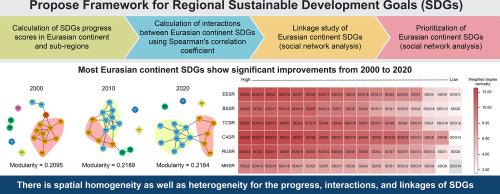
Comprehending the complex interactions and linkages among Sustainable Development Goals (SDGs) is fundamental to prioritizing and advancing progress. However, studies on the regional-scale SDGs and their interactions and linkages are limited. Here, an aggregated approach would allow for progress, trade-offs, synergies, modularity, and prioritization to reveal the relationship between different SDGs. And then, homogeneity and heterogeneity were considered from a comparative regional perspective, that means we used homogeneity and heterogeneity to analyze differences between regions. The results highlight that the synergistic effect among the Eurasian SDGs was greater than the trade-offs. The trade-offs were concentrated in SDG12(Responsible Consumption and Production) and SDG13(Climate Action). As for linkages, between 2000 and 2010, the modularity of the Eurasian SDGs increased from 0.2095 to 0.2189, indicating a weakening of inter-module linkages and a strengthening of intra-module linkages. However, it tended to stabilize between 2010 and 2020. SDG3 (Good Health and Well-Being), SDG4 (Quality Education), and SDG1 (No Poverty) were the prioritized SDGs. In addition, there were spatial homogeneity and heterogeneity in the progress, interactions, and linkages of the SDGs. Our study highlights spatial homogeneity and heterogeneity to focus on regions with SDGs progress networks and may help to fix prioritization to achieve as many SDGs as possible by 2030.
期刊介绍:
Sustainable production and consumption refers to the production and utilization of goods and services in a way that benefits society, is economically viable, and has minimal environmental impact throughout its entire lifespan. Our journal is dedicated to publishing top-notch interdisciplinary research and practical studies in this emerging field. We take a distinctive approach by examining the interplay between technology, consumption patterns, and policy to identify sustainable solutions for both production and consumption systems.



 京公网安备 11010802042870号
京ICP备2023020795号-1
京公网安备 11010802042870号
京ICP备2023020795号-1

 分享
分享
 求助内容:
求助内容: 应助结果提醒方式:
 扫码关注我们
