Ke Xu , Shulai Lei , Panshuo Wang , Weiyi Wang , Yuan Feng , Junsheng Feng
{"title":"Unraveling the microscopic origin of out of plane magnetic anisotropy in VI3","authors":"Ke Xu , Shulai Lei , Panshuo Wang , Weiyi Wang , Yuan Feng , Junsheng Feng","doi":"10.1016/j.cclet.2024.110257","DOIUrl":null,"url":null,"abstract":"<div><div>Intrinsic two-dimensional (2D) ferromagnetic (FM) semiconductors have attracted extensive attentions for their potential applications in next-generation spintronics devices. In recent years, the van der Waals material VI<sub>3</sub> has been experimentally found to be an intrinsic FM semiconductor. However, the electronic structure of the VI<sub>3</sub> is not fully understood. To reveal why the VI<sub>3</sub> is a ferromagnetic semiconductor with strong out-of-plane anisotropy, we systematically studied the electronic structure of the monolayer VI<sub>3</sub>. Our results confirm that the monolayer VI<sub>3</sub> is a Mott insulator, and d<sup>2</sup> electrons occupy a<sub>g</sub> and <span><math><msubsup><mi>e</mi><mrow><mi>g</mi></mrow><mrow><mi>π</mi><mo>+</mo></mrow></msubsup></math></span> orbitals. The half-metallic state is a metastable state with a total energy 0.7 eV higher than the ferromagnetic Mott insulating state. Furthermore, our study confirmed that the VI<sub>3</sub> exhibits the out-of-plane magnetic anisotropy, which originates from d<sup>2</sup> electrons occupying low-lying a<sub>g</sub> and <span><math><msubsup><mi>e</mi><mrow><mi>g</mi></mrow><mrow><mi>π</mi><mo>+</mo></mrow></msubsup></math></span> orbitals. Since the orbital angular momentum of the <span><math><msubsup><mi>e</mi><mrow><mi>g</mi></mrow><mrow><mi>π</mi><mo>+</mo></mrow></msubsup></math></span> state is not completely quenched, the VI<sub>3</sub> has the out-of-plane anisotropy under interplay between the spin-orbit coupling and crystal field. Our study provides valuable guidance for the design of 2D magnetic materials with pronounced out-of-plane anisotropy.</div></div>","PeriodicalId":10088,"journal":{"name":"Chinese Chemical Letters","volume":"36 8","pages":"Article 110257"},"PeriodicalIF":8.9000,"publicationDate":"2024-07-15","publicationTypes":"Journal Article","fieldsOfStudy":null,"isOpenAccess":false,"openAccessPdf":"","citationCount":"0","resultStr":null,"platform":"Semanticscholar","paperid":null,"PeriodicalName":"Chinese Chemical Letters","FirstCategoryId":"92","ListUrlMain":"https://www.sciencedirect.com/science/article/pii/S1001841724007769","RegionNum":1,"RegionCategory":"化学","ArticlePicture":[],"TitleCN":null,"AbstractTextCN":null,"PMCID":null,"EPubDate":"","PubModel":"","JCR":"Q1","JCRName":"CHEMISTRY, MULTIDISCIPLINARY","Score":null,"Total":0}
引用次数: 0
Abstract
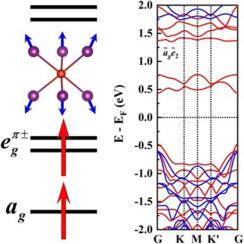
Intrinsic two-dimensional (2D) ferromagnetic (FM) semiconductors have attracted extensive attentions for their potential applications in next-generation spintronics devices. In recent years, the van der Waals material VI3 has been experimentally found to be an intrinsic FM semiconductor. However, the electronic structure of the VI3 is not fully understood. To reveal why the VI3 is a ferromagnetic semiconductor with strong out-of-plane anisotropy, we systematically studied the electronic structure of the monolayer VI3. Our results confirm that the monolayer VI3 is a Mott insulator, and d2 electrons occupy ag and orbitals. The half-metallic state is a metastable state with a total energy 0.7 eV higher than the ferromagnetic Mott insulating state. Furthermore, our study confirmed that the VI3 exhibits the out-of-plane magnetic anisotropy, which originates from d2 electrons occupying low-lying ag and orbitals. Since the orbital angular momentum of the state is not completely quenched, the VI3 has the out-of-plane anisotropy under interplay between the spin-orbit coupling and crystal field. Our study provides valuable guidance for the design of 2D magnetic materials with pronounced out-of-plane anisotropy.
期刊介绍:
Chinese Chemical Letters (CCL) (ISSN 1001-8417) was founded in July 1990. The journal publishes preliminary accounts in the whole field of chemistry, including inorganic chemistry, organic chemistry, analytical chemistry, physical chemistry, polymer chemistry, applied chemistry, etc.Chinese Chemical Letters does not accept articles previously published or scheduled to be published. To verify originality, your article may be checked by the originality detection service CrossCheck.



 京公网安备 11010802042870号
京ICP备2023020795号-1
京公网安备 11010802042870号
京ICP备2023020795号-1

 分享
分享
 求助内容:
求助内容: 应助结果提醒方式:
 扫码关注我们
