{"title":"Recent trends of biodegradable mesoporous silica based nanoplatforms for enhanced tumor theranostics","authors":"Mengwei Ye , Qingqing Xu , Huanhuan Jian, Yiduo Ding, Wenpeng Zhao, Chenxiao Wang, Junya Lu, Shuaipeng Feng, Siling Wang, Qinfu Zhao","doi":"10.1016/j.cclet.2024.110221","DOIUrl":null,"url":null,"abstract":"<div><div>Mesoporous silica nanoparticles (MSNs) are thought to be an attractive drug delivery material because of their advantages including high specific surface area, tunable pore size and morphology, easy surface modification and good biocompatibility. However, as a result of the poor biodegradability of MSNs, their biomedical applications are limited. To break the bottleneck of limited biomedical applications of MSNs, more and more researchers tend to design biodegradable MSNs (b-MSNs) nanosystems to obtain biodegradable as well as safe and reliable drug delivery carriers. In this review, we focused on summarizing strategies to improve the degradability of MSNs and innovatively proposed a series of advantages of b-MSNs, including controlled cargo release behavior, multifunctional frameworks, nano-catalysis, bio-imaging capabilities and enhanced therapeutic effects. Based on these advantages, we have innovatively summarized the applications of b-MSNs for enhanced tumor theranostics, including enhanced chemotherapy, delivery of nanosensitizers, gas molecules and biomacromolecules, initiation of immune response, synergistic therapies and image-guided tumor diagnostics. Finally, the challenges and further clinical translation potential of nanosystems based on b-MSNs are fully discussed and prospected. We believe that such b-MSNs delivery carriers will provide a timely reference for further applications in tumor theranostics.</div></div>","PeriodicalId":10088,"journal":{"name":"Chinese Chemical Letters","volume":"36 6","pages":"Article 110221"},"PeriodicalIF":8.9000,"publicationDate":"2025-06-01","publicationTypes":"Journal Article","fieldsOfStudy":null,"isOpenAccess":false,"openAccessPdf":"","citationCount":"0","resultStr":null,"platform":"Semanticscholar","paperid":null,"PeriodicalName":"Chinese Chemical Letters","FirstCategoryId":"92","ListUrlMain":"https://www.sciencedirect.com/science/article/pii/S100184172400740X","RegionNum":1,"RegionCategory":"化学","ArticlePicture":[],"TitleCN":null,"AbstractTextCN":null,"PMCID":null,"EPubDate":"2024/7/5 0:00:00","PubModel":"Epub","JCR":"Q1","JCRName":"CHEMISTRY, MULTIDISCIPLINARY","Score":null,"Total":0}
引用次数: 0
Abstract
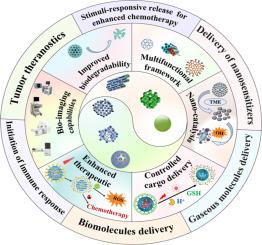
Mesoporous silica nanoparticles (MSNs) are thought to be an attractive drug delivery material because of their advantages including high specific surface area, tunable pore size and morphology, easy surface modification and good biocompatibility. However, as a result of the poor biodegradability of MSNs, their biomedical applications are limited. To break the bottleneck of limited biomedical applications of MSNs, more and more researchers tend to design biodegradable MSNs (b-MSNs) nanosystems to obtain biodegradable as well as safe and reliable drug delivery carriers. In this review, we focused on summarizing strategies to improve the degradability of MSNs and innovatively proposed a series of advantages of b-MSNs, including controlled cargo release behavior, multifunctional frameworks, nano-catalysis, bio-imaging capabilities and enhanced therapeutic effects. Based on these advantages, we have innovatively summarized the applications of b-MSNs for enhanced tumor theranostics, including enhanced chemotherapy, delivery of nanosensitizers, gas molecules and biomacromolecules, initiation of immune response, synergistic therapies and image-guided tumor diagnostics. Finally, the challenges and further clinical translation potential of nanosystems based on b-MSNs are fully discussed and prospected. We believe that such b-MSNs delivery carriers will provide a timely reference for further applications in tumor theranostics.
期刊介绍:
Chinese Chemical Letters (CCL) (ISSN 1001-8417) was founded in July 1990. The journal publishes preliminary accounts in the whole field of chemistry, including inorganic chemistry, organic chemistry, analytical chemistry, physical chemistry, polymer chemistry, applied chemistry, etc.Chinese Chemical Letters does not accept articles previously published or scheduled to be published. To verify originality, your article may be checked by the originality detection service CrossCheck.



 京公网安备 11010802042870号
京ICP备2023020795号-1
京公网安备 11010802042870号
京ICP备2023020795号-1

 分享
分享
 求助内容:
求助内容: 应助结果提醒方式:
 扫码关注我们
