Xudong Wu , Tong Liu , Huimin Li , Yizhou He , Guolin Yang , Wenkun Zhu , Tao Chen
{"title":"Sol-gel transition effect based on konjac glucomannan thermosensitive hydrogel for photo-assisted uranium extraction","authors":"Xudong Wu , Tong Liu , Huimin Li , Yizhou He , Guolin Yang , Wenkun Zhu , Tao Chen","doi":"10.1016/j.scib.2024.07.005","DOIUrl":null,"url":null,"abstract":"<div><div>Exploiting the intelligent photocatalysts capable of phase separation provides a promising solution to the removal of uranium, which is expected to solve the difficulty in separation and the poor selectivity of traditional photocatalysts in carbonate-containing uranium wastewater. In this paper, the γ-FeOOH/konjac glucomannan grafted with phenolic hydroxyl groups/poly-<em>N</em>-isopropylacrylamide (γ-FeOOH/KGM(Ga)/PNIPAM) thermosensitive hydrogel is proposed as the photocatalysts for extracting uranium from carbonate-containing uranium wastewater. The dynamic phase transformation is demonstrated to confirm the arbitrary transition of γ-FeOOH/KGM(Ga)/PNIPAM thermosensitive hydrogel from a dispersed state with a high specific surface area at low temperatures to a stable aggregated state at high temperatures. Notably, the γ-FeOOH/KGM(Ga)/PNIPAM thermosensitive hydrogel achieves a remarkably high rate of 92.3% in the removal of uranium from the wastewater containing carbonates and maintains the efficiency of uranium removal from uranium mine wastewater at over 90%. Relying on electron spin resonance and free radical capture experiment, we reveal the adsorption-reduction-nucleation-crystallization mechanism of uranium on γ-FeOOH/KGM(Ga)/PNIPAM thermosensitive hydrogel. Overall, this strategy provides a promising solution to treating uranium-contaminated wastewater, showing a massive potential in water purification.</div></div>","PeriodicalId":421,"journal":{"name":"Science Bulletin","volume":"69 19","pages":"Pages 3042-3054"},"PeriodicalIF":21.1000,"publicationDate":"2024-10-15","publicationTypes":"Journal Article","fieldsOfStudy":null,"isOpenAccess":false,"openAccessPdf":"","citationCount":"0","resultStr":null,"platform":"Semanticscholar","paperid":null,"PeriodicalName":"Science Bulletin","FirstCategoryId":"103","ListUrlMain":"https://www.sciencedirect.com/science/article/pii/S209592732400481X","RegionNum":1,"RegionCategory":"综合性期刊","ArticlePicture":[],"TitleCN":null,"AbstractTextCN":null,"PMCID":null,"EPubDate":"2024/7/6 0:00:00","PubModel":"Epub","JCR":"Q1","JCRName":"MULTIDISCIPLINARY SCIENCES","Score":null,"Total":0}
引用次数: 0
Abstract
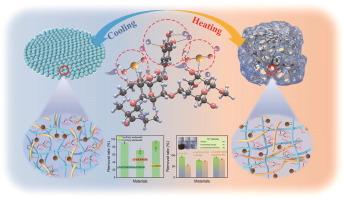
Exploiting the intelligent photocatalysts capable of phase separation provides a promising solution to the removal of uranium, which is expected to solve the difficulty in separation and the poor selectivity of traditional photocatalysts in carbonate-containing uranium wastewater. In this paper, the γ-FeOOH/konjac glucomannan grafted with phenolic hydroxyl groups/poly-N-isopropylacrylamide (γ-FeOOH/KGM(Ga)/PNIPAM) thermosensitive hydrogel is proposed as the photocatalysts for extracting uranium from carbonate-containing uranium wastewater. The dynamic phase transformation is demonstrated to confirm the arbitrary transition of γ-FeOOH/KGM(Ga)/PNIPAM thermosensitive hydrogel from a dispersed state with a high specific surface area at low temperatures to a stable aggregated state at high temperatures. Notably, the γ-FeOOH/KGM(Ga)/PNIPAM thermosensitive hydrogel achieves a remarkably high rate of 92.3% in the removal of uranium from the wastewater containing carbonates and maintains the efficiency of uranium removal from uranium mine wastewater at over 90%. Relying on electron spin resonance and free radical capture experiment, we reveal the adsorption-reduction-nucleation-crystallization mechanism of uranium on γ-FeOOH/KGM(Ga)/PNIPAM thermosensitive hydrogel. Overall, this strategy provides a promising solution to treating uranium-contaminated wastewater, showing a massive potential in water purification.
期刊介绍:
Science Bulletin (Sci. Bull., formerly known as Chinese Science Bulletin) is a multidisciplinary academic journal supervised by the Chinese Academy of Sciences (CAS) and co-sponsored by the CAS and the National Natural Science Foundation of China (NSFC). Sci. Bull. is a semi-monthly international journal publishing high-caliber peer-reviewed research on a broad range of natural sciences and high-tech fields on the basis of its originality, scientific significance and whether it is of general interest. In addition, we are committed to serving the scientific community with immediate, authoritative news and valuable insights into upcoming trends around the globe.



 京公网安备 11010802042870号
京ICP备2023020795号-1
京公网安备 11010802042870号
京ICP备2023020795号-1

 分享
分享
 求助内容:
求助内容: 应助结果提醒方式:
 扫码关注我们
