Design of host-guest interaction based molecularly imprinted polymers: Targeting recognition of the epitope of neuron-specific enolase via a SERS assay
Ran Zhu, Pan Zhang, Yitong Xu, Jiutong Ma, Qiong Jia
{"title":"Design of host-guest interaction based molecularly imprinted polymers: Targeting recognition of the epitope of neuron-specific enolase via a SERS assay","authors":"Ran Zhu, Pan Zhang, Yitong Xu, Jiutong Ma, Qiong Jia","doi":"10.1016/j.cclet.2024.110259","DOIUrl":null,"url":null,"abstract":"<div><div>Molecularly imprinted polymers (MIPs) are a kind of synthetic receptors possessing wide application prospects in proteins recognition. However, there are still great challenges in proteins imprinting due to their large size and easy conformation change. In this study, we explored epitope-oriented MIP based on host-guest interaction (hg-MIP) and constructed a novel hg-MIP-SERS (surface-enhanced Raman scatting) approach for efficiently recognizing the terminal epitopes of neuron-specific enolase (NSE), a well-known disease biomarker for small cell lung cancer, neuroblstom, and Alzheimer's disease. The C- and N-terminal epitopes of NSE were modified with 4-(phenylazo) benzoic acid, then they were used as the templates and immobilized on <em>β</em>-cyclodextrin-functionalized substrates. The imprinted layer was formed by polymerization of various functional monomers. Combined with SERS detection, an antibody-free sandwich assay based on hg-MIP was successfully used to detect the concentration of NSE in human serums, with the advantages of simple operation, small sample volume (5 μL), wide linear range (1–10<sup>4</sup> ng/mL) and a limit of detection as low as 0.01 ng/mL. The developed epitope-oriented hg-MIP-SERS approach can also be extended to other proteins, expanding the imprinting method of proteins, and has a broad development space in the field of protein separation and detection.</div></div>","PeriodicalId":10088,"journal":{"name":"Chinese Chemical Letters","volume":"36 6","pages":"Article 110259"},"PeriodicalIF":8.9000,"publicationDate":"2025-06-01","publicationTypes":"Journal Article","fieldsOfStudy":null,"isOpenAccess":false,"openAccessPdf":"","citationCount":"0","resultStr":null,"platform":"Semanticscholar","paperid":null,"PeriodicalName":"Chinese Chemical Letters","FirstCategoryId":"92","ListUrlMain":"https://www.sciencedirect.com/science/article/pii/S1001841724007782","RegionNum":1,"RegionCategory":"化学","ArticlePicture":[],"TitleCN":null,"AbstractTextCN":null,"PMCID":null,"EPubDate":"2024/7/15 0:00:00","PubModel":"Epub","JCR":"Q1","JCRName":"CHEMISTRY, MULTIDISCIPLINARY","Score":null,"Total":0}
引用次数: 0
Abstract
Molecularly imprinted polymers (MIPs) are a kind of synthetic receptors possessing wide application prospects in proteins recognition. However, there are still great challenges in proteins imprinting due to their large size and easy conformation change. In this study, we explored epitope-oriented MIP based on host-guest interaction (hg-MIP) and constructed a novel hg-MIP-SERS (surface-enhanced Raman scatting) approach for efficiently recognizing the terminal epitopes of neuron-specific enolase (NSE), a well-known disease biomarker for small cell lung cancer, neuroblstom, and Alzheimer's disease. The C- and N-terminal epitopes of NSE were modified with 4-(phenylazo) benzoic acid, then they were used as the templates and immobilized on β-cyclodextrin-functionalized substrates. The imprinted layer was formed by polymerization of various functional monomers. Combined with SERS detection, an antibody-free sandwich assay based on hg-MIP was successfully used to detect the concentration of NSE in human serums, with the advantages of simple operation, small sample volume (5 μL), wide linear range (1–104 ng/mL) and a limit of detection as low as 0.01 ng/mL. The developed epitope-oriented hg-MIP-SERS approach can also be extended to other proteins, expanding the imprinting method of proteins, and has a broad development space in the field of protein separation and detection.
期刊介绍:
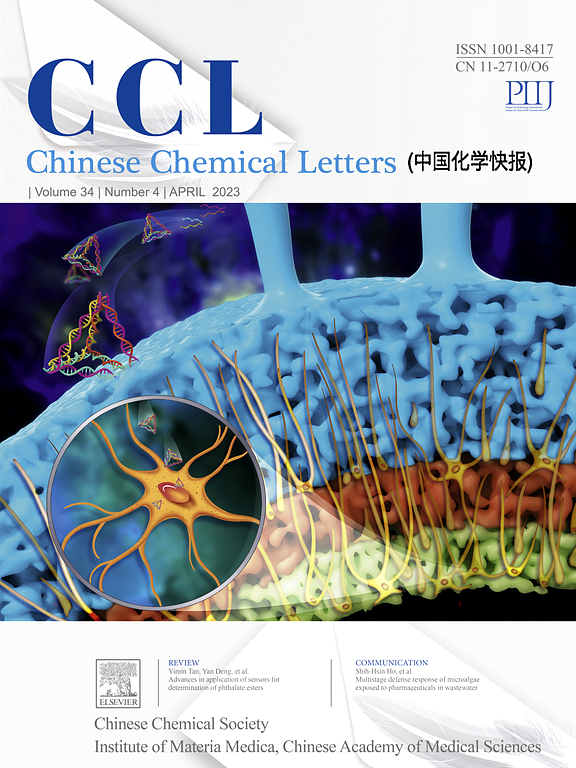
Chinese Chemical Letters (CCL) (ISSN 1001-8417) was founded in July 1990. The journal publishes preliminary accounts in the whole field of chemistry, including inorganic chemistry, organic chemistry, analytical chemistry, physical chemistry, polymer chemistry, applied chemistry, etc.Chinese Chemical Letters does not accept articles previously published or scheduled to be published. To verify originality, your article may be checked by the originality detection service CrossCheck.




 京公网安备 11010802042870号
京ICP备2023020795号-1
京公网安备 11010802042870号
京ICP备2023020795号-1

 分享
分享
 求助内容:
求助内容: 应助结果提醒方式:
 扫码关注我们
