Jong-Moo Lee, Jiho Park, Jeongho Bang, Young-Ik Sohn, Alessio Baldazzi, M. Sanna, S. Azzini, Lorenzo Pavesi
{"title":"Quantum states generation and manipulation in a programmable silicon-photonic four-qubit system with high-fidelity and purity","authors":"Jong-Moo Lee, Jiho Park, Jeongho Bang, Young-Ik Sohn, Alessio Baldazzi, M. Sanna, S. Azzini, Lorenzo Pavesi","doi":"10.1063/5.0207714","DOIUrl":null,"url":null,"abstract":"We present a programmable silicon photonic four-qubit integrated circuit for the generation and manipulation of diverse quantum states. The silicon photonic chip integrates photon-pair sources, pump-reducing filters, wavelength-division-multiplexing filters, Mach–Zehnder interferometer switches, and single-qubit arbitrary gates, enabling versatile state preparation and tomography. We measure Hong–Ou–Mandel interference with an impressive 98% visibility using four-photon coincidence, laying the foundation for high-purity qubits. Our analysis involves estimating the fidelity and purity of distinct quantum states through maximum-likelihood estimation applied to tomographic measurements. In our experimental results, we showcase the following achievements: a heralded single qubit achieving 98.2% fidelity and 98.3% purity, a Bell state reaching 95.2% fidelity and 94.8% purity, and a four-qubit system with two simultaneous Bell states exhibiting 87.4% fidelity and 84.6% purity. Finally, a four-qubit Greenberger–Horne–Zeilinger (GHZ) state demonstrates 85.4% fidelity and 81.7% purity. In addition, we certify the entanglement of the four-photon GHZ state through Bell’s inequality violations and a negative entanglement witness.","PeriodicalId":5,"journal":{"name":"ACS Applied Materials & Interfaces","volume":"67 2","pages":""},"PeriodicalIF":8.2000,"publicationDate":"2024-07-01","publicationTypes":"Journal Article","fieldsOfStudy":null,"isOpenAccess":false,"openAccessPdf":"","citationCount":"0","resultStr":null,"platform":"Semanticscholar","paperid":null,"PeriodicalName":"ACS Applied Materials & Interfaces","FirstCategoryId":"101","ListUrlMain":"https://doi.org/10.1063/5.0207714","RegionNum":2,"RegionCategory":"材料科学","ArticlePicture":[],"TitleCN":null,"AbstractTextCN":null,"PMCID":null,"EPubDate":"","PubModel":"","JCR":"Q1","JCRName":"MATERIALS SCIENCE, MULTIDISCIPLINARY","Score":null,"Total":0}
引用次数: 0
Abstract
We present a programmable silicon photonic four-qubit integrated circuit for the generation and manipulation of diverse quantum states. The silicon photonic chip integrates photon-pair sources, pump-reducing filters, wavelength-division-multiplexing filters, Mach–Zehnder interferometer switches, and single-qubit arbitrary gates, enabling versatile state preparation and tomography. We measure Hong–Ou–Mandel interference with an impressive 98% visibility using four-photon coincidence, laying the foundation for high-purity qubits. Our analysis involves estimating the fidelity and purity of distinct quantum states through maximum-likelihood estimation applied to tomographic measurements. In our experimental results, we showcase the following achievements: a heralded single qubit achieving 98.2% fidelity and 98.3% purity, a Bell state reaching 95.2% fidelity and 94.8% purity, and a four-qubit system with two simultaneous Bell states exhibiting 87.4% fidelity and 84.6% purity. Finally, a four-qubit Greenberger–Horne–Zeilinger (GHZ) state demonstrates 85.4% fidelity and 81.7% purity. In addition, we certify the entanglement of the four-photon GHZ state through Bell’s inequality violations and a negative entanglement witness.
期刊介绍:
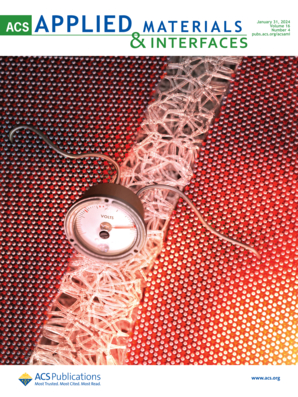
ACS Applied Materials & Interfaces is a leading interdisciplinary journal that brings together chemists, engineers, physicists, and biologists to explore the development and utilization of newly-discovered materials and interfacial processes for specific applications. Our journal has experienced remarkable growth since its establishment in 2009, both in terms of the number of articles published and the impact of the research showcased. We are proud to foster a truly global community, with the majority of published articles originating from outside the United States, reflecting the rapid growth of applied research worldwide.




 京公网安备 11010802042870号
京ICP备2023020795号-1
京公网安备 11010802042870号
京ICP备2023020795号-1

 分享
分享
 求助内容:
求助内容: 应助结果提醒方式:
 扫码关注我们
