Chunyu Yan , Qinglong Qiao , Wei Zhou , Xuelian Zhou , Yonghui Chen , Lu Miao , Zhaochao Xu
{"title":"FRET-based in vitro assay for rapid detecting of SARS-CoV-2 entry inhibitors","authors":"Chunyu Yan , Qinglong Qiao , Wei Zhou , Xuelian Zhou , Yonghui Chen , Lu Miao , Zhaochao Xu","doi":"10.1016/j.cclet.2024.110258","DOIUrl":null,"url":null,"abstract":"<div><div>The continuous mutation and rapid spread of the severe acute respiratory syndrome coronavirus 2 (SARS-CoV-2) have led to the ineffectiveness of many antiviral drugs targeting the original strain. To keep pace with the virus' evolutionary speed, there is a crucial need for the development of rapid, cost-effective, and efficient inhibitor screening methods. In this study, we created a novel approach based on fluorescence resonance energy transfer (FRET) technology for <em>in vitro</em> detection of inhibitors targeting the interaction between the SARS-CoV-2 spike protein RBD (s-RBD) and the virus receptor angiotensin-converting enzyme 2 (ACE2). Utilizing crystallographic insights into the s-RBD/ACE2 interaction, we modified ACE2 by fusing SNAP tag to its N-terminus (resulting in SA740) and Halo tag to s-RBD's C-terminus (producing R525H and R541H), thereby ensuring the proximity (<10 nm) of labeled FRET dyes. We found that relative to the R541H fusion protein, R525H exhibited higher FRET efficiency, which attributed to the shortened distance between FRET dyes due to the truncation of s-RBD. Utilizing the sensitive FRET effect between SA740 and R525H, we evaluated its efficacy in detecting inhibitors of SARS-CoV-2 entry in solution and live cells. Ultimately, this FRET-based detection method was demonstrated high sensitivity, rapidity, and simplicity in solution and held promise for high-throughput screening of SARS-CoV-2 inhibitors.</div></div>","PeriodicalId":10088,"journal":{"name":"Chinese Chemical Letters","volume":"36 5","pages":"Article 110258"},"PeriodicalIF":8.9000,"publicationDate":"2025-05-01","publicationTypes":"Journal Article","fieldsOfStudy":null,"isOpenAccess":false,"openAccessPdf":"","citationCount":"0","resultStr":null,"platform":"Semanticscholar","paperid":null,"PeriodicalName":"Chinese Chemical Letters","FirstCategoryId":"92","ListUrlMain":"https://www.sciencedirect.com/science/article/pii/S1001841724007770","RegionNum":1,"RegionCategory":"化学","ArticlePicture":[],"TitleCN":null,"AbstractTextCN":null,"PMCID":null,"EPubDate":"2024/7/15 0:00:00","PubModel":"Epub","JCR":"Q1","JCRName":"CHEMISTRY, MULTIDISCIPLINARY","Score":null,"Total":0}
引用次数: 0
Abstract
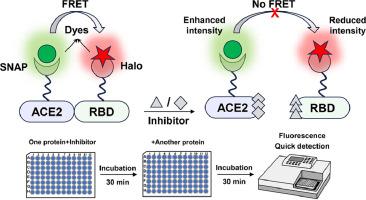
The continuous mutation and rapid spread of the severe acute respiratory syndrome coronavirus 2 (SARS-CoV-2) have led to the ineffectiveness of many antiviral drugs targeting the original strain. To keep pace with the virus' evolutionary speed, there is a crucial need for the development of rapid, cost-effective, and efficient inhibitor screening methods. In this study, we created a novel approach based on fluorescence resonance energy transfer (FRET) technology for in vitro detection of inhibitors targeting the interaction between the SARS-CoV-2 spike protein RBD (s-RBD) and the virus receptor angiotensin-converting enzyme 2 (ACE2). Utilizing crystallographic insights into the s-RBD/ACE2 interaction, we modified ACE2 by fusing SNAP tag to its N-terminus (resulting in SA740) and Halo tag to s-RBD's C-terminus (producing R525H and R541H), thereby ensuring the proximity (<10 nm) of labeled FRET dyes. We found that relative to the R541H fusion protein, R525H exhibited higher FRET efficiency, which attributed to the shortened distance between FRET dyes due to the truncation of s-RBD. Utilizing the sensitive FRET effect between SA740 and R525H, we evaluated its efficacy in detecting inhibitors of SARS-CoV-2 entry in solution and live cells. Ultimately, this FRET-based detection method was demonstrated high sensitivity, rapidity, and simplicity in solution and held promise for high-throughput screening of SARS-CoV-2 inhibitors.
期刊介绍:
Chinese Chemical Letters (CCL) (ISSN 1001-8417) was founded in July 1990. The journal publishes preliminary accounts in the whole field of chemistry, including inorganic chemistry, organic chemistry, analytical chemistry, physical chemistry, polymer chemistry, applied chemistry, etc.Chinese Chemical Letters does not accept articles previously published or scheduled to be published. To verify originality, your article may be checked by the originality detection service CrossCheck.



 京公网安备 11010802042870号
京ICP备2023020795号-1
京公网安备 11010802042870号
京ICP备2023020795号-1

 分享
分享
 求助内容:
求助内容: 应助结果提醒方式:
 扫码关注我们
