Chonglong He , Yulong Wang , Quan-Xin Li , Zichen Yan , Keyuan Zhang , Shao-Fei Ni , Xin-Hua Duan , Le Liu
{"title":"Alkylarylation of alkenes with arylsulfonylacetate as bifunctional reagent via photoredox radical addition/Smiles rearrangement cascade","authors":"Chonglong He , Yulong Wang , Quan-Xin Li , Zichen Yan , Keyuan Zhang , Shao-Fei Ni , Xin-Hua Duan , Le Liu","doi":"10.1016/j.cclet.2024.110253","DOIUrl":null,"url":null,"abstract":"<div><div>The radical difunctionalization of alkenes with sulfonyl bifunctional represents a powerful and straightforward approach to access functionalized alkane derivatives. However, both the mechanistic activation mode and the substrate scopes of this type of radical difunctionalizations are still limited. We demonstrate herein a modular photoredox strategy for the difunctionalization of alkenes, employing arylsulfonyl acetate as the bifunctional reagent. This approach involves a radical addition/Smiles rearrangement cascade process, offering a robust alternative for the synthesis of valuable <em>γ,γ</em>-diaryl and <em>γ</em>-aryl esters. A complementary oxidative bifunctional reagents activation mode is identified to govern the radical cascade reactions, facilitating the simultaneous incorporation of aryl and carboxylate-bearing alkyl groups into the alkenes with excellent diastereoselectivity. Noteworthy features of this method include mild reaction conditions, organophotocatalysis, high atom- and step-economy, excellent functional group compatibility and great structural diversity.</div></div>","PeriodicalId":10088,"journal":{"name":"Chinese Chemical Letters","volume":"36 5","pages":"Article 110253"},"PeriodicalIF":8.9000,"publicationDate":"2025-05-01","publicationTypes":"Journal Article","fieldsOfStudy":null,"isOpenAccess":false,"openAccessPdf":"","citationCount":"0","resultStr":null,"platform":"Semanticscholar","paperid":null,"PeriodicalName":"Chinese Chemical Letters","FirstCategoryId":"92","ListUrlMain":"https://www.sciencedirect.com/science/article/pii/S1001841724007721","RegionNum":1,"RegionCategory":"化学","ArticlePicture":[],"TitleCN":null,"AbstractTextCN":null,"PMCID":null,"EPubDate":"2024/7/15 0:00:00","PubModel":"Epub","JCR":"Q1","JCRName":"CHEMISTRY, MULTIDISCIPLINARY","Score":null,"Total":0}
引用次数: 0
Abstract
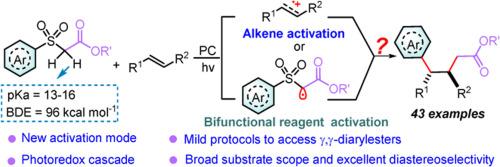
The radical difunctionalization of alkenes with sulfonyl bifunctional represents a powerful and straightforward approach to access functionalized alkane derivatives. However, both the mechanistic activation mode and the substrate scopes of this type of radical difunctionalizations are still limited. We demonstrate herein a modular photoredox strategy for the difunctionalization of alkenes, employing arylsulfonyl acetate as the bifunctional reagent. This approach involves a radical addition/Smiles rearrangement cascade process, offering a robust alternative for the synthesis of valuable γ,γ-diaryl and γ-aryl esters. A complementary oxidative bifunctional reagents activation mode is identified to govern the radical cascade reactions, facilitating the simultaneous incorporation of aryl and carboxylate-bearing alkyl groups into the alkenes with excellent diastereoselectivity. Noteworthy features of this method include mild reaction conditions, organophotocatalysis, high atom- and step-economy, excellent functional group compatibility and great structural diversity.
期刊介绍:
Chinese Chemical Letters (CCL) (ISSN 1001-8417) was founded in July 1990. The journal publishes preliminary accounts in the whole field of chemistry, including inorganic chemistry, organic chemistry, analytical chemistry, physical chemistry, polymer chemistry, applied chemistry, etc.Chinese Chemical Letters does not accept articles previously published or scheduled to be published. To verify originality, your article may be checked by the originality detection service CrossCheck.



 京公网安备 11010802042870号
京ICP备2023020795号-1
京公网安备 11010802042870号
京ICP备2023020795号-1

 分享
分享
 求助内容:
求助内容: 应助结果提醒方式:
 扫码关注我们
