{"title":"Isotope-labeled click-free probes to identify protein targets of lysine-targeting covalent reversible molecules","authors":"Xingyu Ma, Yi-Xin Chen, Zi Ye, Chong-Jing Zhang","doi":"10.1016/j.cclet.2024.110203","DOIUrl":null,"url":null,"abstract":"<div><div>Recent advances in drug development and bioactive molecules that covalently target lysine residues have shown substantial progress. Both reversible and irreversible covalent inhibitors are developed for targeting lysine residues. The identification of protein targets and binding sites of these lysine-targeting molecules in the whole proteome is crucial to understand their proteome-wide selectivity. For covalent inhibitors, the pull down-based methods including activity-based protein profiling (ABPP) are commonly used to profile their target proteins. For covalent reversible inhibitors, it is not easy to pull down the potential protein targets as the captured proteins may get off beads because of the reversible manner. Here, we report a pair of isotope-labelled click-free probes to competitively identify the protein targets of lysine-targeting covalent reversible small molecules. This pair of isotopic probes consists of a lysine-reactive warhead, a desthiobiotin moiety and isotopicable linker. This integrated probe could eliminate the background proteins induced by the click chemistry during the pull-down process. To demonstrate the feasibility of our newly-developed probes for the protein target identification, we selected the natural product Gossypol in that we proved for the first time that it could modify the lysine residue in a covalent reversible manner. Finally, we confirmed that this pair of integrated probes can be used in a competitive manner to precisely identify the protein target as well as binding sites of Gossypol. Interestingly, pretreatment of Gossypol could stop the antibody from recognizing Gossypol-binding proteins. Together, our isotope-labeled click-free probes could be used for whole-proteome profiling of lysine-targeting covalent reversible small molecules.</div></div>","PeriodicalId":10088,"journal":{"name":"Chinese Chemical Letters","volume":"36 5","pages":"Article 110203"},"PeriodicalIF":8.9000,"publicationDate":"2024-07-02","publicationTypes":"Journal Article","fieldsOfStudy":null,"isOpenAccess":false,"openAccessPdf":"","citationCount":"0","resultStr":null,"platform":"Semanticscholar","paperid":null,"PeriodicalName":"Chinese Chemical Letters","FirstCategoryId":"92","ListUrlMain":"https://www.sciencedirect.com/science/article/pii/S1001841724007228","RegionNum":1,"RegionCategory":"化学","ArticlePicture":[],"TitleCN":null,"AbstractTextCN":null,"PMCID":null,"EPubDate":"","PubModel":"","JCR":"Q1","JCRName":"CHEMISTRY, MULTIDISCIPLINARY","Score":null,"Total":0}
引用次数: 0
Abstract
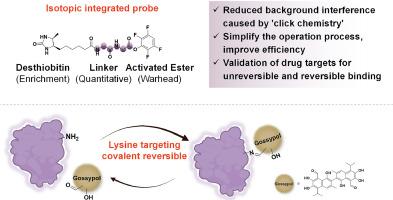
Recent advances in drug development and bioactive molecules that covalently target lysine residues have shown substantial progress. Both reversible and irreversible covalent inhibitors are developed for targeting lysine residues. The identification of protein targets and binding sites of these lysine-targeting molecules in the whole proteome is crucial to understand their proteome-wide selectivity. For covalent inhibitors, the pull down-based methods including activity-based protein profiling (ABPP) are commonly used to profile their target proteins. For covalent reversible inhibitors, it is not easy to pull down the potential protein targets as the captured proteins may get off beads because of the reversible manner. Here, we report a pair of isotope-labelled click-free probes to competitively identify the protein targets of lysine-targeting covalent reversible small molecules. This pair of isotopic probes consists of a lysine-reactive warhead, a desthiobiotin moiety and isotopicable linker. This integrated probe could eliminate the background proteins induced by the click chemistry during the pull-down process. To demonstrate the feasibility of our newly-developed probes for the protein target identification, we selected the natural product Gossypol in that we proved for the first time that it could modify the lysine residue in a covalent reversible manner. Finally, we confirmed that this pair of integrated probes can be used in a competitive manner to precisely identify the protein target as well as binding sites of Gossypol. Interestingly, pretreatment of Gossypol could stop the antibody from recognizing Gossypol-binding proteins. Together, our isotope-labeled click-free probes could be used for whole-proteome profiling of lysine-targeting covalent reversible small molecules.
期刊介绍:
Chinese Chemical Letters (CCL) (ISSN 1001-8417) was founded in July 1990. The journal publishes preliminary accounts in the whole field of chemistry, including inorganic chemistry, organic chemistry, analytical chemistry, physical chemistry, polymer chemistry, applied chemistry, etc.Chinese Chemical Letters does not accept articles previously published or scheduled to be published. To verify originality, your article may be checked by the originality detection service CrossCheck.




 京公网安备 11010802042870号
京ICP备2023020795号-1
京公网安备 11010802042870号
京ICP备2023020795号-1

 分享
分享
 求助内容:
求助内容: 应助结果提醒方式:
 扫码关注我们
