Yusuke Morino, Kentaro Takase, Kazuhiro Kamiguchi, Daisuke Ito
{"title":"Ethanol-Based Solution Synthesis of a Functionalized Sulfide Solid Electrolyte: Investigation and Application","authors":"Yusuke Morino, Kentaro Takase, Kazuhiro Kamiguchi, Daisuke Ito","doi":"10.1002/batt.202400264","DOIUrl":null,"url":null,"abstract":"<p>A sulfide solid electrolyte was synthesized using a solution-phase approach via the dissolution of Li<sub>3</sub>PS<sub>4</sub> in ethanol followed by heat treatment (90–300 °C). This method yielded an electrolyte with a maximum lithium-ion conductivity of 1.7×10<sup>−5</sup> S cm<sup>−1</sup> at 200 °C (down to 25 % of the pristine Li<sub>3</sub>PS<sub>4</sub>); however, increasing the heating temperature resulted in a significant decrease in conductivity. Nuclear magnetic resonance spectroscopy revealed the decomposition of the PS<sub>4</sub><sup>3−</sup> unit into P<sub>2</sub>S<sub>x</sub> dimers (P<sub>2</sub>S<sub>7</sub><sup>4−</sup> and P<sub>2</sub>S<sub>6</sub><sup>4−</sup>) at high temperatures. X-ray absorption spectroscopy further confirmed a core-shell structure in the solution-phase-synthesized electrolyte, with an enriched shell of oxygen-substituted P(S/O)<sub>x</sub> phases. Both the P<sub>2</sub>S<sub>x</sub> dimers in the core and the oxygen-rich shell may have contributed to the reduction in lithium-ion conductivity. Moreover, the oxygen-rich shell unexpectedly suppressed undesirable side reactions at the solid electrolyte/cathode interface. This study demonstrates the functionalization of solution-phase synthesis for sulfide solid electrolytes from ethanol, with a trade-off between conductivity and interface stability. Further optimizing the heat treatment process and shell engineering are promising avenues for enhancing the performance of all-solid-state batteries.</p>","PeriodicalId":132,"journal":{"name":"Batteries & Supercaps","volume":"7 10","pages":""},"PeriodicalIF":4.7000,"publicationDate":"2024-07-17","publicationTypes":"Journal Article","fieldsOfStudy":null,"isOpenAccess":false,"openAccessPdf":"","citationCount":"0","resultStr":null,"platform":"Semanticscholar","paperid":null,"PeriodicalName":"Batteries & Supercaps","FirstCategoryId":"88","ListUrlMain":"https://chemistry-europe.onlinelibrary.wiley.com/doi/10.1002/batt.202400264","RegionNum":4,"RegionCategory":"材料科学","ArticlePicture":[],"TitleCN":null,"AbstractTextCN":null,"PMCID":null,"EPubDate":"","PubModel":"","JCR":"Q2","JCRName":"ELECTROCHEMISTRY","Score":null,"Total":0}
引用次数: 0
Abstract
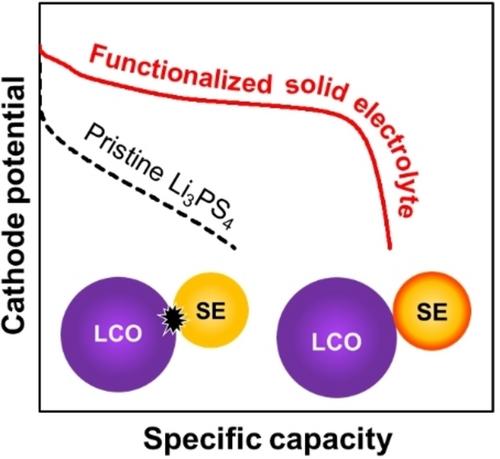
A sulfide solid electrolyte was synthesized using a solution-phase approach via the dissolution of Li3PS4 in ethanol followed by heat treatment (90–300 °C). This method yielded an electrolyte with a maximum lithium-ion conductivity of 1.7×10⁻⁵ S cm−1 at 200 °C (down to 25 % of the pristine Li3PS4); however, increasing the heating temperature resulted in a significant decrease in conductivity. Nuclear magnetic resonance spectroscopy revealed the decomposition of the PS43− unit into P2Sx dimers (P2S74− and P2S64−) at high temperatures. X-ray absorption spectroscopy further confirmed a core-shell structure in the solution-phase-synthesized electrolyte, with an enriched shell of oxygen-substituted P(S/O)x phases. Both the P2Sx dimers in the core and the oxygen-rich shell may have contributed to the reduction in lithium-ion conductivity. Moreover, the oxygen-rich shell unexpectedly suppressed undesirable side reactions at the solid electrolyte/cathode interface. This study demonstrates the functionalization of solution-phase synthesis for sulfide solid electrolytes from ethanol, with a trade-off between conductivity and interface stability. Further optimizing the heat treatment process and shell engineering are promising avenues for enhancing the performance of all-solid-state batteries.
期刊介绍:
Electrochemical energy storage devices play a transformative role in our societies. They have allowed the emergence of portable electronics devices, have triggered the resurgence of electric transportation and constitute key components in smart power grids. Batteries & Supercaps publishes international high-impact experimental and theoretical research on the fundamentals and applications of electrochemical energy storage. We support the scientific community to advance energy efficiency and sustainability.




 京公网安备 11010802042870号
京ICP备2023020795号-1
京公网安备 11010802042870号
京ICP备2023020795号-1

 分享
分享
 求助内容:
求助内容: 应助结果提醒方式:
 扫码关注我们
