{"title":"Correction to “Postnatal growth retardation is associated with deteriorated intestinal mucosal barrier function using a porcine model”","authors":"","doi":"10.1002/jcp.31386","DOIUrl":null,"url":null,"abstract":"<p>Qi, M., Tan, B., Wang, J., Liao, S., Li, J., Cui, Z., Shao, Y., Ji, P., & Yin, Y. (2021). Postnatal growth retardation is associated with deteriorated intestinal mucosal barrier function using a porcine model. <i>Journal of Cellular Physiology</i>, 236, 2631–2648. https://doi.org/10.1002/jcp.30028</p><p>In the original version of this article, the authors mistakenly replicated the panels displaying immunohistochemistry staining in both Figures 3a and 4a. While Figure 3a shows the correct panels, the correct Figure 4a is shown below.</p><p>Additionally, in Figure 5k, the area showing CD68 staining in Ileum sections at 400× magnification has been chosen outside the area depicted for the same sample at 100× magnification. In the corrected Figure 5k below, the 400× panel has been replaced to depict an area within the section shown at 100×.</p><p>Finally, the email address of the corresponding author has been updated to <span>[email protected]</span>.</p><p>This correction does not change the results and conclusions. The authors apologize for any confusion these errors may have caused.</p>","PeriodicalId":15220,"journal":{"name":"Journal of Cellular Physiology","volume":"239 11","pages":""},"PeriodicalIF":4.0000,"publicationDate":"2024-07-19","publicationTypes":"Journal Article","fieldsOfStudy":null,"isOpenAccess":false,"openAccessPdf":"https://onlinelibrary.wiley.com/doi/epdf/10.1002/jcp.31386","citationCount":"0","resultStr":null,"platform":"Semanticscholar","paperid":null,"PeriodicalName":"Journal of Cellular Physiology","FirstCategoryId":"99","ListUrlMain":"https://onlinelibrary.wiley.com/doi/10.1002/jcp.31386","RegionNum":2,"RegionCategory":"生物学","ArticlePicture":[],"TitleCN":null,"AbstractTextCN":null,"PMCID":null,"EPubDate":"","PubModel":"","JCR":"Q2","JCRName":"CELL BIOLOGY","Score":null,"Total":0}
引用次数: 0
Abstract
Qi, M., Tan, B., Wang, J., Liao, S., Li, J., Cui, Z., Shao, Y., Ji, P., & Yin, Y. (2021). Postnatal growth retardation is associated with deteriorated intestinal mucosal barrier function using a porcine model. Journal of Cellular Physiology, 236, 2631–2648. https://doi.org/10.1002/jcp.30028
In the original version of this article, the authors mistakenly replicated the panels displaying immunohistochemistry staining in both Figures 3a and 4a. While Figure 3a shows the correct panels, the correct Figure 4a is shown below.
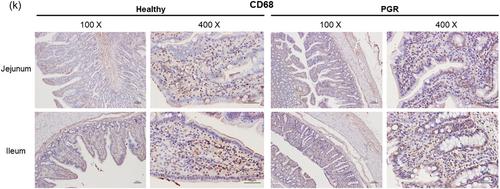
Additionally, in Figure 5k, the area showing CD68 staining in Ileum sections at 400× magnification has been chosen outside the area depicted for the same sample at 100× magnification. In the corrected Figure 5k below, the 400× panel has been replaced to depict an area within the section shown at 100×.
Finally, the email address of the corresponding author has been updated to [email protected].
This correction does not change the results and conclusions. The authors apologize for any confusion these errors may have caused.
期刊介绍:
The Journal of Cellular Physiology publishes reports of high biological significance in areas of eukaryotic cell biology and physiology, focusing on those articles that adopt a molecular mechanistic approach to investigate cell structure and function. There is appreciation for the application of cellular, biochemical, molecular and in vivo genetic approaches, as well as the power of genomics, proteomics, bioinformatics and systems biology. In particular, the Journal encourages submission of high-interest papers investigating the genetic and epigenetic regulation of proliferation and phenotype as well as cell fate and lineage commitment by growth factors, cytokines and their cognate receptors and signal transduction pathways that influence the expression, integration and activities of these physiological mediators. Similarly, the Journal encourages submission of manuscripts exploring the regulation of growth and differentiation by cell adhesion molecules in addition to the interplay between these processes and those induced by growth factors and cytokines. Studies on the genes and processes that regulate cell cycle progression and phase transition in eukaryotic cells, and the mechanisms that determine whether cells enter quiescence, proliferate or undergo apoptosis are also welcomed. Submission of papers that address contributions of the extracellular matrix to cellular phenotypes and physiological control as well as regulatory mechanisms governing fertilization, embryogenesis, gametogenesis, cell fate, lineage commitment, differentiation, development and dynamic parameters of cell motility are encouraged. Finally, the investigation of stem cells and changes that differentiate cancer cells from normal cells including studies on the properties and functions of oncogenes and tumor suppressor genes will remain as one of the major interests of the Journal.



 京公网安备 11010802042870号
京ICP备2023020795号-1
京公网安备 11010802042870号
京ICP备2023020795号-1

 分享
分享
 求助内容:
求助内容: 应助结果提醒方式:
 扫码关注我们
