Kirsten E. Stewart, Chris RuiWen Kuo, Rory Chan, Brian J. Lipworth
{"title":"Effects of dupilumab on quality of life burden in refractory type 2 high unified airway disease","authors":"Kirsten E. Stewart, Chris RuiWen Kuo, Rory Chan, Brian J. Lipworth","doi":"10.1111/all.16249","DOIUrl":null,"url":null,"abstract":"<p>This is the first reported prospective analysis of both upper and lower airway outcomes, including quality of life, in patients with type 2 high (T2H) asthma and chronic rhinosinusitis with nasal polyposis (CRSwNP) who have unified airway disease (UAD) treated with dupilumab. Twenty-one participants with refractory T2H UAD taking inhaled and intranasal corticosteroid (ICS/INCS) were prospectively evaluated after an initial 4-week run-in at baseline, after 12 weeks of dupilumab 300 mg q2wk, and then following a 12-week washout period 14 weeks after the last dose of dupilumab at 24 weeks (EudraCT 2021–005593-25) (Table S1; Figure S1). Significant (<i>p</i> < .001) improvements in the following outcomes were found with dupilumab. Mean (95% CI) changes from baseline at 12 weeks in quality of life scores were: mini-AQLQ 2.36 (1.77–2.94) and SNOT22 43 (29–57); symptom scores: ACQ-6 1.80 (1.29–2.31), hyposmia VAS 5.35 (3.25–7.46); and changes in airflow at 12 weeks were: peak nasal inspiratory flow (PNIF) 44 L/min (23–65), peak expiratory flow (PEF) 60 L/min (30–90), and endoscopic nasal polyp score (NPS) 2.19 (1.72–2.66). (Table 1; Figure 1). Responder analysis for values exceeding the minimal clinically important differences (MCID's)<span><sup>1-4</sup></span> were: AQLQ 20/21 (>0.5), SNOT22 19/21(>9), ACQ-6 19/21(>0.5), Hyposmia VAS 15/21(>2.3), Nasal global VAS 17/21(>2.3), TNSS 18/21(>0.55), PNIF 17/21(>5 L/min), PEF 15/21(>19 L/min), and NP score 15/21(>1.0). For T2 biomarkers significant improvements were seen in nasal nitric oxide (nNO) and FeNO after 12 weeks while peripheral blood eosinophils (PBE) were not significantly altered. Notably, FeNO and nNO went in opposite directions in terms of reduction and increase respectively (Table S2; Figure S2). Following the washout period at week 24, significant changes (<i>p</i> < .001) were noted in the quality of life and symptoms scores compared to week 12 values. Similar significant trends occurred after washout for FeNO, nNO, FEV1, and PEF.</p><p>The results of the present study showed clinically relevant improvements in upper and lower airway outcomes in relation to quality of life, symptoms and airflow obstruction in response to 12 weeks of dupilumab in patients with T2H UAD. Notably in the upper airway this was accompanied by objective improvements in endoscopic NP score and nNO, the latter reflecting ostiomeatal complex patency allowing nNO to be flushed into the nasal cavity.</p><p>We found a mean change in SNOT-22 score of 43 from a baseline of 59 and in nasal polyp score of 2.19 from a baseline of 4.33. In Sinus-24/52, dupilumab 300 mg 2-weekly produced mean reductions in SNOT-22 scores of 21 and 17 at week 24 from a pooled baseline of 51, along with changes in nasal polyp score of 1.9 and 1.8 from a pooled baseline of 6.0.<span><sup>5</sup></span> Here we also reported a mean change of AQLQ of 2.36 from a baseline of 3.72, as compared to LIBERTY QUEST<span><sup>6</sup></span> where there was a change of 0.15 after 24 weeks from a baseline of 4.28 also with 300 mg of dupilumab.</p><p>We appreciate that our study was relatively small, open-label and had no placebo arm which could impact interpretation of the results. However, participants were followed for an additional 12-week washout, where the quality of life and symptom scores all showed commensurate deterioration comparing values at weeks 12 and 24 trending back towards the baseline values. A placebo arm was not enlisted because dupilumab is available to obtain for severe asthma freely through the national health service (NHS) and therefore as well as potentially affecting recruitment, it was also considered unethical. In conclusion dupilumab treatment in T2H UAD produced clinically relevant improvements in upper and lower airway outcomes in terms of QOL burden, symptom scores and airflow obstruction, in association with reduced NP size and ameliorated OMC patency. Such improvements tended to worsen after a 12 week washout period.</p><p>The authors wish to acknowledge Sanofi for their financial support of the study, as an investigator led grant. Sanofi had no input into design, execution, data analysis or manuscript writing. The University of Dundee acted as sponsor for the study.</p><p>Ms Stewart reports no conflicts of interest. Dr Kuo reports personal fees from AstraZeneca, personal fees from Chiesi, and non-financial support from GSK outside the submitted work. Dr Chan reports personal fees (talks) and support attending ERS from AstraZeneca, personal fees (consulting) from Vitalograph, and personal fees (talks) from Thorasys. Dr Lipworth reports grants, personal fees (consulting, talks and advisory board), other support (attending ATS and ERS) from AstraZeneca; grants, personal fees (talks) and other support (attending ATS, ERS and BTS) from Sanofi and Regeneron, personal fees (talks and advisory board) from Niox; grants, personal fees (consulting, talks, advisory board), other support (attending ERS) from Teva; personal fees (talks and consulting), grants and other support (attending ERS and BTS) from Chiesi; personal fees (consulting and talks) from Lupin, personal fees (consulting and talks) from Glenmark; personal fees (consulting) from Sandoz; grants, personal fees (consulting, talks, advisory board), other support (attending BTS) from Boehringer Ingelheim; and the son of BJL is presently an employee of AstraZeneca.</p>","PeriodicalId":122,"journal":{"name":"Allergy","volume":"79 10","pages":"2871-2873"},"PeriodicalIF":11.3000,"publicationDate":"2024-07-20","publicationTypes":"Journal Article","fieldsOfStudy":null,"isOpenAccess":false,"openAccessPdf":"https://onlinelibrary.wiley.com/doi/epdf/10.1111/all.16249","citationCount":"0","resultStr":null,"platform":"Semanticscholar","paperid":null,"PeriodicalName":"Allergy","FirstCategoryId":"3","ListUrlMain":"https://onlinelibrary.wiley.com/doi/10.1111/all.16249","RegionNum":1,"RegionCategory":"医学","ArticlePicture":[],"TitleCN":null,"AbstractTextCN":null,"PMCID":null,"EPubDate":"","PubModel":"","JCR":"Q1","JCRName":"ALLERGY","Score":null,"Total":0}
引用次数: 0
Abstract
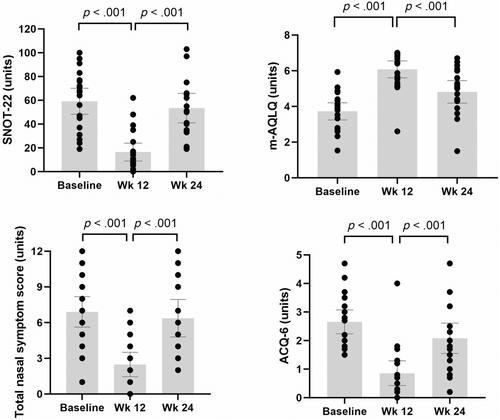
This is the first reported prospective analysis of both upper and lower airway outcomes, including quality of life, in patients with type 2 high (T2H) asthma and chronic rhinosinusitis with nasal polyposis (CRSwNP) who have unified airway disease (UAD) treated with dupilumab. Twenty-one participants with refractory T2H UAD taking inhaled and intranasal corticosteroid (ICS/INCS) were prospectively evaluated after an initial 4-week run-in at baseline, after 12 weeks of dupilumab 300 mg q2wk, and then following a 12-week washout period 14 weeks after the last dose of dupilumab at 24 weeks (EudraCT 2021–005593-25) (Table S1; Figure S1). Significant (p < .001) improvements in the following outcomes were found with dupilumab. Mean (95% CI) changes from baseline at 12 weeks in quality of life scores were: mini-AQLQ 2.36 (1.77–2.94) and SNOT22 43 (29–57); symptom scores: ACQ-6 1.80 (1.29–2.31), hyposmia VAS 5.35 (3.25–7.46); and changes in airflow at 12 weeks were: peak nasal inspiratory flow (PNIF) 44 L/min (23–65), peak expiratory flow (PEF) 60 L/min (30–90), and endoscopic nasal polyp score (NPS) 2.19 (1.72–2.66). (Table 1; Figure 1). Responder analysis for values exceeding the minimal clinically important differences (MCID's)1-4 were: AQLQ 20/21 (>0.5), SNOT22 19/21(>9), ACQ-6 19/21(>0.5), Hyposmia VAS 15/21(>2.3), Nasal global VAS 17/21(>2.3), TNSS 18/21(>0.55), PNIF 17/21(>5 L/min), PEF 15/21(>19 L/min), and NP score 15/21(>1.0). For T2 biomarkers significant improvements were seen in nasal nitric oxide (nNO) and FeNO after 12 weeks while peripheral blood eosinophils (PBE) were not significantly altered. Notably, FeNO and nNO went in opposite directions in terms of reduction and increase respectively (Table S2; Figure S2). Following the washout period at week 24, significant changes (p < .001) were noted in the quality of life and symptoms scores compared to week 12 values. Similar significant trends occurred after washout for FeNO, nNO, FEV1, and PEF.
The results of the present study showed clinically relevant improvements in upper and lower airway outcomes in relation to quality of life, symptoms and airflow obstruction in response to 12 weeks of dupilumab in patients with T2H UAD. Notably in the upper airway this was accompanied by objective improvements in endoscopic NP score and nNO, the latter reflecting ostiomeatal complex patency allowing nNO to be flushed into the nasal cavity.
We found a mean change in SNOT-22 score of 43 from a baseline of 59 and in nasal polyp score of 2.19 from a baseline of 4.33. In Sinus-24/52, dupilumab 300 mg 2-weekly produced mean reductions in SNOT-22 scores of 21 and 17 at week 24 from a pooled baseline of 51, along with changes in nasal polyp score of 1.9 and 1.8 from a pooled baseline of 6.0.5 Here we also reported a mean change of AQLQ of 2.36 from a baseline of 3.72, as compared to LIBERTY QUEST6 where there was a change of 0.15 after 24 weeks from a baseline of 4.28 also with 300 mg of dupilumab.
We appreciate that our study was relatively small, open-label and had no placebo arm which could impact interpretation of the results. However, participants were followed for an additional 12-week washout, where the quality of life and symptom scores all showed commensurate deterioration comparing values at weeks 12 and 24 trending back towards the baseline values. A placebo arm was not enlisted because dupilumab is available to obtain for severe asthma freely through the national health service (NHS) and therefore as well as potentially affecting recruitment, it was also considered unethical. In conclusion dupilumab treatment in T2H UAD produced clinically relevant improvements in upper and lower airway outcomes in terms of QOL burden, symptom scores and airflow obstruction, in association with reduced NP size and ameliorated OMC patency. Such improvements tended to worsen after a 12 week washout period.
The authors wish to acknowledge Sanofi for their financial support of the study, as an investigator led grant. Sanofi had no input into design, execution, data analysis or manuscript writing. The University of Dundee acted as sponsor for the study.
Ms Stewart reports no conflicts of interest. Dr Kuo reports personal fees from AstraZeneca, personal fees from Chiesi, and non-financial support from GSK outside the submitted work. Dr Chan reports personal fees (talks) and support attending ERS from AstraZeneca, personal fees (consulting) from Vitalograph, and personal fees (talks) from Thorasys. Dr Lipworth reports grants, personal fees (consulting, talks and advisory board), other support (attending ATS and ERS) from AstraZeneca; grants, personal fees (talks) and other support (attending ATS, ERS and BTS) from Sanofi and Regeneron, personal fees (talks and advisory board) from Niox; grants, personal fees (consulting, talks, advisory board), other support (attending ERS) from Teva; personal fees (talks and consulting), grants and other support (attending ERS and BTS) from Chiesi; personal fees (consulting and talks) from Lupin, personal fees (consulting and talks) from Glenmark; personal fees (consulting) from Sandoz; grants, personal fees (consulting, talks, advisory board), other support (attending BTS) from Boehringer Ingelheim; and the son of BJL is presently an employee of AstraZeneca.
期刊介绍:
Allergy is an international and multidisciplinary journal that aims to advance, impact, and communicate all aspects of the discipline of Allergy/Immunology. It publishes original articles, reviews, position papers, guidelines, editorials, news and commentaries, letters to the editors, and correspondences. The journal accepts articles based on their scientific merit and quality.
Allergy seeks to maintain contact between basic and clinical Allergy/Immunology and encourages contributions from contributors and readers from all countries. In addition to its publication, Allergy also provides abstracting and indexing information. Some of the databases that include Allergy abstracts are Abstracts on Hygiene & Communicable Disease, Academic Search Alumni Edition, AgBiotech News & Information, AGRICOLA Database, Biological Abstracts, PubMed Dietary Supplement Subset, and Global Health, among others.




 京公网安备 11010802042870号
京ICP备2023020795号-1
京公网安备 11010802042870号
京ICP备2023020795号-1

 分享
分享
 求助内容:
求助内容: 应助结果提醒方式:
 扫码关注我们
