{"title":"Deciphering Pyramidanes: A Quantum Chemical Topology Approach","authors":"Lucía Vidal, Daniel Barrena-Espés, Jorge Echeverría, Julen Munárriz, Ángel Martín Pendás","doi":"10.1002/cphc.202400329","DOIUrl":null,"url":null,"abstract":"<p>C[C<sub>4</sub>H<sub>4</sub>], the simplest compound of the [4]-pyramidane family, has so far eluded experimental characterization, although several of its analogs, E[C<sub>4</sub>(SiMe<sub>3</sub>)<sub>4</sub>] in which the E apex atom is a tetrel group element, have been successfully prepared. The non-classical bonding mode of E, similar to that found in propellanes, has prompted a considerable number of theoretical studies to unravel the nature of the apex-base interaction. Here, we contribute to this knowledge by analyzing the electron localization function (ELF) and classical QTAIM descriptors; as well the statistical distribution of electrons in atomic regions by means of the so-called electron distribution functions (EDFs), calculation of multicenter indices (MCI) as aromaticity descriptors and by performing orbital invariant energy decompositions with the interacting quantum atoms (IQA) approach on a series of E[C<sub>4</sub>(SiMe<sub>3</sub>)<sub>4</sub>] compounds. We find that the bonding evolves from covalent to electrostatic as E changes from C to Pb, with an anomaly when E=Si, which is shown to be the most charged moiety, compatible with an aromatic [C<sub>4</sub>(SiMe<sub>3</sub>)<sub>4</sub>]<sup>2−</sup> scaffold in the pyramidane base.</p>","PeriodicalId":9819,"journal":{"name":"Chemphyschem","volume":"25 22","pages":""},"PeriodicalIF":2.2000,"publicationDate":"2024-07-23","publicationTypes":"Journal Article","fieldsOfStudy":null,"isOpenAccess":false,"openAccessPdf":"https://onlinelibrary.wiley.com/doi/epdf/10.1002/cphc.202400329","citationCount":"0","resultStr":null,"platform":"Semanticscholar","paperid":null,"PeriodicalName":"Chemphyschem","FirstCategoryId":"92","ListUrlMain":"https://chemistry-europe.onlinelibrary.wiley.com/doi/10.1002/cphc.202400329","RegionNum":3,"RegionCategory":"化学","ArticlePicture":[],"TitleCN":null,"AbstractTextCN":null,"PMCID":null,"EPubDate":"","PubModel":"","JCR":"Q3","JCRName":"CHEMISTRY, PHYSICAL","Score":null,"Total":0}
引用次数: 0
Abstract
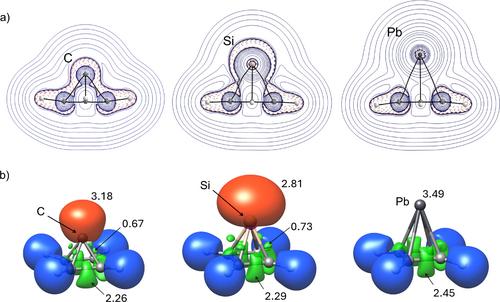
C[C4H4], the simplest compound of the [4]-pyramidane family, has so far eluded experimental characterization, although several of its analogs, E[C4(SiMe3)4] in which the E apex atom is a tetrel group element, have been successfully prepared. The non-classical bonding mode of E, similar to that found in propellanes, has prompted a considerable number of theoretical studies to unravel the nature of the apex-base interaction. Here, we contribute to this knowledge by analyzing the electron localization function (ELF) and classical QTAIM descriptors; as well the statistical distribution of electrons in atomic regions by means of the so-called electron distribution functions (EDFs), calculation of multicenter indices (MCI) as aromaticity descriptors and by performing orbital invariant energy decompositions with the interacting quantum atoms (IQA) approach on a series of E[C4(SiMe3)4] compounds. We find that the bonding evolves from covalent to electrostatic as E changes from C to Pb, with an anomaly when E=Si, which is shown to be the most charged moiety, compatible with an aromatic [C4(SiMe3)4]2− scaffold in the pyramidane base.
期刊介绍:
ChemPhysChem is one of the leading chemistry/physics interdisciplinary journals (ISI Impact Factor 2018: 3.077) for physical chemistry and chemical physics. It is published on behalf of Chemistry Europe, an association of 16 European chemical societies.
ChemPhysChem is an international source for important primary and critical secondary information across the whole field of physical chemistry and chemical physics. It integrates this wide and flourishing field ranging from Solid State and Soft-Matter Research, Electro- and Photochemistry, Femtochemistry and Nanotechnology, Complex Systems, Single-Molecule Research, Clusters and Colloids, Catalysis and Surface Science, Biophysics and Physical Biochemistry, Atmospheric and Environmental Chemistry, and many more topics. ChemPhysChem is peer-reviewed.




 京公网安备 11010802042870号
京ICP备2023020795号-1
京公网安备 11010802042870号
京ICP备2023020795号-1

 分享
分享
 求助内容:
求助内容: 应助结果提醒方式:
 扫码关注我们
