Alexandros Panagiotopoulos, Eleni Kapsia, Ioannis El Michelakis, John Boletis, Smaragdi Marinaki, Petros P Sfikakis, Maria G Tektonidou
{"title":"Immunosuppressives discontinuation after renal response in lupus nephritis: predictors of flares, time to withdrawal and long-term outcomes.","authors":"Alexandros Panagiotopoulos, Eleni Kapsia, Ioannis El Michelakis, John Boletis, Smaragdi Marinaki, Petros P Sfikakis, Maria G Tektonidou","doi":"10.1093/rheumatology/keae381","DOIUrl":null,"url":null,"abstract":"<p><strong>Objectives: </strong>The optimal duration of immunosuppressive (IS) treatment for lupus nephritis (LN) remains uncertain. We assessed the prevalence and predictors of IS tapering and discontinuation (D/C) in LN patients.</p><p><strong>Methods: </strong>Data from 137 inception cohort LN patients were analysed. We examined determinants of flares during tapering and after IS D/C, D/C achievement and time to D/C, and adverse long-term outcomes applying logistic and linear regression models.</p><p><strong>Results: </strong>IS tapering was attempted in 111 (81%) patients, and D/C was achieved in 67.5%. Longer time to achieve complete renal response (CR) [odds ratio (OR): 1.07, P = 0.046] and higher SLEDAI-2K at tapering initiation (OR: 2.57, P = 0.008) were correlated with higher risk of renal flares during tapering. Persistent hydroxychloroquine use (≥2/3 of follow-up) (OR: 0.28, P = 0.08) and lower SLEDAI-2K 12 months before IS D/C (OR: 1.70, P = 0.013) decreased the risk of post-D/C flares. Adverse outcomes (>30% estimated glomerular filtration rate decline, chronic kidney disease, end-stage renal disease, death) at the end of follow-up (median 124 months) were more frequent in patients with flares during IS tapering (53% vs 16%, P < 0.0038) but did not differ between IS D/C achievers and non-achievers. In proliferative LN, differences mirrored those in the entire cohort, except for time to D/C, which occurred 20 months earlier in membranous vs proliferative LN (β = -19.8, P = 0.014).</p><p><strong>Conclusion: </strong>Earlier CR achievement and lower SLEDAI-2K at tapering initiation prevent flares during IS tapering, while persistent hydroxychloroquine use and lower SLEDAI-2K 12 months before IS D/C prevent post-D/C flares. Flares during tapering increase the risk of unfavourable long-term outcomes. Earlier IS D/C is feasible in membranous LN.</p>","PeriodicalId":21255,"journal":{"name":"Rheumatology","volume":" ","pages":"1894-1903"},"PeriodicalIF":4.4000,"publicationDate":"2025-04-01","publicationTypes":"Journal Article","fieldsOfStudy":null,"isOpenAccess":false,"openAccessPdf":"https://www.ncbi.nlm.nih.gov/pmc/articles/PMC11962912/pdf/","citationCount":"0","resultStr":null,"platform":"Semanticscholar","paperid":null,"PeriodicalName":"Rheumatology","FirstCategoryId":"3","ListUrlMain":"https://doi.org/10.1093/rheumatology/keae381","RegionNum":2,"RegionCategory":"医学","ArticlePicture":[],"TitleCN":null,"AbstractTextCN":null,"PMCID":null,"EPubDate":"","PubModel":"","JCR":"Q1","JCRName":"RHEUMATOLOGY","Score":null,"Total":0}
引用次数: 0
Abstract
Objectives: The optimal duration of immunosuppressive (IS) treatment for lupus nephritis (LN) remains uncertain. We assessed the prevalence and predictors of IS tapering and discontinuation (D/C) in LN patients.
Methods: Data from 137 inception cohort LN patients were analysed. We examined determinants of flares during tapering and after IS D/C, D/C achievement and time to D/C, and adverse long-term outcomes applying logistic and linear regression models.
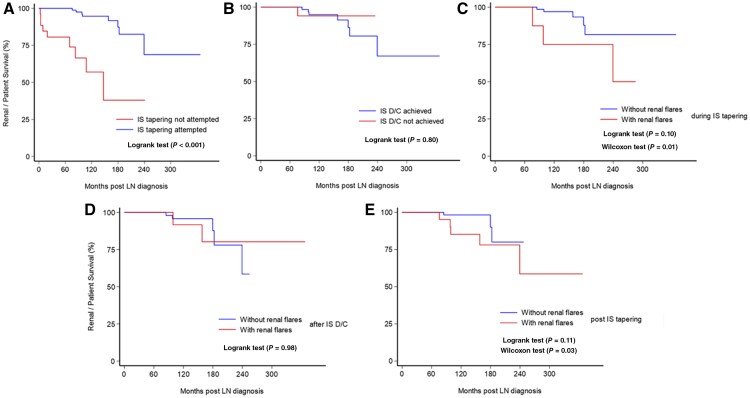
Results: IS tapering was attempted in 111 (81%) patients, and D/C was achieved in 67.5%. Longer time to achieve complete renal response (CR) [odds ratio (OR): 1.07, P = 0.046] and higher SLEDAI-2K at tapering initiation (OR: 2.57, P = 0.008) were correlated with higher risk of renal flares during tapering. Persistent hydroxychloroquine use (≥2/3 of follow-up) (OR: 0.28, P = 0.08) and lower SLEDAI-2K 12 months before IS D/C (OR: 1.70, P = 0.013) decreased the risk of post-D/C flares. Adverse outcomes (>30% estimated glomerular filtration rate decline, chronic kidney disease, end-stage renal disease, death) at the end of follow-up (median 124 months) were more frequent in patients with flares during IS tapering (53% vs 16%, P < 0.0038) but did not differ between IS D/C achievers and non-achievers. In proliferative LN, differences mirrored those in the entire cohort, except for time to D/C, which occurred 20 months earlier in membranous vs proliferative LN (β = -19.8, P = 0.014).
Conclusion: Earlier CR achievement and lower SLEDAI-2K at tapering initiation prevent flares during IS tapering, while persistent hydroxychloroquine use and lower SLEDAI-2K 12 months before IS D/C prevent post-D/C flares. Flares during tapering increase the risk of unfavourable long-term outcomes. Earlier IS D/C is feasible in membranous LN.
期刊介绍:
Rheumatology strives to support research and discovery by publishing the highest quality original scientific papers with a focus on basic, clinical and translational research. The journal’s subject areas cover a wide range of paediatric and adult rheumatological conditions from an international perspective. It is an official journal of the British Society for Rheumatology, published by Oxford University Press.
Rheumatology publishes original articles, reviews, editorials, guidelines, concise reports, meta-analyses, original case reports, clinical vignettes, letters and matters arising from published material. The journal takes pride in serving the global rheumatology community, with a focus on high societal impact in the form of podcasts, videos and extended social media presence, and utilizing metrics such as Altmetric. Keep up to date by following the journal on Twitter @RheumJnl.




 京公网安备 11010802042870号
京ICP备2023020795号-1
京公网安备 11010802042870号
京ICP备2023020795号-1

 分享
分享
 求助内容:
求助内容: 应助结果提醒方式:
 扫码关注我们
