Jan Versijpt, Christina Deligianni, Muizz Hussain, Faisal Amin, Uwe Reuter, Margarita Sanchez-Del-Rio, Derya Uluduz, Deirdre Boucherie, Dena Zeraatkar, Antoinette MaassenVanDenBrink, Simona Sacco, Christian Lampl, Raquel Gil-Gouveia
{"title":"European Headache Federation (EHF) critical re-appraisal and meta-analysis of oral drugs in migraine prevention - part 4: propranolol.","authors":"Jan Versijpt, Christina Deligianni, Muizz Hussain, Faisal Amin, Uwe Reuter, Margarita Sanchez-Del-Rio, Derya Uluduz, Deirdre Boucherie, Dena Zeraatkar, Antoinette MaassenVanDenBrink, Simona Sacco, Christian Lampl, Raquel Gil-Gouveia","doi":"10.1186/s10194-024-01826-y","DOIUrl":null,"url":null,"abstract":"<p><strong>Objective: </strong>The aim of this paper is to critically re-appraise the published trials assessing propranolol for migraine prophylaxis.</p><p><strong>Methods: </strong>We report methods and results following the Preferred Reporting Items for Systematic Reviews (PRISMA), by searching MEDLINE, EMBASE, Cochrane CENTRAL, and ClinicalTrials.gov for randomized trials of pharmacologic treatments for migraine prophylaxis. We included randomized trials that compared propranolol with placebo for migraine prophylaxis in adults. The outcomes of interest were informed by the Core outcome set for preventive intervention trials in chronic and episodic migraine (COSMIG) and include the proportion of patients who experience a 50% or more reduction in monthly migraine days, the reduction of monthly migraine days, and the number of adverse events leading to discontinuation. We assessed risk of bias by using a modified Cochrane RoB (risk of bias) 2.0 tool and the certainty of evidence by using the GRADE approach.</p><p><strong>Results: </strong>Our search yielded twenty trials (n = 1291 patients) eligible for data synthesis and analysis. The analysis revealed a moderate certainty evidence that propranolol leads to a reduction in monthly migraine days versus placebo (-1.27; 95% CI: -2.25 to -0.3). We found moderate certainty evidence that propranolol increases the proportion of patients who experience a 50% or more reduction in monthly migraine days, compared to placebo with a relative risk of 1.65 (95% CI 1.41 to 1.93); absolute risk difference: 179 more per 1,000 (95% CI 113 to 256). We found high certainty evidence that propranolol increases the proportion of patients who discontinue due to adverse events compared to placebo with a risk difference of 0.02 (95% CI 0.00 to 0.03); absolute risk difference: 20 more per 1,000 (95% CI 0 to 30).</p><p><strong>Conclusions: </strong>The present meta-analysis shows that propranolol has a prophylactic role in migraine, with an overall acceptable tolerability profile. Combining these results with its long-standing use and its global availability at a low cost confirms its role as a first line agent in the prophylaxis of migraine.</p>","PeriodicalId":16013,"journal":{"name":"Journal of Headache and Pain","volume":"25 1","pages":"119"},"PeriodicalIF":7.9000,"publicationDate":"2024-07-24","publicationTypes":"Journal Article","fieldsOfStudy":null,"isOpenAccess":false,"openAccessPdf":"https://www.ncbi.nlm.nih.gov/pmc/articles/PMC11267726/pdf/","citationCount":"0","resultStr":null,"platform":"Semanticscholar","paperid":null,"PeriodicalName":"Journal of Headache and Pain","FirstCategoryId":"3","ListUrlMain":"https://doi.org/10.1186/s10194-024-01826-y","RegionNum":1,"RegionCategory":"医学","ArticlePicture":[],"TitleCN":null,"AbstractTextCN":null,"PMCID":null,"EPubDate":"","PubModel":"","JCR":"Q1","JCRName":"CLINICAL NEUROLOGY","Score":null,"Total":0}
引用次数: 0
Abstract
Objective: The aim of this paper is to critically re-appraise the published trials assessing propranolol for migraine prophylaxis.
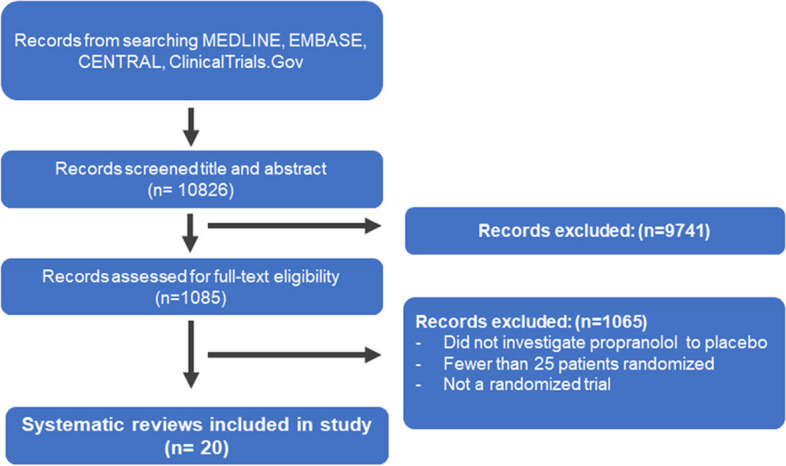
Methods: We report methods and results following the Preferred Reporting Items for Systematic Reviews (PRISMA), by searching MEDLINE, EMBASE, Cochrane CENTRAL, and ClinicalTrials.gov for randomized trials of pharmacologic treatments for migraine prophylaxis. We included randomized trials that compared propranolol with placebo for migraine prophylaxis in adults. The outcomes of interest were informed by the Core outcome set for preventive intervention trials in chronic and episodic migraine (COSMIG) and include the proportion of patients who experience a 50% or more reduction in monthly migraine days, the reduction of monthly migraine days, and the number of adverse events leading to discontinuation. We assessed risk of bias by using a modified Cochrane RoB (risk of bias) 2.0 tool and the certainty of evidence by using the GRADE approach.
Results: Our search yielded twenty trials (n = 1291 patients) eligible for data synthesis and analysis. The analysis revealed a moderate certainty evidence that propranolol leads to a reduction in monthly migraine days versus placebo (-1.27; 95% CI: -2.25 to -0.3). We found moderate certainty evidence that propranolol increases the proportion of patients who experience a 50% or more reduction in monthly migraine days, compared to placebo with a relative risk of 1.65 (95% CI 1.41 to 1.93); absolute risk difference: 179 more per 1,000 (95% CI 113 to 256). We found high certainty evidence that propranolol increases the proportion of patients who discontinue due to adverse events compared to placebo with a risk difference of 0.02 (95% CI 0.00 to 0.03); absolute risk difference: 20 more per 1,000 (95% CI 0 to 30).
Conclusions: The present meta-analysis shows that propranolol has a prophylactic role in migraine, with an overall acceptable tolerability profile. Combining these results with its long-standing use and its global availability at a low cost confirms its role as a first line agent in the prophylaxis of migraine.
期刊介绍:
The Journal of Headache and Pain, a peer-reviewed open-access journal published under the BMC brand, a part of Springer Nature, is dedicated to researchers engaged in all facets of headache and related pain syndromes. It encompasses epidemiology, public health, basic science, translational medicine, clinical trials, and real-world data.
With a multidisciplinary approach, The Journal of Headache and Pain addresses headache medicine and related pain syndromes across all medical disciplines. It particularly encourages submissions in clinical, translational, and basic science fields, focusing on pain management, genetics, neurology, and internal medicine. The journal publishes research articles, reviews, letters to the Editor, as well as consensus articles and guidelines, aimed at promoting best practices in managing patients with headaches and related pain.




 京公网安备 11010802042870号
京ICP备2023020795号-1
京公网安备 11010802042870号
京ICP备2023020795号-1

 分享
分享
 求助内容:
求助内容: 应助结果提醒方式:
 扫码关注我们
