The carbon footprint of the perioperative transurethral resection of bladder tumour pathway

IF 4.4 2区 医学 Q1 UROLOGY & NEPHROLOGY BJU International Pub Date : 2024-07-25 DOI:10.1111/bju.16477
Joseph B. John, Michael Collins, Sophie Eames, Kieran O’Flynn, Tim W.R. Briggs, William K. Gray, John S. McGrath
{"title":"The carbon footprint of the perioperative transurethral resection of bladder tumour pathway","authors":"Joseph B. John,&nbsp;Michael Collins,&nbsp;Sophie Eames,&nbsp;Kieran O’Flynn,&nbsp;Tim W.R. Briggs,&nbsp;William K. Gray,&nbsp;John S. McGrath","doi":"10.1111/bju.16477","DOIUrl":null,"url":null,"abstract":"<div>\n \n <section>\n \n <h3> Objectives</h3>\n \n <p>To evaluate the carbon footprint of the perioperative transurethral resection of bladder tumour (TURBT) pathway from decision to treat to postoperative discharge, and model potential greenhouse gas (GHG) emissions reduction strategies.</p>\n </section>\n \n <section>\n \n <h3> Materials and Methods</h3>\n \n <p>This process-based attributional cradle-to-grave life-cycle assessment (LCA) of GHG emissions modelled the perioperative TURBT pathway at a hospital in Southwest England. We included travel, energy and water use, all reusable and consumable items, and laundry and equipment sterilisation. Resource use for 30 patients undergoing surgery was recorded to understand average GHG emissions and the inter-case variability. Sensitivity analysis was performed for manufacturing location, pharmaceutical manufacturing carbon-intensity, and theatre list utilisation.</p>\n </section>\n \n <section>\n \n <h3> Results</h3>\n \n <p>The median (interquartile range) perioperative TURBT carbon footprint was 131.8 (119.8–153.6) kg of carbon dioxide equivalent. Major pathway categories contributing to GHG emissions were surgical equipment (22.2%), travel (18.6%), gas and electricity (13.3%), and anaesthesia/drugs and associated adjuncts (27.0%), primarily due to consumable items and processes. Readily modifiable GHG emissions hotspots included patient travel for preoperative assessment, glove use, catheter use, irrigation delivery and extraction, and mitomycin C disposal. GHG emissions were higher for those admitted as inpatients after surgery.</p>\n </section>\n \n <section>\n \n <h3> Conclusions</h3>\n \n <p>This cradle-to-grave LCA found multiple modifiable GHG emissions hotspots. Key mitigation themes include minimising avoidable patient travel, rationalising equipment use, optimally filling operating theatre lists, and safely avoiding postoperative catheterisation and hospital admission where possible. A crucial next step is to design and deliver an implementation strategy for the environmentally sustainable changes demonstrated herein.</p>\n </section>\n </div>","PeriodicalId":8985,"journal":{"name":"BJU International","volume":"135 1","pages":"78-87"},"PeriodicalIF":4.4000,"publicationDate":"2024-07-25","publicationTypes":"Journal Article","fieldsOfStudy":null,"isOpenAccess":false,"openAccessPdf":"https://onlinelibrary.wiley.com/doi/epdf/10.1111/bju.16477","citationCount":"0","resultStr":null,"platform":"Semanticscholar","paperid":null,"PeriodicalName":"BJU International","FirstCategoryId":"3","ListUrlMain":"https://bjui-journals.onlinelibrary.wiley.com/doi/10.1111/bju.16477","RegionNum":2,"RegionCategory":"医学","ArticlePicture":[],"TitleCN":null,"AbstractTextCN":null,"PMCID":null,"EPubDate":"","PubModel":"","JCR":"Q1","JCRName":"UROLOGY & NEPHROLOGY","Score":null,"Total":0}
引用次数: 0

Abstract

Objectives

To evaluate the carbon footprint of the perioperative transurethral resection of bladder tumour (TURBT) pathway from decision to treat to postoperative discharge, and model potential greenhouse gas (GHG) emissions reduction strategies.

Materials and Methods

This process-based attributional cradle-to-grave life-cycle assessment (LCA) of GHG emissions modelled the perioperative TURBT pathway at a hospital in Southwest England. We included travel, energy and water use, all reusable and consumable items, and laundry and equipment sterilisation. Resource use for 30 patients undergoing surgery was recorded to understand average GHG emissions and the inter-case variability. Sensitivity analysis was performed for manufacturing location, pharmaceutical manufacturing carbon-intensity, and theatre list utilisation.

Results

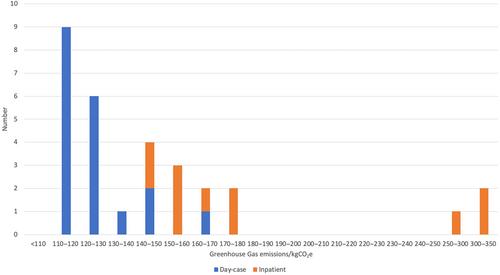
The median (interquartile range) perioperative TURBT carbon footprint was 131.8 (119.8–153.6) kg of carbon dioxide equivalent. Major pathway categories contributing to GHG emissions were surgical equipment (22.2%), travel (18.6%), gas and electricity (13.3%), and anaesthesia/drugs and associated adjuncts (27.0%), primarily due to consumable items and processes. Readily modifiable GHG emissions hotspots included patient travel for preoperative assessment, glove use, catheter use, irrigation delivery and extraction, and mitomycin C disposal. GHG emissions were higher for those admitted as inpatients after surgery.

Conclusions

This cradle-to-grave LCA found multiple modifiable GHG emissions hotspots. Key mitigation themes include minimising avoidable patient travel, rationalising equipment use, optimally filling operating theatre lists, and safely avoiding postoperative catheterisation and hospital admission where possible. A crucial next step is to design and deliver an implementation strategy for the environmentally sustainable changes demonstrated herein.
Abstract Image

Abstract Image

Abstract Image

查看原文
分享 分享
微信好友 朋友圈 QQ好友 复制链接
本刊更多论文
经尿道膀胱肿瘤切除术围手术期路径的碳足迹
评估围手术期经尿道膀胱肿瘤切除术(TURBT)从决定治疗到术后出院整个过程的碳足迹,并模拟潜在的温室气体(GHG)减排策略。
本文章由计算机程序翻译,如有差异,请以英文原文为准。
求助全文
约1分钟内获得全文 去求助
来源期刊
BJU International
BJU International 医学-泌尿学与肾脏学
CiteScore
9.10
自引率
4.40%
发文量
262
审稿时长
1 months
期刊介绍: BJUI is one of the most highly respected medical journals in the world, with a truly international range of published papers and appeal. Every issue gives invaluable practical information in the form of original articles, reviews, comments, surgical education articles, and translational science articles in the field of urology. BJUI employs topical sections, and is in full colour, making it easier to browse or search for something specific.
期刊最新文献
The PRAGMATIC pathway - PRostate cancer diAGnosis and MAnagement Triage In Clinical care A nomogram of testicular volume, follicle-stimulating hormone, and inhibin B for predicting live birth after varicocelectomy Use of parallel fluorescent confocal microscopy for detection of prostatic adenocarcinoma. Patient-side performance metrics and errors in robotic surgery: Junior- European Association of Urology Robotic Urology Section/Young Academic Urologists (J-ERUS/YAU) construct validation. Impact of BCG failure patterns on efficacy of intravesical gemcitabine/docetaxel in high-risk non-muscle-invasive bladder cancer
×
引用
GB/T 7714-2015
复制
MLA
复制
APA
复制
导出至
BibTeX EndNote RefMan NoteFirst NoteExpress
×
×
提示
您的信息不完整,为了账户安全,请先补充。
现在去补充
×
提示
您因"违规操作"
具体请查看互助需知
我知道了
×
提示
现在去查看 取消
×
提示
确定
0
微信
客服QQ
Book学术公众号 扫码关注我们
反馈
×
意见反馈
请填写您的意见或建议
请填写您的手机或邮箱
已复制链接
已复制链接
快去分享给好友吧!
我知道了
×
扫码分享
扫码分享
Book学术官方微信
Book学术文献互助
Book学术文献互助群
群 号:604180095
Book学术
文献互助 智能选刊 最新文献 互助须知 联系我们:info@booksci.cn
Book学术提供免费学术资源搜索服务,方便国内外学者检索中英文文献。致力于提供最便捷和优质的服务体验。
Copyright © 2023 Book学术 All rights reserved.
ghs 京公网安备 11010802042870号 京ICP备2023020795号-1