Michael C. Lanz, Shuyuan Zhang, Matthew P. Swaffer, Inbal Ziv, Luisa Hernández Götz, Jacob Kim, Frank McCarthy, Daniel F. Jarosz, Joshua E. Elias, Jan M. Skotheim
{"title":"Genome dilution by cell growth drives starvation-like proteome remodeling in mammalian and yeast cells","authors":"Michael C. Lanz, Shuyuan Zhang, Matthew P. Swaffer, Inbal Ziv, Luisa Hernández Götz, Jacob Kim, Frank McCarthy, Daniel F. Jarosz, Joshua E. Elias, Jan M. Skotheim","doi":"10.1038/s41594-024-01353-z","DOIUrl":null,"url":null,"abstract":"Cell size is tightly controlled in healthy tissues and single-celled organisms, but it remains unclear how cell size influences physiology. Increasing cell size was recently shown to remodel the proteomes of cultured human cells, demonstrating that large and small cells of the same type can be compositionally different. In the present study, we utilize the natural heterogeneity of hepatocyte ploidy and yeast genetics to establish that the ploidy-to-cell size ratio is a highly conserved determinant of proteome composition. In both mammalian and yeast cells, genome dilution by cell growth elicits a starvation-like phenotype, suggesting that growth in large cells is restricted by genome concentration in a manner that mimics a limiting nutrient. Moreover, genome dilution explains some proteomic changes ascribed to yeast aging. Overall, our data indicate that genome concentration drives changes in cell composition independently of external environmental cues. Here the authors establish that ploidy-to-cell size ratio is a highly conserved determinant of proteome composition. In both mammals and yeast, they find that growth in large cells is restricted by genome concentration as if it were a limiting nutrient.","PeriodicalId":49141,"journal":{"name":"Nature Structural & Molecular Biology","volume":"31 12","pages":"1859-1871"},"PeriodicalIF":10.1000,"publicationDate":"2024-07-24","publicationTypes":"Journal Article","fieldsOfStudy":null,"isOpenAccess":false,"openAccessPdf":"","citationCount":"0","resultStr":null,"platform":"Semanticscholar","paperid":null,"PeriodicalName":"Nature Structural & Molecular Biology","FirstCategoryId":"99","ListUrlMain":"https://www.nature.com/articles/s41594-024-01353-z","RegionNum":1,"RegionCategory":"生物学","ArticlePicture":[],"TitleCN":null,"AbstractTextCN":null,"PMCID":null,"EPubDate":"","PubModel":"","JCR":"Q1","JCRName":"BIOCHEMISTRY & MOLECULAR BIOLOGY","Score":null,"Total":0}
引用次数: 0
Abstract
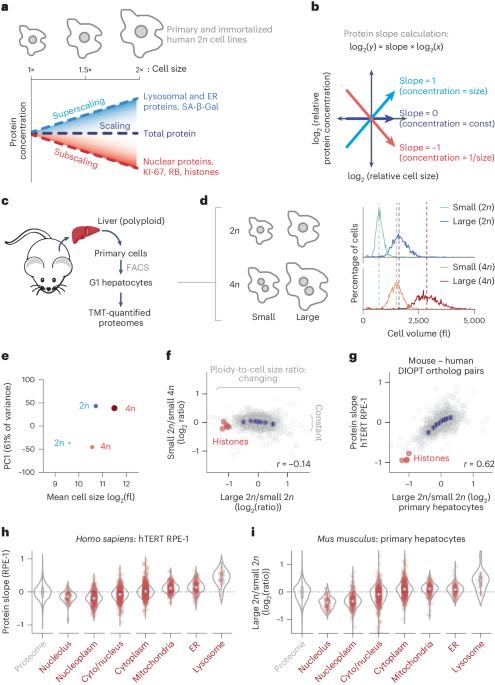
Cell size is tightly controlled in healthy tissues and single-celled organisms, but it remains unclear how cell size influences physiology. Increasing cell size was recently shown to remodel the proteomes of cultured human cells, demonstrating that large and small cells of the same type can be compositionally different. In the present study, we utilize the natural heterogeneity of hepatocyte ploidy and yeast genetics to establish that the ploidy-to-cell size ratio is a highly conserved determinant of proteome composition. In both mammalian and yeast cells, genome dilution by cell growth elicits a starvation-like phenotype, suggesting that growth in large cells is restricted by genome concentration in a manner that mimics a limiting nutrient. Moreover, genome dilution explains some proteomic changes ascribed to yeast aging. Overall, our data indicate that genome concentration drives changes in cell composition independently of external environmental cues. Here the authors establish that ploidy-to-cell size ratio is a highly conserved determinant of proteome composition. In both mammals and yeast, they find that growth in large cells is restricted by genome concentration as if it were a limiting nutrient.
期刊介绍:
Nature Structural & Molecular Biology is a comprehensive platform that combines structural and molecular research. Our journal focuses on exploring the functional and mechanistic aspects of biological processes, emphasizing how molecular components collaborate to achieve a particular function. While structural data can shed light on these insights, our publication does not require them as a prerequisite.



 京公网安备 11010802042870号
京ICP备2023020795号-1
京公网安备 11010802042870号
京ICP备2023020795号-1

 分享
分享
 求助内容:
求助内容: 应助结果提醒方式:
 扫码关注我们
