Tiphaine Voisin, Elodie Labit, Nicolas Gaudenzio, Lilian Basso
{"title":"Anaplastic lymphoma kinase as a new therapeutic target in inflammatory itch","authors":"Tiphaine Voisin, Elodie Labit, Nicolas Gaudenzio, Lilian Basso","doi":"10.1111/all.16260","DOIUrl":null,"url":null,"abstract":"<p>Itch is a devastating symptom observed in different types of skin inflammatory conditions, negatively impacting patient's quality of life. While progresses have been made in the understanding of peripheral neuroimmune circuits and the clinical management of itch, there is still a strong need to develop new therapeutic approaches. Anaplastic lymphoma kinase (ALK) is a receptor tyrosine kinase expressed in the mammalian nervous system identified as an active player in cancer. Accordingly, small molecule ALK inhibitors, including lorlatinib, show good clinical efficacy in various cancers.<span><sup>1</sup></span> Two natural ligands for Alk have been identified, Alkal1 and Alkal2. We recently demonstrated that Alkal2 expression by nociceptors in the dorsal root ganglia (DRG) participates in the development of chronic pain by activating Alk-expressing neurons in the spinal cord.<span><sup>2</sup></span> However, the role of neuronal Alk in inflammatory itch remains unexplored.</p><p>We analyzed two published RNA sequencing (RNAseq) datasets of sensory neurons,<span><sup>3, 4</sup></span> and found an increase in <i>Alkal2</i> gene expression in two mouse models of inflammatory itch induced by MC903 (i.e., type 2 inflammation) and by oxazolone (i.e., contact hypersensitivity, CHS), respectively (Figure 1A). These data were confirmed by qRT-PCR performed on DRGs from wild type mice, treated with MC903 or Di-Nitro-Fluoro-Benzene (i.e., DNFB, a model of CHS) to develop different allergic skin inflammations (Figure 1B). Using an antibody recognizing the active form of Alk (i.e., pAlk), known to be triggered upon binding of Alkal2 on the receptor expressed by spinal cord neurons, we observed a significant increase of pAlk-positive cells in the superficial laminas of the spinal dorsal horn of MC903 and DNFB treated-mice (Figure 1C,D).</p><p>We then investigated the expression of <i>Alk</i> in subsets of mouse spinal cord neurons using a published single cell RNAseq atlas.<span><sup>5</sup></span> After identification of excitatory and inhibitory dorsal horn neurons (Figure 1E), we showed that the population of neurons expressing the highest levels of <i>Alk</i> also expressed the highest levels of the gastrin releasing peptide receptor (<i>Grpr</i>) (Figure 1F), a receptor expressed by a subpopulation of spinal interneurons particularly important for the spinal processing of itch in mice<span><sup>6</sup></span> and macaques.<span><sup>7</sup></span> We next took advantage of a Human Cell Atlas of spinal neurons<span><sup>8</sup></span> and looked for the population of neurons expressing the ortholog <i>ALK</i> gene (Figure 1G). While more broadly expressed in humans, the gene <i>ALK</i> was highly expressed in neurons showing a high density of expression of the gene <i>GRPR</i> (Figure 1H), suggesting that neuronal Alkal2-Alk axis could be conserved between mice and humans.</p><p>We next investigated whether we could interfere with the neuronal Alkal2-Alk axis to alleviate itch symptoms in vivo in the DNFB model of CHS, by treating mice per os with the Alk inhibitor lorlatinib. We could show that daily treatment with lorlatinib in CHS model significantly alleviated itch symptoms (Figure 2B) while levels of inflammation observed on the skin remained unaffected (Figure 2D–G). Chronic lorlatinib treatment was also able to alleviate itch symptoms in MC903 without affecting inflammation (Figure S1A–C) but not in histamine and chloroquine induced-itch (Figure S1D–F). Finally, a single lorlatinib treatment was able to reduce itch in the DNFB model (Figure 2H) but not in the acute histaminergic or chloroquine-induced-itch (Figure S1G–I).</p><p>These data provide compelling evidence that the neuronal Alkal2-Alk axis is critical for the development of inflammatory itch in two different mouse models of allergic contact dermatitis and atopic dermatitis diseases. While known important side effects of current Alk inhibitors can mitigate their use in patients with chronic itch, we propose that elaborating a new strategy to block this pathway, by targeting Alkal2 for instance, could be an interesting therapeutic approach for patients with chronic inflammatory itch.</p><p>TV and LB conceived the project, designed the study and experiments. TV performed experiments, acquired and analyzed the data. EL performed histological analysis. LB performed bioinformatics treatment of published mouse and human single cell dataset. TV, NG and LB wrote the manuscript. LB and NG acquired the funding. All authors read the manuscript.</p><p>This work was supported by the Agence Nationale pour la Recherche (ANR) R21009BB (to NG), European Research Council (ERC-2023-COG # 101124255 to NG) and ANR R21187BB (to LB), by the Société Française de Dermatologie (to LB) and the Société Française d'Allergologie (to LB).</p><p>NG is (or was) collaborating or consulting or member of scientific advisory board for Genoskin (CSO, shareholder), Escient Pharmaceuticals, Aikium, CEVA, MaxiVax, Boehringer Ingelheim, Novartis, Sanofi, ArgenX.</p>","PeriodicalId":122,"journal":{"name":"Allergy","volume":"79 12","pages":"3537-3539"},"PeriodicalIF":12.0000,"publicationDate":"2024-07-26","publicationTypes":"Journal Article","fieldsOfStudy":null,"isOpenAccess":false,"openAccessPdf":"https://onlinelibrary.wiley.com/doi/epdf/10.1111/all.16260","citationCount":"0","resultStr":null,"platform":"Semanticscholar","paperid":null,"PeriodicalName":"Allergy","FirstCategoryId":"3","ListUrlMain":"https://onlinelibrary.wiley.com/doi/10.1111/all.16260","RegionNum":1,"RegionCategory":"医学","ArticlePicture":[],"TitleCN":null,"AbstractTextCN":null,"PMCID":null,"EPubDate":"","PubModel":"","JCR":"Q1","JCRName":"ALLERGY","Score":null,"Total":0}
引用次数: 0
Abstract
Itch is a devastating symptom observed in different types of skin inflammatory conditions, negatively impacting patient's quality of life. While progresses have been made in the understanding of peripheral neuroimmune circuits and the clinical management of itch, there is still a strong need to develop new therapeutic approaches. Anaplastic lymphoma kinase (ALK) is a receptor tyrosine kinase expressed in the mammalian nervous system identified as an active player in cancer. Accordingly, small molecule ALK inhibitors, including lorlatinib, show good clinical efficacy in various cancers.1 Two natural ligands for Alk have been identified, Alkal1 and Alkal2. We recently demonstrated that Alkal2 expression by nociceptors in the dorsal root ganglia (DRG) participates in the development of chronic pain by activating Alk-expressing neurons in the spinal cord.2 However, the role of neuronal Alk in inflammatory itch remains unexplored.
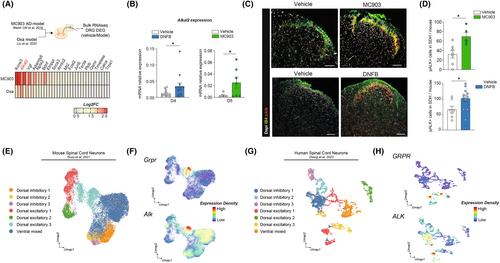
We analyzed two published RNA sequencing (RNAseq) datasets of sensory neurons,3, 4 and found an increase in Alkal2 gene expression in two mouse models of inflammatory itch induced by MC903 (i.e., type 2 inflammation) and by oxazolone (i.e., contact hypersensitivity, CHS), respectively (Figure 1A). These data were confirmed by qRT-PCR performed on DRGs from wild type mice, treated with MC903 or Di-Nitro-Fluoro-Benzene (i.e., DNFB, a model of CHS) to develop different allergic skin inflammations (Figure 1B). Using an antibody recognizing the active form of Alk (i.e., pAlk), known to be triggered upon binding of Alkal2 on the receptor expressed by spinal cord neurons, we observed a significant increase of pAlk-positive cells in the superficial laminas of the spinal dorsal horn of MC903 and DNFB treated-mice (Figure 1C,D).
We then investigated the expression of Alk in subsets of mouse spinal cord neurons using a published single cell RNAseq atlas.5 After identification of excitatory and inhibitory dorsal horn neurons (Figure 1E), we showed that the population of neurons expressing the highest levels of Alk also expressed the highest levels of the gastrin releasing peptide receptor (Grpr) (Figure 1F), a receptor expressed by a subpopulation of spinal interneurons particularly important for the spinal processing of itch in mice6 and macaques.7 We next took advantage of a Human Cell Atlas of spinal neurons8 and looked for the population of neurons expressing the ortholog ALK gene (Figure 1G). While more broadly expressed in humans, the gene ALK was highly expressed in neurons showing a high density of expression of the gene GRPR (Figure 1H), suggesting that neuronal Alkal2-Alk axis could be conserved between mice and humans.
We next investigated whether we could interfere with the neuronal Alkal2-Alk axis to alleviate itch symptoms in vivo in the DNFB model of CHS, by treating mice per os with the Alk inhibitor lorlatinib. We could show that daily treatment with lorlatinib in CHS model significantly alleviated itch symptoms (Figure 2B) while levels of inflammation observed on the skin remained unaffected (Figure 2D–G). Chronic lorlatinib treatment was also able to alleviate itch symptoms in MC903 without affecting inflammation (Figure S1A–C) but not in histamine and chloroquine induced-itch (Figure S1D–F). Finally, a single lorlatinib treatment was able to reduce itch in the DNFB model (Figure 2H) but not in the acute histaminergic or chloroquine-induced-itch (Figure S1G–I).
These data provide compelling evidence that the neuronal Alkal2-Alk axis is critical for the development of inflammatory itch in two different mouse models of allergic contact dermatitis and atopic dermatitis diseases. While known important side effects of current Alk inhibitors can mitigate their use in patients with chronic itch, we propose that elaborating a new strategy to block this pathway, by targeting Alkal2 for instance, could be an interesting therapeutic approach for patients with chronic inflammatory itch.
TV and LB conceived the project, designed the study and experiments. TV performed experiments, acquired and analyzed the data. EL performed histological analysis. LB performed bioinformatics treatment of published mouse and human single cell dataset. TV, NG and LB wrote the manuscript. LB and NG acquired the funding. All authors read the manuscript.
This work was supported by the Agence Nationale pour la Recherche (ANR) R21009BB (to NG), European Research Council (ERC-2023-COG # 101124255 to NG) and ANR R21187BB (to LB), by the Société Française de Dermatologie (to LB) and the Société Française d'Allergologie (to LB).
NG is (or was) collaborating or consulting or member of scientific advisory board for Genoskin (CSO, shareholder), Escient Pharmaceuticals, Aikium, CEVA, MaxiVax, Boehringer Ingelheim, Novartis, Sanofi, ArgenX.
期刊介绍:
Allergy is an international and multidisciplinary journal that aims to advance, impact, and communicate all aspects of the discipline of Allergy/Immunology. It publishes original articles, reviews, position papers, guidelines, editorials, news and commentaries, letters to the editors, and correspondences. The journal accepts articles based on their scientific merit and quality.
Allergy seeks to maintain contact between basic and clinical Allergy/Immunology and encourages contributions from contributors and readers from all countries. In addition to its publication, Allergy also provides abstracting and indexing information. Some of the databases that include Allergy abstracts are Abstracts on Hygiene & Communicable Disease, Academic Search Alumni Edition, AgBiotech News & Information, AGRICOLA Database, Biological Abstracts, PubMed Dietary Supplement Subset, and Global Health, among others.




 京公网安备 11010802042870号
京ICP备2023020795号-1
京公网安备 11010802042870号
京ICP备2023020795号-1

 分享
分享
 求助内容:
求助内容: 应助结果提醒方式:
 扫码关注我们
