Revealing the key antioxidant compounds and potential action mechanisms of Chinese Cabernet Sauvignon red wines by integrating UHPLC-QTOF-MS-based untargeted metabolomics, network pharmacology and molecular docking approaches
Zhi-Xin Peng , Hui-Wen Gu , Yuan Pan , Yan Wang , Jun Yan , Wanjun Long , Haiyan Fu , Yuanbin She
{"title":"Revealing the key antioxidant compounds and potential action mechanisms of Chinese Cabernet Sauvignon red wines by integrating UHPLC-QTOF-MS-based untargeted metabolomics, network pharmacology and molecular docking approaches","authors":"Zhi-Xin Peng , Hui-Wen Gu , Yuan Pan , Yan Wang , Jun Yan , Wanjun Long , Haiyan Fu , Yuanbin She","doi":"10.1016/j.foodchem.2024.140540","DOIUrl":null,"url":null,"abstract":"<div><p>In recent years, red wine drinking has become more popular in China owing to its antioxidant effects. However, the key antioxidant compounds and their action mechanisms of Chinese red wines are still unclear. Herein, the antioxidant activities and chemical compositions of 45 Chinese Cabernet Sauvignon red wine samples were determined using chemical antioxidant assays and an UHPLC-QTOF-MS-based untargeted metabolomics method. The key antioxidant compounds in red wines and potential action mechanisms were revealed by integrating network pharmacology and molecular docking approaches. Results showed that there are 8 key antioxidant compounds in the red wine samples. These compounds are involved in several metabolic pathways in the body, particularly PI3K/AKT. What's more, they bind to the core antioxidant targets through hydrogen bonding and hydrophobic interaction. Among them, myricetin, laricitrin, 2,3,8-tri-<em>O</em>-methylellagic acid and AKT1 have the highest binding energies. This study could provide the theoretical basis for further investigation of physiological activities and functions of Chinese red wines.</p></div>","PeriodicalId":318,"journal":{"name":"Food Chemistry","volume":"460 ","pages":"Article 140540"},"PeriodicalIF":9.8000,"publicationDate":"2024-12-01","publicationTypes":"Journal Article","fieldsOfStudy":null,"isOpenAccess":false,"openAccessPdf":"","citationCount":"0","resultStr":null,"platform":"Semanticscholar","paperid":null,"PeriodicalName":"Food Chemistry","FirstCategoryId":"97","ListUrlMain":"https://www.sciencedirect.com/science/article/pii/S0308814624021903","RegionNum":1,"RegionCategory":"农林科学","ArticlePicture":[],"TitleCN":null,"AbstractTextCN":null,"PMCID":null,"EPubDate":"2024/7/20 0:00:00","PubModel":"Epub","JCR":"Q1","JCRName":"CHEMISTRY, APPLIED","Score":null,"Total":0}
引用次数: 0
Abstract
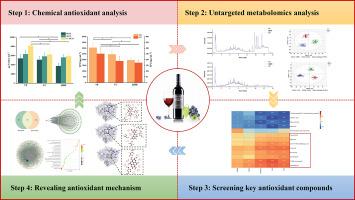
In recent years, red wine drinking has become more popular in China owing to its antioxidant effects. However, the key antioxidant compounds and their action mechanisms of Chinese red wines are still unclear. Herein, the antioxidant activities and chemical compositions of 45 Chinese Cabernet Sauvignon red wine samples were determined using chemical antioxidant assays and an UHPLC-QTOF-MS-based untargeted metabolomics method. The key antioxidant compounds in red wines and potential action mechanisms were revealed by integrating network pharmacology and molecular docking approaches. Results showed that there are 8 key antioxidant compounds in the red wine samples. These compounds are involved in several metabolic pathways in the body, particularly PI3K/AKT. What's more, they bind to the core antioxidant targets through hydrogen bonding and hydrophobic interaction. Among them, myricetin, laricitrin, 2,3,8-tri-O-methylellagic acid and AKT1 have the highest binding energies. This study could provide the theoretical basis for further investigation of physiological activities and functions of Chinese red wines.
期刊介绍:
Food Chemistry publishes original research papers dealing with the advancement of the chemistry and biochemistry of foods or the analytical methods/ approach used. All papers should focus on the novelty of the research carried out.



 京公网安备 11010802042870号
京ICP备2023020795号-1
京公网安备 11010802042870号
京ICP备2023020795号-1

 分享
分享
 求助内容:
求助内容: 应助结果提醒方式:
 扫码关注我们
