{"title":"Perinatal Remote Blood Pressure Monitoring.","authors":"Adam K Lewkowitz, Alisse Hauspurg","doi":"10.1097/AOG.0000000000005690","DOIUrl":null,"url":null,"abstract":"<p><p>Perinatal mortality and severe maternal morbidity among individuals with hypertensive disorders of pregnancy (HDP) are often driven by persistent, uncontrolled hypertension. Whereas traditional perinatal blood pressure (BP) ascertainment occurs through in-person clinic appointments, self-measured blood pressure (SMBP) programs allow individuals to measure their BP remotely and receive remote management by a medical team. Though data remain limited on clinically important outcomes such as maternal morbidity, these programs have shown promise in improving BP ascertainment rates in the immediate postpartum period and enhancing racial and ethnic equity in BP ascertainment after hospital discharge. In this narrative review, we provide an overview of perinatal SMBP programs that have been described in the literature and the data that support their efficacy. Furthermore, we offer suggestions for practitioners, institutions, and health systems that may be considering implementing SMBP programs, including important health equity concerns to be considered. Last, we discuss opportunities for ongoing and future research regarding SMBP programs' effects on maternal morbidity, long-term health outcomes, inequities that are known to exist in HDP and HDP-related outcomes, and the cost effectiveness of these programs.</p>","PeriodicalId":19483,"journal":{"name":"Obstetrics and gynecology","volume":" ","pages":"339-345"},"PeriodicalIF":4.7000,"publicationDate":"2024-09-01","publicationTypes":"Journal Article","fieldsOfStudy":null,"isOpenAccess":false,"openAccessPdf":"https://www.ncbi.nlm.nih.gov/pmc/articles/PMC11326962/pdf/","citationCount":"0","resultStr":null,"platform":"Semanticscholar","paperid":null,"PeriodicalName":"Obstetrics and gynecology","FirstCategoryId":"3","ListUrlMain":"https://doi.org/10.1097/AOG.0000000000005690","RegionNum":2,"RegionCategory":"医学","ArticlePicture":[],"TitleCN":null,"AbstractTextCN":null,"PMCID":null,"EPubDate":"2024/7/25 0:00:00","PubModel":"Epub","JCR":"Q1","JCRName":"OBSTETRICS & GYNECOLOGY","Score":null,"Total":0}
引用次数: 0
Abstract
Perinatal mortality and severe maternal morbidity among individuals with hypertensive disorders of pregnancy (HDP) are often driven by persistent, uncontrolled hypertension. Whereas traditional perinatal blood pressure (BP) ascertainment occurs through in-person clinic appointments, self-measured blood pressure (SMBP) programs allow individuals to measure their BP remotely and receive remote management by a medical team. Though data remain limited on clinically important outcomes such as maternal morbidity, these programs have shown promise in improving BP ascertainment rates in the immediate postpartum period and enhancing racial and ethnic equity in BP ascertainment after hospital discharge. In this narrative review, we provide an overview of perinatal SMBP programs that have been described in the literature and the data that support their efficacy. Furthermore, we offer suggestions for practitioners, institutions, and health systems that may be considering implementing SMBP programs, including important health equity concerns to be considered. Last, we discuss opportunities for ongoing and future research regarding SMBP programs' effects on maternal morbidity, long-term health outcomes, inequities that are known to exist in HDP and HDP-related outcomes, and the cost effectiveness of these programs.
期刊介绍:
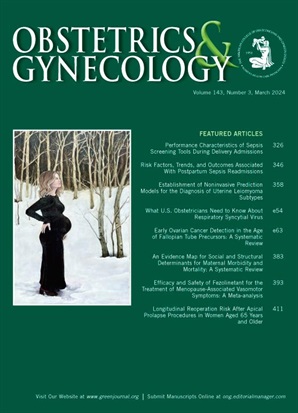
"Obstetrics & Gynecology," affectionately known as "The Green Journal," is the official publication of the American College of Obstetricians and Gynecologists (ACOG). Since its inception in 1953, the journal has been dedicated to advancing the clinical practice of obstetrics and gynecology, as well as related fields. The journal's mission is to promote excellence in these areas by publishing a diverse range of articles that cover translational and clinical topics.
"Obstetrics & Gynecology" provides a platform for the dissemination of evidence-based research, clinical guidelines, and expert opinions that are essential for the continuous improvement of women's health care. The journal's content is designed to inform and educate obstetricians, gynecologists, and other healthcare professionals, ensuring that they stay abreast of the latest developments and best practices in their field.



 京公网安备 11010802042870号
京ICP备2023020795号-1
京公网安备 11010802042870号
京ICP备2023020795号-1

 分享
分享
 求助内容:
求助内容: 应助结果提醒方式:
 扫码关注我们
