Vertebrate taxonomic and functional hotspots in the Brazilian Atlantic Forest

IF 4.2 2区 环境科学与生态学 Q1 BIODIVERSITY CONSERVATION Diversity and Distributions Pub Date : 2024-07-24 DOI:10.1111/ddi.13908
Fillipe Pedroso-Santos, Renato Richard Hilário, Bruna da Silva Xavier, Ana M. C. Santos, Karen Mustin, William Douglas Carvalho
{"title":"Vertebrate taxonomic and functional hotspots in the Brazilian Atlantic Forest","authors":"Fillipe Pedroso-Santos,&nbsp;Renato Richard Hilário,&nbsp;Bruna da Silva Xavier,&nbsp;Ana M. C. Santos,&nbsp;Karen Mustin,&nbsp;William Douglas Carvalho","doi":"10.1111/ddi.13908","DOIUrl":null,"url":null,"abstract":"<div>\n \n \n <section>\n \n <h3> Aim</h3>\n \n <p>We aim to find the main drivers of the taxonomic and functional richness and functional dispersion of vertebrates (amphibians, birds, primates, marsupials, rodents, bats and medium- and large-sized mammals) across the Brazilian Atlantic Forest. We also aim to identify hotspots of vertebrate diversity and quantify the extent to which they are legally protected.</p>\n </section>\n \n <section>\n \n <h3> Location</h3>\n \n <p>Brazilian Atlantic Forest.</p>\n </section>\n \n <section>\n \n <h3> Methods</h3>\n \n <p>We gathered data on the occurrence of vertebrates based on the most recent published databases for Atlantic Forest vertebrates and measured taxonomic richness, functional richness and functional dispersion. We then related variation in diversity, within each group and overall, to environmental and landscape variables. Also, we modelled the diversity of each group for the entire extent of the Atlantic Forest, superimposing the diversity maps to delimit the vertebrate biodiversity hotspots and verified how much of these hotspots are covered by protected areas.</p>\n </section>\n \n <section>\n \n <h3> Results</h3>\n \n <p>Taxonomic/functional diversity were driven by environmental (e.g., average annual precipitation and precipitation of the driest quarter) and landscape variables (e.g., amount of forest and agricultural areas) for most taxonomic groups. The main hotspots of taxonomic richness are located in the central region of the Atlantic Forest, whereas those for functional diversity occur in the southern region of the biome. Only a little over 10% of the Atlantic Forest is covered by protected areas, and, as such, the vast majority of the medium and high diversity areas fall outside of protected areas, being therefore not legally protected.</p>\n </section>\n \n <section>\n \n <h3> Main Conclusions</h3>\n \n <p>We found evidence for previously described patterns, including the predicted positive effects of the amount of forest in the landscape and precipitation and the negative effects of agricultural areas on vertebrate diversity. Finally, our results show that most diversity hotspots are outside of legally protected areas, indicating that more conservation efforts should be made towards safeguarding these important areas.</p>\n </section>\n </div>","PeriodicalId":51018,"journal":{"name":"Diversity and Distributions","volume":"30 9","pages":""},"PeriodicalIF":4.2000,"publicationDate":"2024-07-24","publicationTypes":"Journal Article","fieldsOfStudy":null,"isOpenAccess":false,"openAccessPdf":"https://onlinelibrary.wiley.com/doi/epdf/10.1111/ddi.13908","citationCount":"0","resultStr":null,"platform":"Semanticscholar","paperid":null,"PeriodicalName":"Diversity and Distributions","FirstCategoryId":"93","ListUrlMain":"https://onlinelibrary.wiley.com/doi/10.1111/ddi.13908","RegionNum":2,"RegionCategory":"环境科学与生态学","ArticlePicture":[],"TitleCN":null,"AbstractTextCN":null,"PMCID":null,"EPubDate":"","PubModel":"","JCR":"Q1","JCRName":"BIODIVERSITY CONSERVATION","Score":null,"Total":0}
引用次数: 0

Abstract

Aim

We aim to find the main drivers of the taxonomic and functional richness and functional dispersion of vertebrates (amphibians, birds, primates, marsupials, rodents, bats and medium- and large-sized mammals) across the Brazilian Atlantic Forest. We also aim to identify hotspots of vertebrate diversity and quantify the extent to which they are legally protected.

Location

Brazilian Atlantic Forest.

Methods

We gathered data on the occurrence of vertebrates based on the most recent published databases for Atlantic Forest vertebrates and measured taxonomic richness, functional richness and functional dispersion. We then related variation in diversity, within each group and overall, to environmental and landscape variables. Also, we modelled the diversity of each group for the entire extent of the Atlantic Forest, superimposing the diversity maps to delimit the vertebrate biodiversity hotspots and verified how much of these hotspots are covered by protected areas.

Results

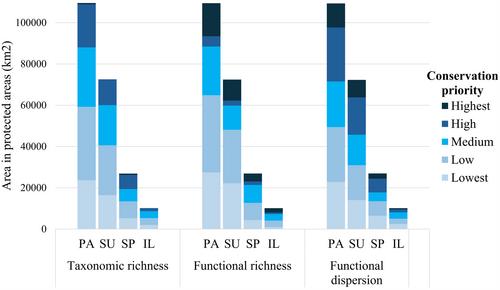
Taxonomic/functional diversity were driven by environmental (e.g., average annual precipitation and precipitation of the driest quarter) and landscape variables (e.g., amount of forest and agricultural areas) for most taxonomic groups. The main hotspots of taxonomic richness are located in the central region of the Atlantic Forest, whereas those for functional diversity occur in the southern region of the biome. Only a little over 10% of the Atlantic Forest is covered by protected areas, and, as such, the vast majority of the medium and high diversity areas fall outside of protected areas, being therefore not legally protected.

Main Conclusions

We found evidence for previously described patterns, including the predicted positive effects of the amount of forest in the landscape and precipitation and the negative effects of agricultural areas on vertebrate diversity. Finally, our results show that most diversity hotspots are outside of legally protected areas, indicating that more conservation efforts should be made towards safeguarding these important areas.
Abstract Image

查看原文
分享 分享
微信好友 朋友圈 QQ好友 复制链接
本刊更多论文
巴西大西洋森林中的脊椎动物分类和功能热点
目的我们的目标是找到巴西大西洋森林中脊椎动物(两栖类、鸟类、灵长类、有袋类、啮齿类、蝙蝠和大中型哺乳动物)分类和功能丰富性及功能分散性的主要驱动因素。我们还旨在确定脊椎动物多样性的热点地区,并量化这些地区受法律保护的程度。方法我们根据最新公布的大西洋森林脊椎动物数据库收集了脊椎动物的出现数据,并测量了分类丰富度、功能丰富度和功能分散度。然后,我们将每个类群内部和整体的多样性变化与环境和景观变量联系起来。此外,我们还模拟了大西洋森林整个范围内每个类群的多样性,通过叠加多样性地图来划定脊椎动物生物多样性热点地区,并验证了保护区对这些热点地区的覆盖程度。结果对于大多数分类群而言,环境变量(如年平均降水量和最干旱季度的降水量)和景观变量(如森林和农业区的数量)驱动了分类/功能多样性。分类丰富度的主要热点位于大西洋森林的中部地区,而功能多样性的热点则位于生物群落的南部地区。大西洋森林只有 10%多一点的面积被保护区覆盖,因此,绝大多数中度和高度多样性区域都在保护区之外,没有受到法律保护。主要结论我们发现了之前描述的模式的证据,包括预测的景观中森林数量和降水量的积极影响,以及农业区对脊椎动物多样性的负面影响。最后,我们的研究结果表明,大多数多样性热点地区都在法律保护区之外,这表明应加大保护力度,以保护这些重要地区。
本文章由计算机程序翻译,如有差异,请以英文原文为准。
求助全文
约1分钟内获得全文 去求助
来源期刊
Diversity and Distributions
Diversity and Distributions 环境科学-生态学
CiteScore
8.90
自引率
4.30%
发文量
195
审稿时长
8-16 weeks
期刊介绍: Diversity and Distributions is a journal of conservation biogeography. We publish papers that deal with the application of biogeographical principles, theories, and analyses (being those concerned with the distributional dynamics of taxa and assemblages) to problems concerning the conservation of biodiversity. We no longer consider papers the sole aim of which is to describe or analyze patterns of biodiversity or to elucidate processes that generate biodiversity.
期刊最新文献
High Habitat Potential but Limited Connectivity for Brown Bears Throughout Europe Issue Information Low Migratory Connectivity and Use of Multiple Non-Breeding Sites in American Golden-Plovers Breeding Across the Nearctic Tundra Cover page Climate Change Will Resize and Reshape Plant–Hummingbird Networks in the Atlantic Forest
×
引用
GB/T 7714-2015
复制
MLA
复制
APA
复制
导出至
BibTeX EndNote RefMan NoteFirst NoteExpress
×
×
提示
您的信息不完整,为了账户安全,请先补充。
现在去补充
×
提示
您因"违规操作"
具体请查看互助需知
我知道了
×
提示
现在去查看 取消
×
提示
确定
0
微信
客服QQ
Book学术公众号 扫码关注我们
反馈
×
意见反馈
请填写您的意见或建议
请填写您的手机或邮箱
已复制链接
已复制链接
快去分享给好友吧!
我知道了
×
扫码分享
扫码分享
Book学术官方微信
Book学术文献互助
Book学术文献互助群
群 号:604180095
Book学术
文献互助 智能选刊 最新文献 互助须知 联系我们:info@booksci.cn
Book学术提供免费学术资源搜索服务,方便国内外学者检索中英文文献。致力于提供最便捷和优质的服务体验。
Copyright © 2023 Book学术 All rights reserved.
ghs 京公网安备 11010802042870号 京ICP备2023020795号-1





