Karen Yee , Nazlee Sharmin PhD, MEd, Ava K. Chow PhD
{"title":"Developing a digital educational escape room for an online dental hygiene course","authors":"Karen Yee , Nazlee Sharmin PhD, MEd, Ava K. Chow PhD","doi":"10.1002/jdd.13671","DOIUrl":null,"url":null,"abstract":"<p>The application of digital educational escape rooms (DEERs) is becoming increasingly popular in higher education, positively impacting cognitive, behavioral, and affective skills.<span><sup>1</sup></span> However, reports of actual use of DEERs in the training of oral health professionals are scarce.<span><sup>1</sup></span> One reason for this may be the resources and costs involved in developing DEERs.<span><sup>2</sup></span> Fostering active learning and student engagement in online courses may be challenging for instructors; however, well-designed and easy-to-develop DEERs can greatly benefit the student learning experience.</p><p>We developed a DEER using Google slides and Google forms for an online biochemistry course offered to the second year dental hygiene (DH) students. The aim was to create an engaging game that can serve as a self-assessment tool for students and a formative assessment tool for the instructor to gauge student understanding. The traditional structure of an escape room<span><sup>3</sup></span> was followed to create our DEER game, called “The Biochemist's Island.” It was based on a storyline, where students were required to solve puzzles and discover hidden clues to progress through the storyline to reach the final goal (Figure 1). The puzzles were organized sequentially, students must solve one puzzle correctly for the next task to open.<span><sup>4</sup></span> Solving each puzzle provided a code needed in the last step to solve the mystery. The steps of making the DEER are in Figure 2.</p><p>The game was posted in the Learning Management System (LMS) of the online synchronous biochemistry course. The LMS data were analyzed to assess students’ engagement with the escape room. The LMS, however, reports the number of instances of interactions with the DEER only, without providing the time of engagement. A survey, adapted from the validated Gameful Experience Scale (GAMEX)<span><sup>5</sup></span> was incorporated at the end of the escape room to evaluate students’ gaming experience and their perception of the DEER as a teaching and learning tool. This study was approved by the University of Alberta Research Ethics Board (ID: Pro00138302).</p><p>The biochemistry course enrolls 28 DH students and runs for 15 weeks. The escape room was posted on week 3 to supplement the lecture materials on amino acids. This material was tested on week 6 in a noncumulative exam. Seventy-five percent (75%) of the class (<i>n</i> = 21) interacted with the DEER. High student engagement with the DEER occurred between week 5 and week 6, immediately prior to the exam (Figure 3A). Eleven percent (11%, <i>n</i> = 3) of the class participated in the survey. The survey participants indicated that the escape room game was fun, helpful for learning (Figure 3B), and made them feel adventurous and active (Figure 3C).</p><p>The authors declare no conflicts of interest.</p>","PeriodicalId":50216,"journal":{"name":"Journal of Dental Education","volume":"88 S3","pages":"1952-1955"},"PeriodicalIF":1.6000,"publicationDate":"2024-07-28","publicationTypes":"Journal Article","fieldsOfStudy":null,"isOpenAccess":false,"openAccessPdf":"https://www.ncbi.nlm.nih.gov/pmc/articles/PMC11674992/pdf/","citationCount":"0","resultStr":null,"platform":"Semanticscholar","paperid":null,"PeriodicalName":"Journal of Dental Education","FirstCategoryId":"3","ListUrlMain":"https://onlinelibrary.wiley.com/doi/10.1002/jdd.13671","RegionNum":4,"RegionCategory":"医学","ArticlePicture":[],"TitleCN":null,"AbstractTextCN":null,"PMCID":null,"EPubDate":"","PubModel":"","JCR":"Q3","JCRName":"DENTISTRY, ORAL SURGERY & MEDICINE","Score":null,"Total":0}
引用次数: 0
Abstract
The application of digital educational escape rooms (DEERs) is becoming increasingly popular in higher education, positively impacting cognitive, behavioral, and affective skills.1 However, reports of actual use of DEERs in the training of oral health professionals are scarce.1 One reason for this may be the resources and costs involved in developing DEERs.2 Fostering active learning and student engagement in online courses may be challenging for instructors; however, well-designed and easy-to-develop DEERs can greatly benefit the student learning experience.
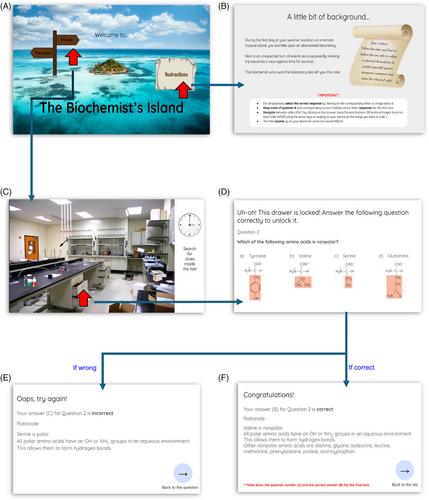
We developed a DEER using Google slides and Google forms for an online biochemistry course offered to the second year dental hygiene (DH) students. The aim was to create an engaging game that can serve as a self-assessment tool for students and a formative assessment tool for the instructor to gauge student understanding. The traditional structure of an escape room3 was followed to create our DEER game, called “The Biochemist's Island.” It was based on a storyline, where students were required to solve puzzles and discover hidden clues to progress through the storyline to reach the final goal (Figure 1). The puzzles were organized sequentially, students must solve one puzzle correctly for the next task to open.4 Solving each puzzle provided a code needed in the last step to solve the mystery. The steps of making the DEER are in Figure 2.
The game was posted in the Learning Management System (LMS) of the online synchronous biochemistry course. The LMS data were analyzed to assess students’ engagement with the escape room. The LMS, however, reports the number of instances of interactions with the DEER only, without providing the time of engagement. A survey, adapted from the validated Gameful Experience Scale (GAMEX)5 was incorporated at the end of the escape room to evaluate students’ gaming experience and their perception of the DEER as a teaching and learning tool. This study was approved by the University of Alberta Research Ethics Board (ID: Pro00138302).
The biochemistry course enrolls 28 DH students and runs for 15 weeks. The escape room was posted on week 3 to supplement the lecture materials on amino acids. This material was tested on week 6 in a noncumulative exam. Seventy-five percent (75%) of the class (n = 21) interacted with the DEER. High student engagement with the DEER occurred between week 5 and week 6, immediately prior to the exam (Figure 3A). Eleven percent (11%, n = 3) of the class participated in the survey. The survey participants indicated that the escape room game was fun, helpful for learning (Figure 3B), and made them feel adventurous and active (Figure 3C).
期刊介绍:
The Journal of Dental Education (JDE) is a peer-reviewed monthly journal that publishes a wide variety of educational and scientific research in dental, allied dental and advanced dental education. Published continuously by the American Dental Education Association since 1936 and internationally recognized as the premier journal for academic dentistry, the JDE publishes articles on such topics as curriculum reform, education research methods, innovative educational and assessment methodologies, faculty development, community-based dental education, student recruitment and admissions, professional and educational ethics, dental education around the world and systematic reviews of educational interest. The JDE is one of the top scholarly journals publishing the most important work in oral health education today; it celebrated its 80th anniversary in 2016.




 京公网安备 11010802042870号
京ICP备2023020795号-1
京公网安备 11010802042870号
京ICP备2023020795号-1

 分享
分享
 求助内容:
求助内容: 应助结果提醒方式:
 扫码关注我们
