Mixture of arsenic and chromium alters antioxidant, DNA repair and tumor suppressor gene expressions in zebrafish brain at environmental concentrations
{"title":"Mixture of arsenic and chromium alters antioxidant, DNA repair and tumor suppressor gene expressions in zebrafish brain at environmental concentrations","authors":"Sreejata Kamila, Koushik Kumar Dey, Shehnaz Islam, Ansuman Chattopadhyay","doi":"10.1016/j.jes.2024.07.014","DOIUrl":null,"url":null,"abstract":"<div><div>Arsenic (As) and chromium (Cr) are two harmful toxicants as well as carcinogens which can coexist in polluted surface water and groundwater. This coexistence leads to mixture effects in animals including fish. Both of these heavy metals are reported to manifest reactive oxygen species (ROS) mediated toxicity. Though individual neurotoxic effects have been reported, their mixture effects, its mechanism and cellular responses against oxidative stress and DNA damages remain unknown. The present study evaluated the individual and mixture effects of As and Cr at their environmentally relevant concentrations in zebrafish (<em>Danio rerio</em>) brain after 15, 30 and 60 days of exposure. Nrf2, a transcription factor is involved in the expressional regulation of enzymes needed to maintain cellular redox homeostasis. This study reported the expressional pattern of Nrf2 and its associated xenobiotic metabolizing enzyme Nqo1 and other markers of oxidative stress such as ROS generation, reduced glutathione level, lipid peroxidation and catalase activity. Increased malondialdehyde (MDA) content, glutathione level, and catalase activity indicated oxidative stress in exposed groups. In addition, this study revealed expressional alterations of neurotoxicity marker (<em>ache</em>), DNA repair (<em>ogg1, apex1, creb1, polb, mlh1, msh2</em> and <em>msh6</em>) and tumor suppressor (<em>p53, brca2</em>) genes. Results of ROS generation, MDA level, histopathological analysis, gene expression and immunofluorescence study confirmed that As and Cr did not show antagonistic effects in combination rather indicated additive effects which was dose-dependent but not always linear.</div></div>","PeriodicalId":15788,"journal":{"name":"Journal of Environmental Sciences-china","volume":"155 ","pages":"Pages 60-72"},"PeriodicalIF":6.3000,"publicationDate":"2024-07-20","publicationTypes":"Journal Article","fieldsOfStudy":null,"isOpenAccess":false,"openAccessPdf":"","citationCount":"0","resultStr":null,"platform":"Semanticscholar","paperid":null,"PeriodicalName":"Journal of Environmental Sciences-china","FirstCategoryId":"93","ListUrlMain":"https://www.sciencedirect.com/science/article/pii/S1001074224003796","RegionNum":2,"RegionCategory":"环境科学与生态学","ArticlePicture":[],"TitleCN":null,"AbstractTextCN":null,"PMCID":null,"EPubDate":"","PubModel":"","JCR":"Q1","JCRName":"ENVIRONMENTAL SCIENCES","Score":null,"Total":0}
引用次数: 0
Abstract
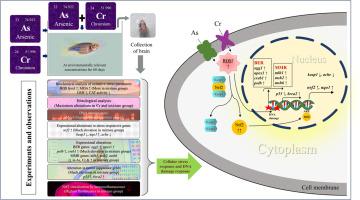
Arsenic (As) and chromium (Cr) are two harmful toxicants as well as carcinogens which can coexist in polluted surface water and groundwater. This coexistence leads to mixture effects in animals including fish. Both of these heavy metals are reported to manifest reactive oxygen species (ROS) mediated toxicity. Though individual neurotoxic effects have been reported, their mixture effects, its mechanism and cellular responses against oxidative stress and DNA damages remain unknown. The present study evaluated the individual and mixture effects of As and Cr at their environmentally relevant concentrations in zebrafish (Danio rerio) brain after 15, 30 and 60 days of exposure. Nrf2, a transcription factor is involved in the expressional regulation of enzymes needed to maintain cellular redox homeostasis. This study reported the expressional pattern of Nrf2 and its associated xenobiotic metabolizing enzyme Nqo1 and other markers of oxidative stress such as ROS generation, reduced glutathione level, lipid peroxidation and catalase activity. Increased malondialdehyde (MDA) content, glutathione level, and catalase activity indicated oxidative stress in exposed groups. In addition, this study revealed expressional alterations of neurotoxicity marker (ache), DNA repair (ogg1, apex1, creb1, polb, mlh1, msh2 and msh6) and tumor suppressor (p53, brca2) genes. Results of ROS generation, MDA level, histopathological analysis, gene expression and immunofluorescence study confirmed that As and Cr did not show antagonistic effects in combination rather indicated additive effects which was dose-dependent but not always linear.
期刊介绍:
The Journal of Environmental Sciences is an international journal started in 1989. The journal is devoted to publish original, peer-reviewed research papers on main aspects of environmental sciences, such as environmental chemistry, environmental biology, ecology, geosciences and environmental physics. Appropriate subjects include basic and applied research on atmospheric, terrestrial and aquatic environments, pollution control and abatement technology, conservation of natural resources, environmental health and toxicology. Announcements of international environmental science meetings and other recent information are also included.




 京公网安备 11010802042870号
京ICP备2023020795号-1
京公网安备 11010802042870号
京ICP备2023020795号-1

 分享
分享
 求助内容:
求助内容: 应助结果提醒方式:
 扫码关注我们
