Feng Hu , Pinhua Xie , Jin Xu , Yinsheng Lv , Zhidong Zhang , Jiangyi Zheng , Xin Tian
{"title":"Long-term trends of ozone in the Yangtze River Delta, China: Spatiotemporal impacts of meteorological factors, local, and non-local emissions","authors":"Feng Hu , Pinhua Xie , Jin Xu , Yinsheng Lv , Zhidong Zhang , Jiangyi Zheng , Xin Tian","doi":"10.1016/j.jes.2024.07.017","DOIUrl":null,"url":null,"abstract":"<div><div>The Yangtze River Delta (YRD) region has witnessed a consistent decrease in NO<sub>2</sub>, CO, and PM<sub>2.5</sub> from 2016 to 2023. However, ozone has exhibited fluctuating patterns. Quantifying ozone contributions from emissions, both within and outside the YRD, is essential for understanding city-cluster-scale ozone pollution (CCSOP). To address these concerns, a comprehensive approach combining Kolmogorov-Zurbenko filtering, Empirical Orthogonal Function, Absolute Principal Component Score, and Multiple Linear Regression methods (KZ-EOF-APCs-MLR) was employed to quantify the impacts of meteorological factors, local and non-local emission contributions of ozone (LECO and NECO). Emission changes were identified as the predominant factor shaping annual fluctuations in ambient ozone. Notably, during the previous and middle stages of the COVID-19 pandemic (from 2017 to 2021), emissions reductions led to a marked decrease in YRD ozone levels (-7.01 µg/m<sup>3</sup>), with a pronounced rebound post-pandemic (2022 to 2023) (+8.04 µg/m<sup>3</sup>). Seasonally, the emission-induced ozone exhibited fluctuating upward trend during autumn and winter, suggesting a transition of ozone pollution towards colder seasons. Spatially, high LECO concentrated in the eastern YRD (EYRD) across spring, autumn, and winter, becoming prominent in the central YRD (CYRD) during summer. During CCSOP, the CYRD exhibited the highest LECO and exceedance frequency (20.82 µg/m<sup>3</sup> and 45.27 %). LECO explained a large portion of ozone variability during CCSOP, particularly in the EYRD, while NECO showed less explanatory power but consistently high contributions (148.05 ± 15.52 µg/m<sup>3</sup>). These findings offer valuable insights for a deeper understanding of the evolving patterns of ozone pollution and the issue of CCSOP in the YRD.</div></div>","PeriodicalId":15788,"journal":{"name":"Journal of Environmental Sciences-china","volume":"156 ","pages":"Pages 408-420"},"PeriodicalIF":6.3000,"publicationDate":"2025-10-01","publicationTypes":"Journal Article","fieldsOfStudy":null,"isOpenAccess":false,"openAccessPdf":"","citationCount":"0","resultStr":null,"platform":"Semanticscholar","paperid":null,"PeriodicalName":"Journal of Environmental Sciences-china","FirstCategoryId":"93","ListUrlMain":"https://www.sciencedirect.com/science/article/pii/S1001074224003826","RegionNum":2,"RegionCategory":"环境科学与生态学","ArticlePicture":[],"TitleCN":null,"AbstractTextCN":null,"PMCID":null,"EPubDate":"2024/7/22 0:00:00","PubModel":"Epub","JCR":"Q1","JCRName":"ENVIRONMENTAL SCIENCES","Score":null,"Total":0}
引用次数: 0
Abstract
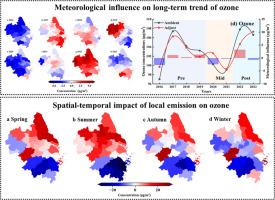
The Yangtze River Delta (YRD) region has witnessed a consistent decrease in NO2, CO, and PM2.5 from 2016 to 2023. However, ozone has exhibited fluctuating patterns. Quantifying ozone contributions from emissions, both within and outside the YRD, is essential for understanding city-cluster-scale ozone pollution (CCSOP). To address these concerns, a comprehensive approach combining Kolmogorov-Zurbenko filtering, Empirical Orthogonal Function, Absolute Principal Component Score, and Multiple Linear Regression methods (KZ-EOF-APCs-MLR) was employed to quantify the impacts of meteorological factors, local and non-local emission contributions of ozone (LECO and NECO). Emission changes were identified as the predominant factor shaping annual fluctuations in ambient ozone. Notably, during the previous and middle stages of the COVID-19 pandemic (from 2017 to 2021), emissions reductions led to a marked decrease in YRD ozone levels (-7.01 µg/m3), with a pronounced rebound post-pandemic (2022 to 2023) (+8.04 µg/m3). Seasonally, the emission-induced ozone exhibited fluctuating upward trend during autumn and winter, suggesting a transition of ozone pollution towards colder seasons. Spatially, high LECO concentrated in the eastern YRD (EYRD) across spring, autumn, and winter, becoming prominent in the central YRD (CYRD) during summer. During CCSOP, the CYRD exhibited the highest LECO and exceedance frequency (20.82 µg/m3 and 45.27 %). LECO explained a large portion of ozone variability during CCSOP, particularly in the EYRD, while NECO showed less explanatory power but consistently high contributions (148.05 ± 15.52 µg/m3). These findings offer valuable insights for a deeper understanding of the evolving patterns of ozone pollution and the issue of CCSOP in the YRD.
期刊介绍:
The Journal of Environmental Sciences is an international journal started in 1989. The journal is devoted to publish original, peer-reviewed research papers on main aspects of environmental sciences, such as environmental chemistry, environmental biology, ecology, geosciences and environmental physics. Appropriate subjects include basic and applied research on atmospheric, terrestrial and aquatic environments, pollution control and abatement technology, conservation of natural resources, environmental health and toxicology. Announcements of international environmental science meetings and other recent information are also included.





 京公网安备 11010802042870号
京ICP备2023020795号-1
京公网安备 11010802042870号
京ICP备2023020795号-1

 分享
分享
 求助内容:
求助内容: 应助结果提醒方式:
 扫码关注我们
