Yuqing Liu , Shiling Zhang , Kai Jiang , Shiyue Ding , Limei Xu , Yingqi Liu , Ting Wang , Fenfen Zheng , Weiwei Xiong , Jun-Jie Zhu
{"title":"Near-infrared light responsive upconversion-DNA nanocapsules for remote-controlled CRISPR-Cas9 genome editing","authors":"Yuqing Liu , Shiling Zhang , Kai Jiang , Shiyue Ding , Limei Xu , Yingqi Liu , Ting Wang , Fenfen Zheng , Weiwei Xiong , Jun-Jie Zhu","doi":"10.1016/j.cclet.2024.110282","DOIUrl":null,"url":null,"abstract":"<div><div>As a renovator in the field of gene editing, CRISPR-Cas9 has demonstrated immense potential for advancing next-generation gene therapy owing to its simplicity and precision. However, this potential faces significant challenges primarily stemming from the difficulty in efficiently delivering large-sized genome editing system (including Cas9 protein and sgRNA) into targeted cells and spatiotemporally controlling their activity <em>in vitro</em> and <em>in vivo</em>. Therefore, the development of CRISPR/Cas9 nanovectors that integrate high loading capacity, efficient encapsulation and spatiotemporally-controlled release is highly desirable. Herein, we have engineered a near-infrared (NIR) light-activated upconversion-DNA nanocapsule for the remote control of CRISPR-Cas9 genome editing. The light-responsive upconversion-DNA nanocapsules consist of macroporous silica (mSiO<sub>2</sub>) coated upconversion nanoparticles (UCNPs) and photocleavable <em>o</em>-nitrobenzyl-phosphate-modified DNA shells. The UCNPs act as a “nanotransducers” to convert NIR light (980 nm) into local ultraviolet light, thereby facilitating the cleavage of photosensitive DNA nanocapsules and enabling on-demand release of CRISPR-Cas9 encapsuled in the macroporous silica. Furthermore, by formulating a sgRNA targeted to a tumor gene (polo-like kinase-1, PLK-1), the CRISPR-Cas9 loaded UCNP-DNA nanocapsules (crUCNP-DNA nanocapsules) have effectively suppressed the proliferation of tumor cells through NIR light-activated gene editing both <em>in vitro</em> and <em>in vivo</em>. Overall, this UCNP-DNA nanocapsule holds tremendous potential for CRISPR-Cas9 delivery and remote-controlled gene editing in deep tissues, as well as the treatment of diverse diseases.</div></div>","PeriodicalId":10088,"journal":{"name":"Chinese Chemical Letters","volume":"36 5","pages":"Article 110282"},"PeriodicalIF":8.9000,"publicationDate":"2025-05-01","publicationTypes":"Journal Article","fieldsOfStudy":null,"isOpenAccess":false,"openAccessPdf":"","citationCount":"0","resultStr":null,"platform":"Semanticscholar","paperid":null,"PeriodicalName":"Chinese Chemical Letters","FirstCategoryId":"92","ListUrlMain":"https://www.sciencedirect.com/science/article/pii/S1001841724008015","RegionNum":1,"RegionCategory":"化学","ArticlePicture":[],"TitleCN":null,"AbstractTextCN":null,"PMCID":null,"EPubDate":"2024/7/18 0:00:00","PubModel":"Epub","JCR":"Q1","JCRName":"CHEMISTRY, MULTIDISCIPLINARY","Score":null,"Total":0}
引用次数: 0
Abstract
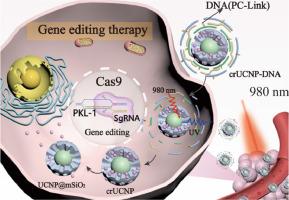
As a renovator in the field of gene editing, CRISPR-Cas9 has demonstrated immense potential for advancing next-generation gene therapy owing to its simplicity and precision. However, this potential faces significant challenges primarily stemming from the difficulty in efficiently delivering large-sized genome editing system (including Cas9 protein and sgRNA) into targeted cells and spatiotemporally controlling their activity in vitro and in vivo. Therefore, the development of CRISPR/Cas9 nanovectors that integrate high loading capacity, efficient encapsulation and spatiotemporally-controlled release is highly desirable. Herein, we have engineered a near-infrared (NIR) light-activated upconversion-DNA nanocapsule for the remote control of CRISPR-Cas9 genome editing. The light-responsive upconversion-DNA nanocapsules consist of macroporous silica (mSiO2) coated upconversion nanoparticles (UCNPs) and photocleavable o-nitrobenzyl-phosphate-modified DNA shells. The UCNPs act as a “nanotransducers” to convert NIR light (980 nm) into local ultraviolet light, thereby facilitating the cleavage of photosensitive DNA nanocapsules and enabling on-demand release of CRISPR-Cas9 encapsuled in the macroporous silica. Furthermore, by formulating a sgRNA targeted to a tumor gene (polo-like kinase-1, PLK-1), the CRISPR-Cas9 loaded UCNP-DNA nanocapsules (crUCNP-DNA nanocapsules) have effectively suppressed the proliferation of tumor cells through NIR light-activated gene editing both in vitro and in vivo. Overall, this UCNP-DNA nanocapsule holds tremendous potential for CRISPR-Cas9 delivery and remote-controlled gene editing in deep tissues, as well as the treatment of diverse diseases.
期刊介绍:
Chinese Chemical Letters (CCL) (ISSN 1001-8417) was founded in July 1990. The journal publishes preliminary accounts in the whole field of chemistry, including inorganic chemistry, organic chemistry, analytical chemistry, physical chemistry, polymer chemistry, applied chemistry, etc.Chinese Chemical Letters does not accept articles previously published or scheduled to be published. To verify originality, your article may be checked by the originality detection service CrossCheck.




 京公网安备 11010802042870号
京ICP备2023020795号-1
京公网安备 11010802042870号
京ICP备2023020795号-1

 分享
分享
 求助内容:
求助内容: 应助结果提醒方式:
 扫码关注我们
