Madhavan Vasudevan , Francesco Pilla , Aonghus McNabola
{"title":"Assessment of pollution removal mechanisms in steep-asymmetric city-type environments using wind deflectors","authors":"Madhavan Vasudevan , Francesco Pilla , Aonghus McNabola","doi":"10.1016/j.enbenv.2024.07.007","DOIUrl":null,"url":null,"abstract":"<div><div>Traffic emissions directly impact indoor air quality in near-road buildings. Adjustable wind deflectors on building roofs were previously shown to be effective in mitigating air pollution for ideal city-type environments. This was based on the hypothesis that wind deflectors promoted higher pollutant removal by reducing the dependence on turbulent fluctuations. However, the question of whether such a deflector system would work in a more complex city-type environment such as an asymmetric street canyon remains unanswered. In addition, the fundamental impact a deflector could impart on flow dynamics within street canyons in the context of pollution removal through differing mechanisms also requires further research. The current study seeks to answer both questions by introducing adjustable wind deflectors for step-up and step-down asymmetric canyons with two traffic flow directions. For the step-down canyon, the deflectors promoted CO reduction in building facades by 73.55% and 34.79% from leeward and windward walls under a Cross Road Pollution (CRP) source. A 16.57% reduction was achieved on side walls under a Side Road Pollution (SRP) source. However, apart from the 13.87% CO reduction across windward walls under the CRP source, the wind deflectors predominantly resulted in detrimental results for step-up canyons. The ratio of pollution exchange rate achieved by mean flow-induced fluxes and total pollution exchange rate (<span><math><mi>θ</mi></math></span>), Sherwood number is the ratio of convective and diffusive mass transfer (Sh) and average canyon concentration (<span><math><msub><mover><mrow><mi>C</mi></mrow><mo>‾</mo></mover><mrow><mi>c</mi><mi>a</mi><mi>n</mi><mi>y</mi><mi>o</mi><mi>n</mi></mrow></msub></math></span>) were used as indices to investigate pollution removal mechanisms. Although both <span><math><mrow><mi>S</mi><mi>h</mi><mspace></mspace><mi>v</mi><mo>/</mo><mi>s</mi><mspace></mspace><msub><mover><mrow><mi>C</mi></mrow><mo>‾</mo></mover><mrow><mi>c</mi><mi>a</mi><mi>n</mi><mi>y</mi><mi>o</mi><mi>n</mi></mrow></msub></mrow></math></span> and <span><math><mrow><mi>θ</mi><mspace></mspace><mi>v</mi><mo>/</mo><mi>s</mi><mspace></mspace><msub><mover><mrow><mi>C</mi></mrow><mo>‾</mo></mover><mrow><mi>c</mi><mi>a</mi><mi>n</mi><mi>y</mi><mi>o</mi><mi>n</mi></mrow></msub></mrow></math></span> relationships exhibited good inverse correlations when the deflector was positioned at different locations, the <span><math><mrow><mi>S</mi><mi>h</mi><mspace></mspace><mi>v</mi><mo>/</mo><mi>s</mi><mspace></mspace><msub><mover><mrow><mi>C</mi></mrow><mo>‾</mo></mover><mrow><mi>c</mi><mi>a</mi><mi>n</mi><mi>y</mi><mi>o</mi><mi>n</mi></mrow></msub></mrow></math></span> showed superior performance in distinguishing the scenarios where a deflector was involved and when not. This implies that the introduction of wind deflectors impacted more in effecting convective fluxes than fluctuations for pollution removal.</div></div>","PeriodicalId":33659,"journal":{"name":"Energy and Built Environment","volume":"7 1","pages":"Pages 128-149"},"PeriodicalIF":0.0000,"publicationDate":"2026-02-01","publicationTypes":"Journal Article","fieldsOfStudy":null,"isOpenAccess":false,"openAccessPdf":"","citationCount":"0","resultStr":null,"platform":"Semanticscholar","paperid":null,"PeriodicalName":"Energy and Built Environment","FirstCategoryId":"1085","ListUrlMain":"https://www.sciencedirect.com/science/article/pii/S2666123324000758","RegionNum":0,"RegionCategory":null,"ArticlePicture":[],"TitleCN":null,"AbstractTextCN":null,"PMCID":null,"EPubDate":"2024/7/25 0:00:00","PubModel":"Epub","JCR":"Q1","JCRName":"Engineering","Score":null,"Total":0}
引用次数: 0
Abstract
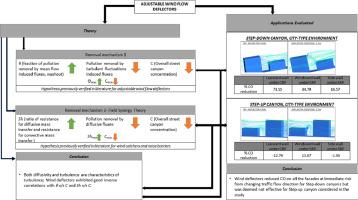
Traffic emissions directly impact indoor air quality in near-road buildings. Adjustable wind deflectors on building roofs were previously shown to be effective in mitigating air pollution for ideal city-type environments. This was based on the hypothesis that wind deflectors promoted higher pollutant removal by reducing the dependence on turbulent fluctuations. However, the question of whether such a deflector system would work in a more complex city-type environment such as an asymmetric street canyon remains unanswered. In addition, the fundamental impact a deflector could impart on flow dynamics within street canyons in the context of pollution removal through differing mechanisms also requires further research. The current study seeks to answer both questions by introducing adjustable wind deflectors for step-up and step-down asymmetric canyons with two traffic flow directions. For the step-down canyon, the deflectors promoted CO reduction in building facades by 73.55% and 34.79% from leeward and windward walls under a Cross Road Pollution (CRP) source. A 16.57% reduction was achieved on side walls under a Side Road Pollution (SRP) source. However, apart from the 13.87% CO reduction across windward walls under the CRP source, the wind deflectors predominantly resulted in detrimental results for step-up canyons. The ratio of pollution exchange rate achieved by mean flow-induced fluxes and total pollution exchange rate (), Sherwood number is the ratio of convective and diffusive mass transfer (Sh) and average canyon concentration () were used as indices to investigate pollution removal mechanisms. Although both and relationships exhibited good inverse correlations when the deflector was positioned at different locations, the showed superior performance in distinguishing the scenarios where a deflector was involved and when not. This implies that the introduction of wind deflectors impacted more in effecting convective fluxes than fluctuations for pollution removal.




 京公网安备 11010802042870号
京ICP备2023020795号-1
京公网安备 11010802042870号
京ICP备2023020795号-1

 分享
分享
 求助内容:
求助内容: 应助结果提醒方式:
 扫码关注我们
