Meng Gao , Jiqiu Yin , XianChao Jia , Ye Gao , Yang Jiao
{"title":"On-target site enriching fluorescent bioprobe for imaging of receptor tyrosine kinase in tumor","authors":"Meng Gao , Jiqiu Yin , XianChao Jia , Ye Gao , Yang Jiao","doi":"10.1016/j.cclet.2024.110297","DOIUrl":null,"url":null,"abstract":"<div><div>Receptor tyrosine kinases (RTKs) are biological enzymes expressed on cell membranes that can influence cellular signaling, and their overexpression in tumor cells makes them a key route to assess relevant tumor processes. The development of a delivery system that targets and accumulates in RTKs overexpressing-cells at the on-target site is significant for the monitoring of tumor progression and clinical applications through longer tumor site signaling response under low injection frequency. Here, a host-guest nanoscale fluorescent probe SNI@ZIF-8 based on zeolitic imidazolate framework-8 (ZIF-8) and a fluorescent probe SNI constructed from receptor tyrosine kinase inhibitor was proposed and prepared for targeting RTKs and enabling prolonged fluorescence imaging <em>in vivo</em>. The folded conformation of the probe SNI resulted in low background fluorescence, and the unfolding of the SNI conformation upon insertion of the RTKs active pocket showed significant fluorescence enhancement thus enabling real-time detection of RTKs. The host-guest system SNI@ZIF-8 could release guest molecules due to the presence of the enzyme, emphasizing the reporting of stable fluorescent signals over time under low injection frequency. SNI@ZIF-8 could provide a signal response on the cell membrane of RTKs overexpressing cells without interference from other substances, and provided a longer fluorescent signal than SNI at equivalent number of injections in tumor-bearing mice. The host-guest system SNI@ZIF-8, with its obvious tumor site enrichment ability and clear fluorescence imaging ability, could be successfully applied to the detection of RTKs on cell membranes in biological systems, providing a new strategy for determining the process of tumor development in clinical applications.</div></div>","PeriodicalId":10088,"journal":{"name":"Chinese Chemical Letters","volume":"36 6","pages":"Article 110297"},"PeriodicalIF":8.9000,"publicationDate":"2025-06-01","publicationTypes":"Journal Article","fieldsOfStudy":null,"isOpenAccess":false,"openAccessPdf":"","citationCount":"0","resultStr":null,"platform":"Semanticscholar","paperid":null,"PeriodicalName":"Chinese Chemical Letters","FirstCategoryId":"92","ListUrlMain":"https://www.sciencedirect.com/science/article/pii/S1001841724008167","RegionNum":1,"RegionCategory":"化学","ArticlePicture":[],"TitleCN":null,"AbstractTextCN":null,"PMCID":null,"EPubDate":"2024/7/26 0:00:00","PubModel":"Epub","JCR":"Q1","JCRName":"CHEMISTRY, MULTIDISCIPLINARY","Score":null,"Total":0}
引用次数: 0
Abstract
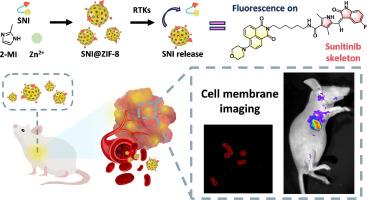
Receptor tyrosine kinases (RTKs) are biological enzymes expressed on cell membranes that can influence cellular signaling, and their overexpression in tumor cells makes them a key route to assess relevant tumor processes. The development of a delivery system that targets and accumulates in RTKs overexpressing-cells at the on-target site is significant for the monitoring of tumor progression and clinical applications through longer tumor site signaling response under low injection frequency. Here, a host-guest nanoscale fluorescent probe SNI@ZIF-8 based on zeolitic imidazolate framework-8 (ZIF-8) and a fluorescent probe SNI constructed from receptor tyrosine kinase inhibitor was proposed and prepared for targeting RTKs and enabling prolonged fluorescence imaging in vivo. The folded conformation of the probe SNI resulted in low background fluorescence, and the unfolding of the SNI conformation upon insertion of the RTKs active pocket showed significant fluorescence enhancement thus enabling real-time detection of RTKs. The host-guest system SNI@ZIF-8 could release guest molecules due to the presence of the enzyme, emphasizing the reporting of stable fluorescent signals over time under low injection frequency. SNI@ZIF-8 could provide a signal response on the cell membrane of RTKs overexpressing cells without interference from other substances, and provided a longer fluorescent signal than SNI at equivalent number of injections in tumor-bearing mice. The host-guest system SNI@ZIF-8, with its obvious tumor site enrichment ability and clear fluorescence imaging ability, could be successfully applied to the detection of RTKs on cell membranes in biological systems, providing a new strategy for determining the process of tumor development in clinical applications.
期刊介绍:
Chinese Chemical Letters (CCL) (ISSN 1001-8417) was founded in July 1990. The journal publishes preliminary accounts in the whole field of chemistry, including inorganic chemistry, organic chemistry, analytical chemistry, physical chemistry, polymer chemistry, applied chemistry, etc.Chinese Chemical Letters does not accept articles previously published or scheduled to be published. To verify originality, your article may be checked by the originality detection service CrossCheck.



 京公网安备 11010802042870号
京ICP备2023020795号-1
京公网安备 11010802042870号
京ICP备2023020795号-1

 分享
分享
 求助内容:
求助内容: 应助结果提醒方式:
 扫码关注我们
