Hao Zhang , Hao Liu , Ke Huang, Qingxiu Xia, Hongjie Xiong, Xiaohui Liu, Hui Jiang, Xuemei Wang
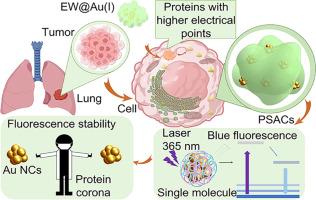
{"title":"Ionic exchange based intracellular self-assembly of pitaya-structured nanoparticles for tumor imaging","authors":"Hao Zhang , Hao Liu , Ke Huang, Qingxiu Xia, Hongjie Xiong, Xiaohui Liu, Hui Jiang, Xuemei Wang","doi":"10.1016/j.cclet.2024.110281","DOIUrl":null,"url":null,"abstract":"<div><div>The potential of metal nanoclusters in biomedical applications is limited due to aggregation-caused quenching (ACQ). In this study, an <em>in situ</em> self-assembled pitaya structure was proposed to obtain stable fluorescence emission through protein coronas-controlled distance between gold nanoclusters (Au NCs). Interestingly, the gold ion complexes coated with proteins of low isoelectric point (pI) nucleate at the secondary structure of proteins with high pI through ionic exchange within cells, generating fluorescent Au NCs. It is worth noting that due to the steric hindrance formed by the protein coronas on the surface of Au NCs, the distance between Au NCs can be controlled, avoiding electron transfer caused by close proximity of Au NCs and inhibiting fluorescence ACQ. This strategy can achieve fluorescence imaging of clinical tissue samples without observable side effects. Therefore, this study proposes a distance-controllable self-assembled pitaya structure to provide a new approach for Au NCs with stable fluorescence.</div></div>","PeriodicalId":10088,"journal":{"name":"Chinese Chemical Letters","volume":"36 6","pages":"Article 110281"},"PeriodicalIF":8.9000,"publicationDate":"2024-07-18","publicationTypes":"Journal Article","fieldsOfStudy":null,"isOpenAccess":false,"openAccessPdf":"","citationCount":"0","resultStr":null,"platform":"Semanticscholar","paperid":null,"PeriodicalName":"Chinese Chemical Letters","FirstCategoryId":"92","ListUrlMain":"https://www.sciencedirect.com/science/article/pii/S1001841724008003","RegionNum":1,"RegionCategory":"化学","ArticlePicture":[],"TitleCN":null,"AbstractTextCN":null,"PMCID":null,"EPubDate":"","PubModel":"","JCR":"Q1","JCRName":"CHEMISTRY, MULTIDISCIPLINARY","Score":null,"Total":0}
引用次数: 0
Abstract
The potential of metal nanoclusters in biomedical applications is limited due to aggregation-caused quenching (ACQ). In this study, an in situ self-assembled pitaya structure was proposed to obtain stable fluorescence emission through protein coronas-controlled distance between gold nanoclusters (Au NCs). Interestingly, the gold ion complexes coated with proteins of low isoelectric point (pI) nucleate at the secondary structure of proteins with high pI through ionic exchange within cells, generating fluorescent Au NCs. It is worth noting that due to the steric hindrance formed by the protein coronas on the surface of Au NCs, the distance between Au NCs can be controlled, avoiding electron transfer caused by close proximity of Au NCs and inhibiting fluorescence ACQ. This strategy can achieve fluorescence imaging of clinical tissue samples without observable side effects. Therefore, this study proposes a distance-controllable self-assembled pitaya structure to provide a new approach for Au NCs with stable fluorescence.
期刊介绍:
Chinese Chemical Letters (CCL) (ISSN 1001-8417) was founded in July 1990. The journal publishes preliminary accounts in the whole field of chemistry, including inorganic chemistry, organic chemistry, analytical chemistry, physical chemistry, polymer chemistry, applied chemistry, etc.Chinese Chemical Letters does not accept articles previously published or scheduled to be published. To verify originality, your article may be checked by the originality detection service CrossCheck.



 京公网安备 11010802042870号
京ICP备2023020795号-1
京公网安备 11010802042870号
京ICP备2023020795号-1

 分享
分享
 求助内容:
求助内容: 应助结果提醒方式:
 扫码关注我们
