Yubang Liu , Jiaxin Lin , Huayu Liang, Yinwu Li, Zhuofeng Ke
{"title":"Computational insights into three-centre four-electron bridging hydride bond in boryl type PBP-M dihydride complexes✰","authors":"Yubang Liu , Jiaxin Lin , Huayu Liang, Yinwu Li, Zhuofeng Ke","doi":"10.1016/j.cclet.2024.110291","DOIUrl":null,"url":null,"abstract":"<div><div>Metal hydrides serve as crucial intermediates in many chemical processes, facilitating the utilization of hydrogen resources. Traditionally, three-centre metal hydrides have been viewed as less reactive due to their multi-stabilization effects. However, recent discoveries show the \"three-centre four-electron\" (<strong>3c-4e</strong>) bridging hydride bond exhibits significant activity in boryl transition metal systems. This research employs computational techniques to explore the factors that influence the formation of the <strong>3c-4e</strong> bridging hydride, focusing on boryl 3d non-noble transition metals ranging from chromium (Cr) to nickel (Ni). By analyzing bond distances and bond orders, the study sheds light on the electronic and structural characteristics of the B-H-M bridging hydride. It reveals a clear link between the metal centre's redox properties and the emergence of bridging hydrides. Specifically, metal centres like Cr and Co, which have lower oxidation states and electronegativity, are more inclined to form active <strong>3c-4e</strong> bridging hydrides. These insights, derived from computational analyses, offer valuable guidelines for the development of active <strong>3c-4e</strong> bridging metal hydrides, thereby contributing to the advancement of new hydrogen transformation catalysts.</div></div>","PeriodicalId":10088,"journal":{"name":"Chinese Chemical Letters","volume":"36 5","pages":"Article 110291"},"PeriodicalIF":8.9000,"publicationDate":"2025-05-01","publicationTypes":"Journal Article","fieldsOfStudy":null,"isOpenAccess":false,"openAccessPdf":"","citationCount":"0","resultStr":null,"platform":"Semanticscholar","paperid":null,"PeriodicalName":"Chinese Chemical Letters","FirstCategoryId":"92","ListUrlMain":"https://www.sciencedirect.com/science/article/pii/S1001841724008106","RegionNum":1,"RegionCategory":"化学","ArticlePicture":[],"TitleCN":null,"AbstractTextCN":null,"PMCID":null,"EPubDate":"2024/7/23 0:00:00","PubModel":"Epub","JCR":"Q1","JCRName":"CHEMISTRY, MULTIDISCIPLINARY","Score":null,"Total":0}
引用次数: 0
Abstract
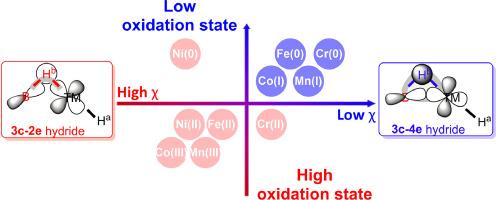
Metal hydrides serve as crucial intermediates in many chemical processes, facilitating the utilization of hydrogen resources. Traditionally, three-centre metal hydrides have been viewed as less reactive due to their multi-stabilization effects. However, recent discoveries show the "three-centre four-electron" (3c-4e) bridging hydride bond exhibits significant activity in boryl transition metal systems. This research employs computational techniques to explore the factors that influence the formation of the 3c-4e bridging hydride, focusing on boryl 3d non-noble transition metals ranging from chromium (Cr) to nickel (Ni). By analyzing bond distances and bond orders, the study sheds light on the electronic and structural characteristics of the B-H-M bridging hydride. It reveals a clear link between the metal centre's redox properties and the emergence of bridging hydrides. Specifically, metal centres like Cr and Co, which have lower oxidation states and electronegativity, are more inclined to form active 3c-4e bridging hydrides. These insights, derived from computational analyses, offer valuable guidelines for the development of active 3c-4e bridging metal hydrides, thereby contributing to the advancement of new hydrogen transformation catalysts.
期刊介绍:
Chinese Chemical Letters (CCL) (ISSN 1001-8417) was founded in July 1990. The journal publishes preliminary accounts in the whole field of chemistry, including inorganic chemistry, organic chemistry, analytical chemistry, physical chemistry, polymer chemistry, applied chemistry, etc.Chinese Chemical Letters does not accept articles previously published or scheduled to be published. To verify originality, your article may be checked by the originality detection service CrossCheck.



 京公网安备 11010802042870号
京ICP备2023020795号-1
京公网安备 11010802042870号
京ICP备2023020795号-1

 分享
分享
 求助内容:
求助内容: 应助结果提醒方式:
 扫码关注我们
