A near-infrared naphthalocyanine photosensitizer with superior light absorption and renal clearance for type-I photodynamic and photothermal combination therapy
Li Li, Jiale Wen, Xiaojun Zhang, Shuwen Fu, Zixuan Chen, Kai Huang, Luyue Fang, Tinghe Zhao, Peipei Zhang, Xingshu Li
{"title":"A near-infrared naphthalocyanine photosensitizer with superior light absorption and renal clearance for type-I photodynamic and photothermal combination therapy","authors":"Li Li, Jiale Wen, Xiaojun Zhang, Shuwen Fu, Zixuan Chen, Kai Huang, Luyue Fang, Tinghe Zhao, Peipei Zhang, Xingshu Li","doi":"10.1016/j.cclet.2024.110290","DOIUrl":null,"url":null,"abstract":"<div><div>Currently, it is still a challenge to develop an organic photosensitizer (PS) with outstanding near-infrared absorption, low O<sub>2</sub> dependence, precise tumor targeting and rapid clearance through the kidney to improve the overall outcome of phototherapy. In this study, we have designed an organic PS (NcPB) with an excellent near-infrared light absorption through a refined molecular strategy. Meanwhile, NcPB was assembled into nanoparticles with different sizes (NanoNcPB-1 and NanoNcPB-0) by a supramolecular modulation strategy. As the results, the nanoparticle with an ultra-small size (NanoNcPB-1) generated a large number of superoxide anion (O<sub>2</sub><sup>•−</sup>) in a low-O<sub>2</sub>-dependent manner and release plenty of heat. Furthermore, the results of <em>in vivo</em> experiments demonstrated that NanoNcPB-1 actively accumulated in tumor tissues and showed a 92 % tumor inhibition after photodynamic and photothermal combination therapy. More importantly, NanoNcPB-1 could be rapidly cleared from the body of mice <em>via</em> the renal pathway, which alleviates potential side effects of prolonged retention of PS in the circulation.</div></div>","PeriodicalId":10088,"journal":{"name":"Chinese Chemical Letters","volume":"36 6","pages":"Article 110290"},"PeriodicalIF":8.9000,"publicationDate":"2025-06-01","publicationTypes":"Journal Article","fieldsOfStudy":null,"isOpenAccess":false,"openAccessPdf":"","citationCount":"0","resultStr":null,"platform":"Semanticscholar","paperid":null,"PeriodicalName":"Chinese Chemical Letters","FirstCategoryId":"92","ListUrlMain":"https://www.sciencedirect.com/science/article/pii/S100184172400809X","RegionNum":1,"RegionCategory":"化学","ArticlePicture":[],"TitleCN":null,"AbstractTextCN":null,"PMCID":null,"EPubDate":"2024/7/23 0:00:00","PubModel":"Epub","JCR":"Q1","JCRName":"CHEMISTRY, MULTIDISCIPLINARY","Score":null,"Total":0}
引用次数: 0
Abstract
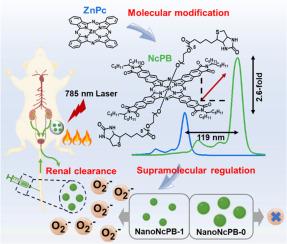
Currently, it is still a challenge to develop an organic photosensitizer (PS) with outstanding near-infrared absorption, low O2 dependence, precise tumor targeting and rapid clearance through the kidney to improve the overall outcome of phototherapy. In this study, we have designed an organic PS (NcPB) with an excellent near-infrared light absorption through a refined molecular strategy. Meanwhile, NcPB was assembled into nanoparticles with different sizes (NanoNcPB-1 and NanoNcPB-0) by a supramolecular modulation strategy. As the results, the nanoparticle with an ultra-small size (NanoNcPB-1) generated a large number of superoxide anion (O2•−) in a low-O2-dependent manner and release plenty of heat. Furthermore, the results of in vivo experiments demonstrated that NanoNcPB-1 actively accumulated in tumor tissues and showed a 92 % tumor inhibition after photodynamic and photothermal combination therapy. More importantly, NanoNcPB-1 could be rapidly cleared from the body of mice via the renal pathway, which alleviates potential side effects of prolonged retention of PS in the circulation.
期刊介绍:
Chinese Chemical Letters (CCL) (ISSN 1001-8417) was founded in July 1990. The journal publishes preliminary accounts in the whole field of chemistry, including inorganic chemistry, organic chemistry, analytical chemistry, physical chemistry, polymer chemistry, applied chemistry, etc.Chinese Chemical Letters does not accept articles previously published or scheduled to be published. To verify originality, your article may be checked by the originality detection service CrossCheck.



 京公网安备 11010802042870号
京ICP备2023020795号-1
京公网安备 11010802042870号
京ICP备2023020795号-1

 分享
分享
 求助内容:
求助内容: 应助结果提醒方式:
 扫码关注我们
