Jiajun Feng, Xuming Dan, Yangkai Cui, Yi Gong, Minyue Peng, Yupeng Sang, Pär K Ingvarsson, Jing Wang
{"title":"Integrating evolutionary genomics of forest trees to inform future tree breeding amid rapid climate change.","authors":"Jiajun Feng, Xuming Dan, Yangkai Cui, Yi Gong, Minyue Peng, Yupeng Sang, Pär K Ingvarsson, Jing Wang","doi":"10.1016/j.xplc.2024.101044","DOIUrl":null,"url":null,"abstract":"<p><p>Global climate change is leading to rapid and drastic shifts in environmental conditions, posing threats to biodiversity and nearly all life forms worldwide. Forest trees serve as foundational components of terrestrial ecosystems and play a crucial and leading role in combating and mitigating the adverse effects of extreme climate events, despite their own vulnerability to these threats. Therefore, understanding and monitoring how natural forests respond to rapid climate change is a key priority for biodiversity conservation. Recent progress in evolutionary genomics, driven primarily by cutting-edge multi-omics technologies, offers powerful new tools to address several key issues. These include precise delineation of species and evolutionary units, inference of past evolutionary histories and demographic fluctuations, identification of environmentally adaptive variants, and measurement of genetic load levels. As the urgency to deal with more extreme environmental stresses grows, understanding the genomics of evolutionary history, local adaptation, future responses to climate change, and conservation and restoration of natural forest trees will be critical for research at the nexus of global change, population genomics, and conservation biology. In this review, we explore the application of evolutionary genomics to assess the effects of global climate change using multi-omics approaches and discuss the outlook for breeding of climate-adapted trees.</p>","PeriodicalId":52373,"journal":{"name":"Plant Communications","volume":" ","pages":"101044"},"PeriodicalIF":11.6000,"publicationDate":"2024-10-14","publicationTypes":"Journal Article","fieldsOfStudy":null,"isOpenAccess":false,"openAccessPdf":"https://www.ncbi.nlm.nih.gov/pmc/articles/PMC11573912/pdf/","citationCount":"0","resultStr":null,"platform":"Semanticscholar","paperid":null,"PeriodicalName":"Plant Communications","FirstCategoryId":"99","ListUrlMain":"https://doi.org/10.1016/j.xplc.2024.101044","RegionNum":1,"RegionCategory":"生物学","ArticlePicture":[],"TitleCN":null,"AbstractTextCN":null,"PMCID":null,"EPubDate":"2024/8/7 0:00:00","PubModel":"Epub","JCR":"Q1","JCRName":"BIOCHEMISTRY & MOLECULAR BIOLOGY","Score":null,"Total":0}
引用次数: 0
Abstract
Global climate change is leading to rapid and drastic shifts in environmental conditions, posing threats to biodiversity and nearly all life forms worldwide. Forest trees serve as foundational components of terrestrial ecosystems and play a crucial and leading role in combating and mitigating the adverse effects of extreme climate events, despite their own vulnerability to these threats. Therefore, understanding and monitoring how natural forests respond to rapid climate change is a key priority for biodiversity conservation. Recent progress in evolutionary genomics, driven primarily by cutting-edge multi-omics technologies, offers powerful new tools to address several key issues. These include precise delineation of species and evolutionary units, inference of past evolutionary histories and demographic fluctuations, identification of environmentally adaptive variants, and measurement of genetic load levels. As the urgency to deal with more extreme environmental stresses grows, understanding the genomics of evolutionary history, local adaptation, future responses to climate change, and conservation and restoration of natural forest trees will be critical for research at the nexus of global change, population genomics, and conservation biology. In this review, we explore the application of evolutionary genomics to assess the effects of global climate change using multi-omics approaches and discuss the outlook for breeding of climate-adapted trees.
期刊介绍:
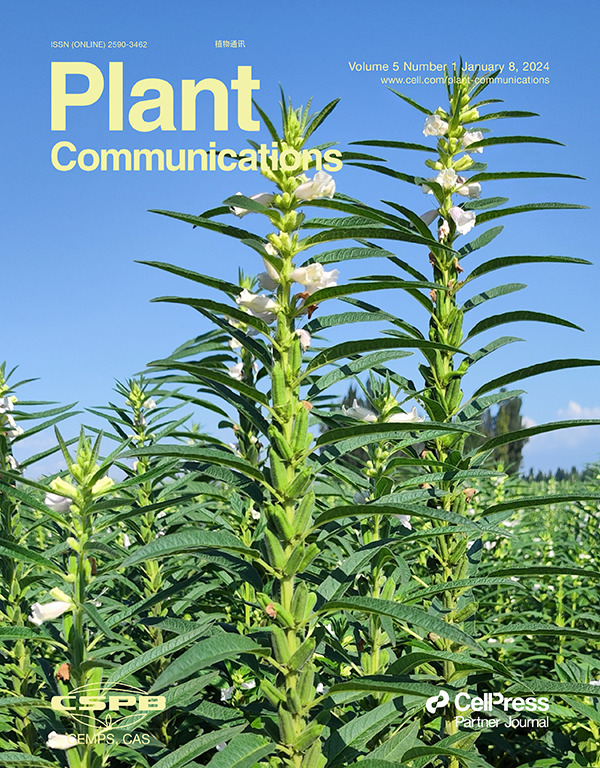
Plant Communications is an open access publishing platform that supports the global plant science community. It publishes original research, review articles, technical advances, and research resources in various areas of plant sciences. The scope of topics includes evolution, ecology, physiology, biochemistry, development, reproduction, metabolism, molecular and cellular biology, genetics, genomics, environmental interactions, biotechnology, breeding of higher and lower plants, and their interactions with other organisms. The goal of Plant Communications is to provide a high-quality platform for the dissemination of plant science research.



 京公网安备 11010802042870号
京ICP备2023020795号-1
京公网安备 11010802042870号
京ICP备2023020795号-1

 分享
分享
 求助内容:
求助内容: 应助结果提醒方式:
 扫码关注我们
