Deng Zhang, Zili Chen, Junfei Nie, Yanwu Chu and Lianbo Guo
{"title":"A novel spectral standardization method capable of eliminating the influence of plasma morphology to improve LIBS performance","authors":"Deng Zhang, Zili Chen, Junfei Nie, Yanwu Chu and Lianbo Guo","doi":"10.1039/D4JA00203B","DOIUrl":null,"url":null,"abstract":"<p >The poor spectral stability of laser-induced breakdown spectroscopy (LIBS) seriously affects its analytical performance, which is a key obstacle to its further development. To overcome this challenge, an improved spectral standardization method based on plasma image-spectrum fusion (ISS-PISF) was proposed in this study. This method, for the first time, considers and quantifies the influence of plasma morphology on spectral intensity based on the line-integrated intensity formula of LIBS spectra. It recognizes that the spectral fluctuations mainly stem from variations in total number density, plasma temperature, electron number density, and plasma morphology. Therefore, ISS-PISF innovatively utilizes easily accessible features from plasma images and spectra to eliminate the influence of these four plasma parameters, thereby improving the spectral stability and analytical performance of LIBS. To validate the effectiveness of this method, the spectra of aluminum alloy samples obtained under complex detection conditions simulated by varying laser energy and defocusing amount were analyzed. After correction by ISS-PISF, the <em>R</em><small><sup>2</sup></small> for Mg I 516.73 nm, Mn II 294.92 nm, and Si I 288.16 nm improved to 0.990, 0.976, and 0.961, and the average RMSE of the validation set decreased by 46.154%, while the average STD of the validation set decreased by 37.405%. These experimental results indicate that this study provides a simple, effective, and physically supported spectral standardization method, which contributes to the further promotion and application of LIBS.</p>","PeriodicalId":81,"journal":{"name":"Journal of Analytical Atomic Spectrometry","volume":" 10","pages":" 2402-2408"},"PeriodicalIF":3.1000,"publicationDate":"2024-08-02","publicationTypes":"Journal Article","fieldsOfStudy":null,"isOpenAccess":false,"openAccessPdf":"","citationCount":"0","resultStr":null,"platform":"Semanticscholar","paperid":null,"PeriodicalName":"Journal of Analytical Atomic Spectrometry","FirstCategoryId":"92","ListUrlMain":"https://pubs.rsc.org/en/content/articlelanding/2024/ja/d4ja00203b","RegionNum":2,"RegionCategory":"化学","ArticlePicture":[],"TitleCN":null,"AbstractTextCN":null,"PMCID":null,"EPubDate":"","PubModel":"","JCR":"Q2","JCRName":"CHEMISTRY, ANALYTICAL","Score":null,"Total":0}
引用次数: 0
Abstract
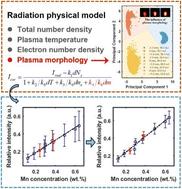
The poor spectral stability of laser-induced breakdown spectroscopy (LIBS) seriously affects its analytical performance, which is a key obstacle to its further development. To overcome this challenge, an improved spectral standardization method based on plasma image-spectrum fusion (ISS-PISF) was proposed in this study. This method, for the first time, considers and quantifies the influence of plasma morphology on spectral intensity based on the line-integrated intensity formula of LIBS spectra. It recognizes that the spectral fluctuations mainly stem from variations in total number density, plasma temperature, electron number density, and plasma morphology. Therefore, ISS-PISF innovatively utilizes easily accessible features from plasma images and spectra to eliminate the influence of these four plasma parameters, thereby improving the spectral stability and analytical performance of LIBS. To validate the effectiveness of this method, the spectra of aluminum alloy samples obtained under complex detection conditions simulated by varying laser energy and defocusing amount were analyzed. After correction by ISS-PISF, the R2 for Mg I 516.73 nm, Mn II 294.92 nm, and Si I 288.16 nm improved to 0.990, 0.976, and 0.961, and the average RMSE of the validation set decreased by 46.154%, while the average STD of the validation set decreased by 37.405%. These experimental results indicate that this study provides a simple, effective, and physically supported spectral standardization method, which contributes to the further promotion and application of LIBS.



 京公网安备 11010802042870号
京ICP备2023020795号-1
京公网安备 11010802042870号
京ICP备2023020795号-1

 分享
分享
 求助内容:
求助内容: 应助结果提醒方式:
 扫码关注我们
