{"title":"Phytic acid derivatized lignin as a thermally stable and flame retardant material†","authors":"Saba Khodavandegar , Pedram Fatehi","doi":"10.1039/d4gc03169e","DOIUrl":null,"url":null,"abstract":"<div><div>Phosphorus-containing flame retardants have attracted attention due to their outstanding flame retardancy, enhanced thermal stability, and limited toxic smoke emission. Bio-based phosphorus-containing flame retardants could be excellent options to impart environmental benefits, renewability, and sustainability to these materials. Lignin is an underutilized but abundant and sustainable material that can be used to serve this purpose. In the present work, a lignin-derived flame retardant was produced following the facile solvent-free polycondensation reaction of kraft lignin (KL) and phytic acid (PHA) at a low temperature in an aqueous system. The optimized conditions for this reaction were 1/0.4 mol/mol KL/PHA, pH 11, 20 °C, and 20 min. By utilizing advanced NMR (H, P, and HSQC), XPS, and FTIR techniques, the covalent bonding of the phosphorus of PHA with the oxygen of aliphatic and aromatic hydroxyl groups of KL was confirmed. C–P–O and P–O–P bonds provided high decomposition temperature (<em>T</em><sub>max</sub>), high glass transition temperature (<em>T</em><sub>g</sub>), and char formation in the product. The presence of phosphorus atoms was observed on the combusted material by EDS mapping and EDX, illustrating the increase in the intensity of this element after combustion at 800 °C. The results of this work provided a new approach for preparing a fully bio-based flame-retardant with limited smoke density (<em>i.e.</em>, a decrease from 34% for KL to 17.7% for modified KL) and a higher limiting oxygen index (<em>i.e.</em>, an increase from 21.8% for KL to 26% for modified KL) following a green chemistry concept.</div></div>","PeriodicalId":78,"journal":{"name":"Green Chemistry","volume":"26 19","pages":"Pages 10070-10086"},"PeriodicalIF":9.2000,"publicationDate":"2024-09-30","publicationTypes":"Journal Article","fieldsOfStudy":null,"isOpenAccess":false,"openAccessPdf":"","citationCount":"0","resultStr":null,"platform":"Semanticscholar","paperid":null,"PeriodicalName":"Green Chemistry","FirstCategoryId":"92","ListUrlMain":"https://www.sciencedirect.com/org/science/article/pii/S1463926224007830","RegionNum":1,"RegionCategory":"化学","ArticlePicture":[],"TitleCN":null,"AbstractTextCN":null,"PMCID":null,"EPubDate":"2024/7/29 0:00:00","PubModel":"Epub","JCR":"Q1","JCRName":"CHEMISTRY, MULTIDISCIPLINARY","Score":null,"Total":0}
引用次数: 0
Abstract
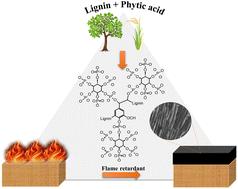
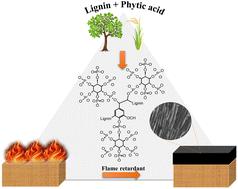
Phosphorus-containing flame retardants have attracted attention due to their outstanding flame retardancy, enhanced thermal stability, and limited toxic smoke emission. Bio-based phosphorus-containing flame retardants could be excellent options to impart environmental benefits, renewability, and sustainability to these materials. Lignin is an underutilized but abundant and sustainable material that can be used to serve this purpose. In the present work, a lignin-derived flame retardant was produced following the facile solvent-free polycondensation reaction of kraft lignin (KL) and phytic acid (PHA) at a low temperature in an aqueous system. The optimized conditions for this reaction were 1/0.4 mol/mol KL/PHA, pH 11, 20 °C, and 20 min. By utilizing advanced NMR (H, P, and HSQC), XPS, and FTIR techniques, the covalent bonding of the phosphorus of PHA with the oxygen of aliphatic and aromatic hydroxyl groups of KL was confirmed. C–P–O and P–O–P bonds provided high decomposition temperature (Tmax), high glass transition temperature (Tg), and char formation in the product. The presence of phosphorus atoms was observed on the combusted material by EDS mapping and EDX, illustrating the increase in the intensity of this element after combustion at 800 °C. The results of this work provided a new approach for preparing a fully bio-based flame-retardant with limited smoke density (i.e., a decrease from 34% for KL to 17.7% for modified KL) and a higher limiting oxygen index (i.e., an increase from 21.8% for KL to 26% for modified KL) following a green chemistry concept.
期刊介绍:
Green Chemistry is a journal that provides a unique forum for the publication of innovative research on the development of alternative green and sustainable technologies. The scope of Green Chemistry is based on the definition proposed by Anastas and Warner (Green Chemistry: Theory and Practice, P T Anastas and J C Warner, Oxford University Press, Oxford, 1998), which defines green chemistry as the utilisation of a set of principles that reduces or eliminates the use or generation of hazardous substances in the design, manufacture and application of chemical products. Green Chemistry aims to reduce the environmental impact of the chemical enterprise by developing a technology base that is inherently non-toxic to living things and the environment. The journal welcomes submissions on all aspects of research relating to this endeavor and publishes original and significant cutting-edge research that is likely to be of wide general appeal. For a work to be published, it must present a significant advance in green chemistry, including a comparison with existing methods and a demonstration of advantages over those methods.



 京公网安备 11010802042870号
京ICP备2023020795号-1
京公网安备 11010802042870号
京ICP备2023020795号-1

 分享
分享
 求助内容:
求助内容: 应助结果提醒方式:
 扫码关注我们
