Jun Cao PhD, Iain K. Ball PhD, Elizabeth Summerell PhD, Peter Humburg PhD, Tom Denson PhD, Caroline D. Rae PhD
{"title":"Effect of Ethanol on Brain Electrical Tissue Conductivity in Social Drinkers","authors":"Jun Cao PhD, Iain K. Ball PhD, Elizabeth Summerell PhD, Peter Humburg PhD, Tom Denson PhD, Caroline D. Rae PhD","doi":"10.1002/jmri.29548","DOIUrl":null,"url":null,"abstract":"<div>\n \n <section>\n \n <h3> Background</h3>\n \n <p>How the biophysics of electrical conductivity measures relate to brain activity is poorly understood. The sedative, ethanol, reduces metabolic activity but its impact on brain electrical conductivity is unknown.</p>\n </section>\n \n <section>\n \n <h3> Purpose</h3>\n \n <p>To investigate whether ethanol reduces brain electrical tissue conductivity.</p>\n </section>\n \n <section>\n \n <h3> Study Type</h3>\n \n <p>Prospective.</p>\n </section>\n \n <section>\n \n <h3> Subjects</h3>\n \n <p>Fifty-two healthy volunteers (aged 18–37 years, 22 females, 30 males).</p>\n </section>\n \n <section>\n \n <h3> Field Strength/Sequence</h3>\n \n <p>3 T, T1-weighted, multi-shot, turbo-field echo (TFE); 3D balanced fast-field echo (bFFE).</p>\n </section>\n \n <section>\n \n <h3> Assessment</h3>\n \n <p>Brain gray and white matter tissue conductivity measured with phase-based magnetic resonance electrical properties tomography (MREPT) compared before and 20 minutes after ethanol consumption (0.7 g/kg body weight). Differential conductivity whole brain maps were generated for three subgroups: those with strong (<span></span><math>\n <mrow>\n <mo>∆</mo>\n <msub>\n <mi>σ</mi>\n <mi>max</mi>\n </msub>\n </mrow></math> > 0.1 S/m; N = 33), weak (0.02 S/m ≤ <span></span><math>\n <mrow>\n <mo>∆</mo>\n <msub>\n <mi>σ</mi>\n <mi>max</mi>\n </msub>\n </mrow></math> ≤ 0.1 S/m; N = 9) conductivity decrease, and no significant response (<span></span><math>\n <mrow>\n <mo>∆</mo>\n <msub>\n <mi>σ</mi>\n <mi>max</mi>\n </msub>\n </mrow></math> < 0.02 S/m, N = 10). Maps were compared in the strong response group where breath alcohol rose between scans, vs. those where it fell.</p>\n </section>\n \n <section>\n \n <h3> Statistical Tests</h3>\n \n <p>Average breath alcohol levels were compared to the differential conductivity maps using linear regression. T-maps were generated (threshold <i>P</i> < 0.05 and <i>P</i> < 0.001; minimum cluster 48 mm<sup>3</sup>). Differential conductivity maps were compared with ANOVA.</p>\n </section>\n \n <section>\n \n <h3> Results</h3>\n \n <p>Whole-group analysis showed decreased conductivity that did not survive statistical thresholding. Strong responders (N = 33) showed a consistent pattern of significantly decreased conductivity (<span></span><math>\n <mrow>\n <mo>∆</mo>\n <msub>\n <mi>σ</mi>\n <mi>max</mi>\n </msub>\n </mrow></math> > 0.1 S/m) in frontal/occipital and cerebellar white matter. The weak response group (N = 9) showed a similar pattern of conductivity decrease (0.02 S/m ≤ <span></span><math>\n <mrow>\n <mo>∆</mo>\n <msub>\n <mi>σ</mi>\n <mi>max</mi>\n </msub>\n </mrow></math> ≤ 0.1 S/m). There was no significant relationship with breath alcohol levels, alcohol use, age, ethnicity, or sex. The strong responders' regional response was different between ascending (N = 12) or descending (N = 20) alcohol during the scan.</p>\n </section>\n \n <section>\n \n <h3> Data Conclusion</h3>\n \n <p>Ethanol reduces brain tissue conductivity in a participant-dependent and spatially dependent fashion.</p>\n </section>\n \n <section>\n \n <h3> Evidence Level</h3>\n \n <p>1</p>\n </section>\n \n <section>\n \n <h3> Technical Efficacy</h3>\n \n <p>Stage 2</p>\n </section>\n </div>","PeriodicalId":16140,"journal":{"name":"Journal of Magnetic Resonance Imaging","volume":"61 3","pages":"1181-1187"},"PeriodicalIF":3.5000,"publicationDate":"2024-08-06","publicationTypes":"Journal Article","fieldsOfStudy":null,"isOpenAccess":false,"openAccessPdf":"https://onlinelibrary.wiley.com/doi/epdf/10.1002/jmri.29548","citationCount":"0","resultStr":null,"platform":"Semanticscholar","paperid":null,"PeriodicalName":"Journal of Magnetic Resonance Imaging","FirstCategoryId":"3","ListUrlMain":"https://onlinelibrary.wiley.com/doi/10.1002/jmri.29548","RegionNum":2,"RegionCategory":"医学","ArticlePicture":[],"TitleCN":null,"AbstractTextCN":null,"PMCID":null,"EPubDate":"","PubModel":"","JCR":"Q1","JCRName":"RADIOLOGY, NUCLEAR MEDICINE & MEDICAL IMAGING","Score":null,"Total":0}
引用次数: 0
Abstract
Background
How the biophysics of electrical conductivity measures relate to brain activity is poorly understood. The sedative, ethanol, reduces metabolic activity but its impact on brain electrical conductivity is unknown.
Purpose
To investigate whether ethanol reduces brain electrical tissue conductivity.
Study Type
Prospective.
Subjects
Fifty-two healthy volunteers (aged 18–37 years, 22 females, 30 males).
Brain gray and white matter tissue conductivity measured with phase-based magnetic resonance electrical properties tomography (MREPT) compared before and 20 minutes after ethanol consumption (0.7 g/kg body weight). Differential conductivity whole brain maps were generated for three subgroups: those with strong ( > 0.1 S/m; N = 33), weak (0.02 S/m ≤ ≤ 0.1 S/m; N = 9) conductivity decrease, and no significant response ( < 0.02 S/m, N = 10). Maps were compared in the strong response group where breath alcohol rose between scans, vs. those where it fell.
Statistical Tests
Average breath alcohol levels were compared to the differential conductivity maps using linear regression. T-maps were generated (threshold P < 0.05 and P < 0.001; minimum cluster 48 mm3). Differential conductivity maps were compared with ANOVA.
Results
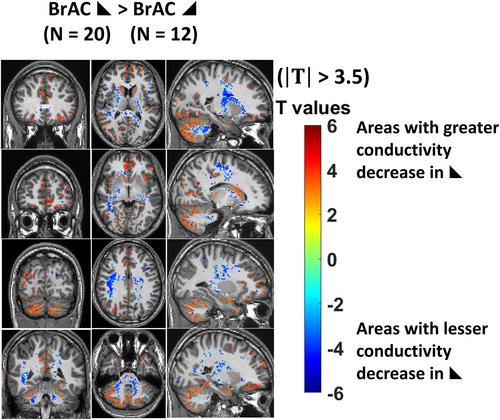
Whole-group analysis showed decreased conductivity that did not survive statistical thresholding. Strong responders (N = 33) showed a consistent pattern of significantly decreased conductivity ( > 0.1 S/m) in frontal/occipital and cerebellar white matter. The weak response group (N = 9) showed a similar pattern of conductivity decrease (0.02 S/m ≤ ≤ 0.1 S/m). There was no significant relationship with breath alcohol levels, alcohol use, age, ethnicity, or sex. The strong responders' regional response was different between ascending (N = 12) or descending (N = 20) alcohol during the scan.
Data Conclusion
Ethanol reduces brain tissue conductivity in a participant-dependent and spatially dependent fashion.
期刊介绍:
The Journal of Magnetic Resonance Imaging (JMRI) is an international journal devoted to the timely publication of basic and clinical research, educational and review articles, and other information related to the diagnostic applications of magnetic resonance.



 京公网安备 11010802042870号
京ICP备2023020795号-1
京公网安备 11010802042870号
京ICP备2023020795号-1

 分享
分享
 求助内容:
求助内容: 应助结果提醒方式:
 扫码关注我们
