{"title":"The functions of leg muscles, structures and mechanisms in running.","authors":"James R Usherwood","doi":"10.1098/rsbl.2024.0260","DOIUrl":null,"url":null,"abstract":"<p><p>The actions of the major human leg muscles are well established; however, the functions of these muscle actions during steady running remain unclear. Here, leg structures and mechanisms are considered in terms of their functions in meeting the task of a vehicle acting as an effective machine, supporting body weight during translation with low mechanical work demand and in supplying mechanical work economically. Legs are modelled as a sequence of linkages that predict muscle actions and reveal the varying muscle functions within the integrated leg. Work avoidance is achieved with isometric muscles and linkages that promote a sliding of the hip over the ground contact, resulting in an approximately horizontal path of the centre of mass. Economical work supply requires, for muscle with constrained power, shortening over the entire stance duration; this function is achieved by the hamstrings without disrupting the linkages resulting in work avoidance. In late stance, the two functions occur through coactivation of antagonistic muscles, providing one answer to Lombard's paradox. Quadriceps and hamstring tensions result in opposing moments about both hip and knee joints, but by doing so perform the independent yet complementary roles of work avoidance during translating weight support and economical work supply.</p>","PeriodicalId":9005,"journal":{"name":"Biology Letters","volume":"20 8","pages":"20240260"},"PeriodicalIF":3.0000,"publicationDate":"2024-08-01","publicationTypes":"Journal Article","fieldsOfStudy":null,"isOpenAccess":false,"openAccessPdf":"https://www.ncbi.nlm.nih.gov/pmc/articles/PMC11305130/pdf/","citationCount":"0","resultStr":null,"platform":"Semanticscholar","paperid":null,"PeriodicalName":"Biology Letters","FirstCategoryId":"99","ListUrlMain":"https://doi.org/10.1098/rsbl.2024.0260","RegionNum":2,"RegionCategory":"生物学","ArticlePicture":[],"TitleCN":null,"AbstractTextCN":null,"PMCID":null,"EPubDate":"2024/8/7 0:00:00","PubModel":"Epub","JCR":"Q2","JCRName":"BIOLOGY","Score":null,"Total":0}
引用次数: 0
Abstract
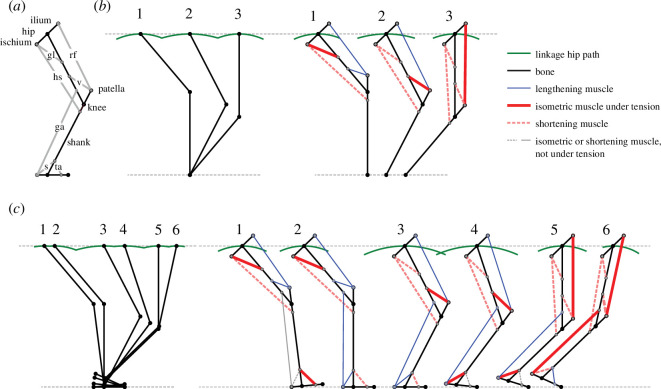
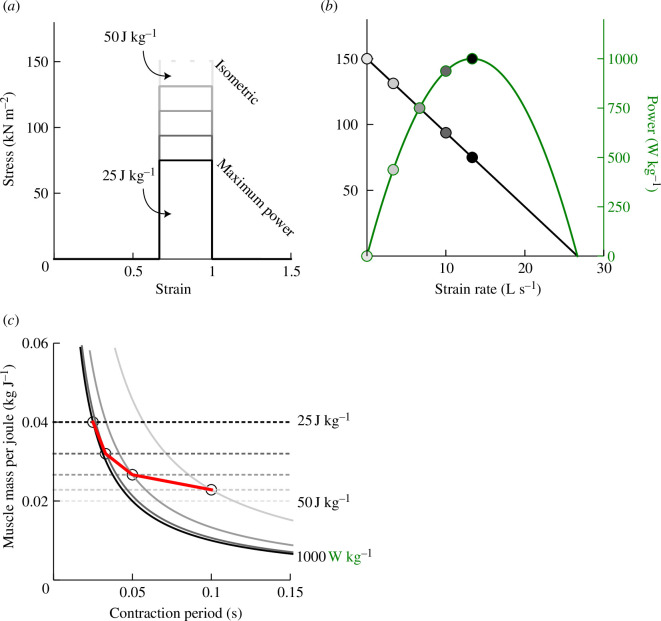
The actions of the major human leg muscles are well established; however, the functions of these muscle actions during steady running remain unclear. Here, leg structures and mechanisms are considered in terms of their functions in meeting the task of a vehicle acting as an effective machine, supporting body weight during translation with low mechanical work demand and in supplying mechanical work economically. Legs are modelled as a sequence of linkages that predict muscle actions and reveal the varying muscle functions within the integrated leg. Work avoidance is achieved with isometric muscles and linkages that promote a sliding of the hip over the ground contact, resulting in an approximately horizontal path of the centre of mass. Economical work supply requires, for muscle with constrained power, shortening over the entire stance duration; this function is achieved by the hamstrings without disrupting the linkages resulting in work avoidance. In late stance, the two functions occur through coactivation of antagonistic muscles, providing one answer to Lombard's paradox. Quadriceps and hamstring tensions result in opposing moments about both hip and knee joints, but by doing so perform the independent yet complementary roles of work avoidance during translating weight support and economical work supply.
期刊介绍:
Previously a supplement to Proceedings B, and launched as an independent journal in 2005, Biology Letters is a primarily online, peer-reviewed journal that publishes short, high-quality articles, reviews and opinion pieces from across the biological sciences. The scope of Biology Letters is vast - publishing high-quality research in any area of the biological sciences. However, we have particular strengths in the biology, evolution and ecology of whole organisms. We also publish in other areas of biology, such as molecular ecology and evolution, environmental science, and phylogenetics.




 京公网安备 11010802042870号
京ICP备2023020795号-1
京公网安备 11010802042870号
京ICP备2023020795号-1

 分享
分享
 求助内容:
求助内容: 应助结果提醒方式:
 扫码关注我们
