{"title":"Medication beliefs and depression in Black individuals with diabetes and mild cognitive impairment","authors":"Barry W. Rovner MD, Robin J. Casten PhD","doi":"10.1111/jgs.19123","DOIUrl":null,"url":null,"abstract":"<p>Depression and impaired cognition occur frequently in older patients with diabetes, and may influence beliefs about diabetes medications.<span><sup>1, 2</sup></span> These beliefs, when not shared by clinicians, may engender mistrust and reduce medication adherence. Thus, the relationship between depression, cognition, and medication beliefs is important, especially because treating depression may improve cognition and reverse depressive symptoms (e.g., pessimism, loss of interest, and hopelessness) that compromise medication adherence. In this study, we examined relationships between beliefs about diabetes medications, depression, and cognition in older Black individuals with type 2 diabetes and mild cognitive impairment (MCI). The results may guide ways to optimize diabetes treatment in this high-risk population.</p><p>This was a cross-sectional analysis of baseline data (<i>N</i> = 289) from two clinical trials testing the efficacy of two different behavioral interventions in older Black primary care patients with type 2 diabetes and MCI to improve glycemic control. Previous publications describe the two studies (Study 1; <i>N</i> = 144 and Study 2; <i>N</i> = 145).<span><sup>3, 4</sup></span> Institutional Review Board (IRB) approval was obtained, and all participants provided informed consent. Baseline data in both studies included age, sex, and education; hemoglobin A1c level; Patient Health Questionnaire-9 (PHQ-9); participants with PHQ-9 scores ≥10 were considered to have clinically significant depression<span><sup>5</sup></span>; and Beliefs About Medicines Questionnaire (BMQ), which rates medication beliefs from 1 (“strongly disagree”) to 5 (“strongly agree”).<span><sup>6</sup></span> Beliefs that were agreed to or strongly agreed to were considered present. To assess cognition, we used the Mini-Mental Status Examination (MMSE)<span><sup>7</sup></span> in Study 1, and the Montreal Cognitive Assessment (MoCA)<span><sup>8</sup></span> in Study 2. Statistical tests included one-way analysis of variance (ANOVA) for continuous data and chi-squares for categorical variables.</p><p>Among 289 participants, 89 (30.8%) met criteria for clinically significant depression. Depressed and nondepressed participants were similar in age, sex, education, and hemoglobin A1c levels (Table 1). In the Study 1 sample, depressed and nondepressed participants had comparable MMSE scores; in the Study 2 sample, depressed participants had lower MoCA scores than nondepressed participants (Table 1). Depressed participants were significantly more likely to endorse negative medication beliefs than nondepressed participants (Figure 1). Many participants held negative beliefs about physicians' medication prescribing (i.e., “doctors use too many medicines”; “doctors place too much trust on medicines”; and “if doctors had more time with patients, they would prescribe fewer medicines”) but rates were higher in depressed than nondepressed participants.</p><p>We found that negative beliefs about diabetes medications were related to depression in older Black patients with type 2 diabetes and MCI. Although depression may induce negative health beliefs (e.g., worry, disruption, and misunderstanding), both depressed and nondepressed participants held many negative medication beliefs, particularly concerning physicians. These findings are important because depression, health beliefs, medication adherence, glycemic control, and diabetes complications are interrelated.<span><sup>9, 10</sup></span> In this study, all participants had impaired cognition, which can compromise insight and shape health beliefs. Medication beliefs, however, appeared more related to depression than cognition, notwithstanding the somewhat lower MoCA scores in depressed versus nondepressed participants in Study 2. This study has a number of limitations, including uncertain generalizability, absence of data on medication beliefs among individuals with normal cognition, and uncertainty about whether treating depression can modify health beliefs. Despite these limitations, this study suggests that discussing medication beliefs with patients may identify those at risk of medication nonadherence, depression, and impaired cognition. Moreover, such discussions can provide an opportunity to promote positive attitudes about treatment and trust in physicians, and thereby optimize care for older Black individuals, in whom rates of diabetes, depression, and impaired cognition are high.</p><p>Concept and design: Both authors. Acquisition, analysis, or interpretation of data: Both authors. Drafting of the manuscript: Barry W. Rovner, Robin J. Casten. Statistical analysis: Robin J. Casten. Obtained funding: Barry W. Rovner.</p><p>The authors have no conflicts of interest to disclose.</p><p>The sponsors had no role in the study design, data collection, in the analysis and interpretation of data, in the writing of this manuscript, or the decision to submit this manuscript for publication.</p><p>This study was supported by the National Institute of Diabetes and Digestive and Kidney Diseases (NIDDK; grant R01 DK102609-01) and the National Institute on Aging (R01AG065467).</p>","PeriodicalId":17240,"journal":{"name":"Journal of the American Geriatrics Society","volume":"72 12","pages":"3920-3922"},"PeriodicalIF":4.5000,"publicationDate":"2024-08-08","publicationTypes":"Journal Article","fieldsOfStudy":null,"isOpenAccess":false,"openAccessPdf":"https://www.ncbi.nlm.nih.gov/pmc/articles/PMC11637241/pdf/","citationCount":"0","resultStr":null,"platform":"Semanticscholar","paperid":null,"PeriodicalName":"Journal of the American Geriatrics Society","FirstCategoryId":"3","ListUrlMain":"https://agsjournals.onlinelibrary.wiley.com/doi/10.1111/jgs.19123","RegionNum":2,"RegionCategory":"医学","ArticlePicture":[],"TitleCN":null,"AbstractTextCN":null,"PMCID":null,"EPubDate":"","PubModel":"","JCR":"Q1","JCRName":"GERIATRICS & GERONTOLOGY","Score":null,"Total":0}
引用次数: 0
Abstract
Depression and impaired cognition occur frequently in older patients with diabetes, and may influence beliefs about diabetes medications.1, 2 These beliefs, when not shared by clinicians, may engender mistrust and reduce medication adherence. Thus, the relationship between depression, cognition, and medication beliefs is important, especially because treating depression may improve cognition and reverse depressive symptoms (e.g., pessimism, loss of interest, and hopelessness) that compromise medication adherence. In this study, we examined relationships between beliefs about diabetes medications, depression, and cognition in older Black individuals with type 2 diabetes and mild cognitive impairment (MCI). The results may guide ways to optimize diabetes treatment in this high-risk population.
This was a cross-sectional analysis of baseline data (N = 289) from two clinical trials testing the efficacy of two different behavioral interventions in older Black primary care patients with type 2 diabetes and MCI to improve glycemic control. Previous publications describe the two studies (Study 1; N = 144 and Study 2; N = 145).3, 4 Institutional Review Board (IRB) approval was obtained, and all participants provided informed consent. Baseline data in both studies included age, sex, and education; hemoglobin A1c level; Patient Health Questionnaire-9 (PHQ-9); participants with PHQ-9 scores ≥10 were considered to have clinically significant depression5; and Beliefs About Medicines Questionnaire (BMQ), which rates medication beliefs from 1 (“strongly disagree”) to 5 (“strongly agree”).6 Beliefs that were agreed to or strongly agreed to were considered present. To assess cognition, we used the Mini-Mental Status Examination (MMSE)7 in Study 1, and the Montreal Cognitive Assessment (MoCA)8 in Study 2. Statistical tests included one-way analysis of variance (ANOVA) for continuous data and chi-squares for categorical variables.
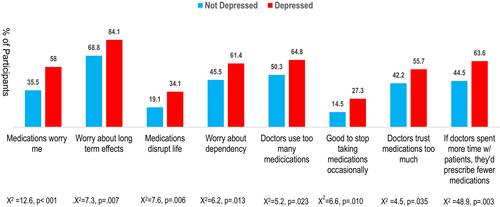
Among 289 participants, 89 (30.8%) met criteria for clinically significant depression. Depressed and nondepressed participants were similar in age, sex, education, and hemoglobin A1c levels (Table 1). In the Study 1 sample, depressed and nondepressed participants had comparable MMSE scores; in the Study 2 sample, depressed participants had lower MoCA scores than nondepressed participants (Table 1). Depressed participants were significantly more likely to endorse negative medication beliefs than nondepressed participants (Figure 1). Many participants held negative beliefs about physicians' medication prescribing (i.e., “doctors use too many medicines”; “doctors place too much trust on medicines”; and “if doctors had more time with patients, they would prescribe fewer medicines”) but rates were higher in depressed than nondepressed participants.
We found that negative beliefs about diabetes medications were related to depression in older Black patients with type 2 diabetes and MCI. Although depression may induce negative health beliefs (e.g., worry, disruption, and misunderstanding), both depressed and nondepressed participants held many negative medication beliefs, particularly concerning physicians. These findings are important because depression, health beliefs, medication adherence, glycemic control, and diabetes complications are interrelated.9, 10 In this study, all participants had impaired cognition, which can compromise insight and shape health beliefs. Medication beliefs, however, appeared more related to depression than cognition, notwithstanding the somewhat lower MoCA scores in depressed versus nondepressed participants in Study 2. This study has a number of limitations, including uncertain generalizability, absence of data on medication beliefs among individuals with normal cognition, and uncertainty about whether treating depression can modify health beliefs. Despite these limitations, this study suggests that discussing medication beliefs with patients may identify those at risk of medication nonadherence, depression, and impaired cognition. Moreover, such discussions can provide an opportunity to promote positive attitudes about treatment and trust in physicians, and thereby optimize care for older Black individuals, in whom rates of diabetes, depression, and impaired cognition are high.
Concept and design: Both authors. Acquisition, analysis, or interpretation of data: Both authors. Drafting of the manuscript: Barry W. Rovner, Robin J. Casten. Statistical analysis: Robin J. Casten. Obtained funding: Barry W. Rovner.
The authors have no conflicts of interest to disclose.
The sponsors had no role in the study design, data collection, in the analysis and interpretation of data, in the writing of this manuscript, or the decision to submit this manuscript for publication.
This study was supported by the National Institute of Diabetes and Digestive and Kidney Diseases (NIDDK; grant R01 DK102609-01) and the National Institute on Aging (R01AG065467).
老年糖尿病患者经常出现抑郁和认知障碍,并可能影响对糖尿病药物的看法。1,2当临床医生不认同这些信念时,可能会产生不信任并降低药物依从性。因此,抑郁症、认知和药物信念之间的关系是重要的,特别是因为治疗抑郁症可以改善认知和逆转影响药物依从性的抑郁症状(例如,悲观、失去兴趣和绝望)。在这项研究中,我们研究了老年黑人2型糖尿病和轻度认知障碍(MCI)患者对糖尿病药物、抑郁和认知的看法之间的关系。该结果可能指导在这一高危人群中优化糖尿病治疗的方法。这是对两项临床试验基线数据(N = 289)的横断面分析,该试验测试了两种不同行为干预对老年黑人2型糖尿病和轻度认知障碍患者改善血糖控制的效果。先前的出版物描述了这两项研究(研究1;N = 144,研究2;n = 145)。3,4获得了机构审查委员会(IRB)的批准,所有参与者都提供了知情同意。两项研究的基线数据包括年龄、性别和教育程度;血红蛋白A1c水平;患者健康问卷-9;PHQ-9得分≥10的参与者被认为有临床显著的抑郁症5;以及关于药物的信念问卷(BMQ),对药物的信念进行评分,从1(“非常不同意”)到5(“非常同意”)被同意或强烈同意的信仰被认为是存在的。为了评估认知,我们在研究1中使用了迷你精神状态检查(MMSE)7,在研究2中使用了蒙特利尔认知评估(MoCA)8。统计检验包括连续数据的单因素方差分析(ANOVA)和分类变量的卡方分析。289名参与者中,89名(30.8%)符合临床显著抑郁标准。抑郁和非抑郁参与者在年龄、性别、教育程度和血红蛋白A1c水平上相似(表1)。在研究1样本中,抑郁和非抑郁参与者的MMSE得分相当;在研究2样本中,抑郁参与者的MoCA得分低于非抑郁参与者(表1)。与非抑郁参与者相比,抑郁参与者明显更倾向于支持消极的药物信念(图1)。许多参与者对医生的药物处方持有消极信念(即“医生用药过多”;“医生过于相信药物”;“如果医生有更多的时间和病人在一起,他们就会开更少的药”),但抑郁症患者的比例高于非抑郁症患者。我们发现,对糖尿病药物的负面信念与老年黑人2型糖尿病和轻度认知障碍患者的抑郁有关。尽管抑郁可能会导致消极的健康信念(例如,担忧、破坏和误解),但抑郁和非抑郁参与者都持有许多消极的药物信念,特别是对医生。这些发现很重要,因为抑郁、健康信念、药物依从性、血糖控制和糖尿病并发症是相互关联的。9,10在这项研究中,所有参与者都有认知障碍,这可能会损害洞察力和形成健康信念。尽管在研究2中,抑郁参与者的MoCA得分略低于非抑郁参与者,但药物信念似乎与抑郁的关系大于认知。这项研究有许多局限性,包括不确定的普遍性,缺乏正常认知个体的药物信念数据,以及治疗抑郁症是否可以改变健康信念的不确定性。尽管存在这些局限性,但本研究表明,与患者讨论用药信念可能会识别出那些有服药不依、抑郁和认知受损风险的患者。此外,这样的讨论可以提供一个机会,促进对治疗的积极态度和对医生的信任,从而优化老年黑人的护理,他们的糖尿病、抑郁症和认知障碍的发病率很高。概念和设计:两位作者。数据的获取、分析或解释:两位作者。手稿起草:Barry W. Rovner, Robin J. Casten。统计分析:Robin J. Casten。获得资助:Barry W. Rovner。作者没有需要披露的利益冲突。申办者没有参与研究设计、数据收集、数据分析和解释、撰写本文或决定是否将本文提交发表。这项研究得到了美国国家糖尿病、消化和肾脏疾病研究所(NIDDK;资助R01 DK102609-01)和国家老龄研究所(R01AG065467)。
期刊介绍:
Journal of the American Geriatrics Society (JAGS) is the go-to journal for clinical aging research. We provide a diverse, interprofessional community of healthcare professionals with the latest insights on geriatrics education, clinical practice, and public policy—all supporting the high-quality, person-centered care essential to our well-being as we age. Since the publication of our first edition in 1953, JAGS has remained one of the oldest and most impactful journals dedicated exclusively to gerontology and geriatrics.




 京公网安备 11010802042870号
京ICP备2023020795号-1
京公网安备 11010802042870号
京ICP备2023020795号-1

 分享
分享
 求助内容:
求助内容: 应助结果提醒方式:
 扫码关注我们
