Stacey Cowe, Simon Cooper, Rachel Malcolm, Louis Hall, David Donkin, Caroline Sunderland
{"title":"The effect of a combined cooling intervention on cognitive function in the heat during an intermittent running protocol","authors":"Stacey Cowe, Simon Cooper, Rachel Malcolm, Louis Hall, David Donkin, Caroline Sunderland","doi":"10.1002/ejsc.12178","DOIUrl":null,"url":null,"abstract":"<p>Despite optimal cognitive function being essential for performance, there is a lack of research on the effectiveness of combined cooling interventions on team sport athlete's cognitive function when exercising in the heat. In a randomised, crossover design, 12 unacclimatised men (age: 22.3 ± 3.0 years, body mass: 73.4 ± 5.1 kg, height: 181.0 ± 5.3 cm and <span></span><math></math> max: 51.2 ± 9.5 mL/kg/min) participated in a control (CON) and combined cooling trial (ice slurry and ice collar; COOL). A battery of cognitive tests were completed prior to, during (at half-time) and following a 90-min intermittent running protocol in the heat (33°C, 50% relative humidity (RH)). Perceptual and physiological measures were taken throughout the protocol. In CON, response times were quicker on the Stroop task complex level (<i>p</i> = 0.002) and the visual search test complex level at full-time (<i>p</i> = 0.014) compared to COOL. During COOL, response times were quicker at half-time on the Stroop task complex level (<i>p</i> = 0.024) compared to CON. Lower rectal temperatures were seen during COOL (CON: 37.44 ± 0.65°C and COOL: 37.28 ± 0.68°C) as well as lower skin, neck and forehead temperatures (main effect of trial, all <i>p</i> < 0.05). Lower ratings of thermal sensation and perceived exertion and enhanced thermal comfort were recorded during COOL (main effect of trial, all <i>p</i> < 0.05). Whilst minimal differences in cognitive function were found when using the combined cooling intervention, the findings highlight a practical and effective strategy to improving many physiological and perceptual responses to intermittent exercise in the heat.</p>","PeriodicalId":93999,"journal":{"name":"European journal of sport science","volume":"24 9","pages":"1287-1301"},"PeriodicalIF":3.0000,"publicationDate":"2024-08-08","publicationTypes":"Journal Article","fieldsOfStudy":null,"isOpenAccess":false,"openAccessPdf":"https://onlinelibrary.wiley.com/doi/epdf/10.1002/ejsc.12178","citationCount":"0","resultStr":null,"platform":"Semanticscholar","paperid":null,"PeriodicalName":"European journal of sport science","FirstCategoryId":"1085","ListUrlMain":"https://onlinelibrary.wiley.com/doi/10.1002/ejsc.12178","RegionNum":0,"RegionCategory":null,"ArticlePicture":[],"TitleCN":null,"AbstractTextCN":null,"PMCID":null,"EPubDate":"","PubModel":"","JCR":"","JCRName":"","Score":null,"Total":0}
引用次数: 0
Abstract
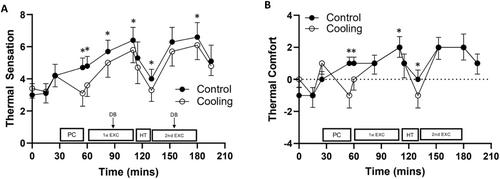
Despite optimal cognitive function being essential for performance, there is a lack of research on the effectiveness of combined cooling interventions on team sport athlete's cognitive function when exercising in the heat. In a randomised, crossover design, 12 unacclimatised men (age: 22.3 ± 3.0 years, body mass: 73.4 ± 5.1 kg, height: 181.0 ± 5.3 cm and max: 51.2 ± 9.5 mL/kg/min) participated in a control (CON) and combined cooling trial (ice slurry and ice collar; COOL). A battery of cognitive tests were completed prior to, during (at half-time) and following a 90-min intermittent running protocol in the heat (33°C, 50% relative humidity (RH)). Perceptual and physiological measures were taken throughout the protocol. In CON, response times were quicker on the Stroop task complex level (p = 0.002) and the visual search test complex level at full-time (p = 0.014) compared to COOL. During COOL, response times were quicker at half-time on the Stroop task complex level (p = 0.024) compared to CON. Lower rectal temperatures were seen during COOL (CON: 37.44 ± 0.65°C and COOL: 37.28 ± 0.68°C) as well as lower skin, neck and forehead temperatures (main effect of trial, all p < 0.05). Lower ratings of thermal sensation and perceived exertion and enhanced thermal comfort were recorded during COOL (main effect of trial, all p < 0.05). Whilst minimal differences in cognitive function were found when using the combined cooling intervention, the findings highlight a practical and effective strategy to improving many physiological and perceptual responses to intermittent exercise in the heat.



 京公网安备 11010802042870号
京ICP备2023020795号-1
京公网安备 11010802042870号
京ICP备2023020795号-1

 分享
分享

 求助内容:
求助内容: 应助结果提醒方式:
 扫码关注我们
