Cristina Martin-Garcia, Andrea Dionelly Murillo-Casas, Milagros Lázaro-Sastre, Miguel Estravís, Francisco Javier Muñoz-Bellido, Elena Mazoteras-Martinez, Ignacio Dávila
{"title":"Assessment of sIgE to rLep d 2 for detecting Lepidoglyphus destructor sensitization","authors":"Cristina Martin-Garcia, Andrea Dionelly Murillo-Casas, Milagros Lázaro-Sastre, Miguel Estravís, Francisco Javier Muñoz-Bellido, Elena Mazoteras-Martinez, Ignacio Dávila","doi":"10.1111/all.16272","DOIUrl":null,"url":null,"abstract":"<p><i>Lepidoglyphus destructor</i> is an important aeroallergen in some regions of Europe, such as Galicia (Spain).<span><sup>1</sup></span> rLep d 2 has been introduced to diagnose IgE-mediated allergy to <i>L. destructor</i>. We aimed to analyze the sensitivity, specificity, and positive and negative likelihood ratios (PLR and NLR) of sIgE to <i>L. destructor</i> benchmarked against rLep d 2.</p><p>We retrospectively analyzed 95 sera of patients previously diagnosed with respiratory allergy to <i>L. destructor</i>, to whom an IgE determination of <i>L. destructor</i> had been requested. The protocol was approved by the Hospital Ethics Committee for Clinical Research (PI 2023/09/1425). Material and methods are specified in Supplementary material (Data S1).</p><p>Statistically significant differences were found between patients sensitized and not sensitized to <i>L. destructor</i>. Patients with a sIgE positive to <i>L. destructor</i> had a higher percentage of asthma and moderate/severe persistent rhinitis. (Table 1).</p><p>There was a high correlation between <i>L. destructor</i> and rLep d 2 (<i>R</i> = .940, <i>p</i> < .001), but no correlation between <i>L. destructor</i> and rDer p 2 (<i>R</i> = .117, <i>p</i> = .260) (Figure S1).</p><p>The sensitivity of sIgE to rLep d 2 was 71.64% (95% CI, 59.31–81.99), and specificity was 96.43% (95% CI, 81.65–99.91). PLR was 20.06 (95%CI, 2.91–138.28) and NLR 0.29 (95% CI, 0.20–0.43). The Receiver Operating Characteristic (ROC) curve for sIgE benchmarked against rLep d 2 had an area under the curve of 0.931 (Figure S2). The results are summarized in Figure 1.</p><p>This is the first study to examine the accuracy of the commercially available major allergen rLep d 2 in a population of patients allergic and non-allergic to <i>L. destructor</i> with rhinitis and/or asthma. Good sensitivity (71.64%), excellent specificity (96.43%), remarkable PLR (20.06) and NRL (0.29), and a noteworthy ROC result (0.931) were observed.</p><p>Data analysis showed a high correlation between sIgE to rLep d 2 and sIgE to <i>L. destructor</i> (0.94) (Figure S1A), much higher than that previously obtained by Johansson et al.,<span><sup>2</sup></span> who used a non-commercial recombinant extract of Lep d 2, finding a correlation coefficient of .70. Additionally, the lack of correlation between sIgE to rDer p 2 and sIgE to <i>L. destructor</i>, with a correlation coefficient of .117 (Figure S1B), agrees with the lack of cross-reactivity between group 2 allergens of <i>L. destructor</i> and <i>D. pteronyssinus</i>.<span><sup>3</sup></span> Therefore, most patients who test positive for rLep d 2 and rDer p 2 can be considered co-sensitized.</p><p>The sensitivity and specificity data for sIgE to rLep d 2 indicate that a positive result suggests sensitization to <i>L. destructor</i>. In contrast, a negative result does not necessarily rule out sensitization, as almost 30% of patients can still be sensitized to <i>L. destructor</i>. The PLR of 20.06 provides robust evidence for <i>L. destructor</i> allergy when rLep d 2 values are ≥0.35 kU/L. However, it is noteworthy that the ability to exclude <i>L. destructor</i> allergy is weaker when rLep d 2 values fall below that threshold.</p><p>Patients' test results (Figure 1) suggest that SPT and sIgE should be used when evaluating a patient with suspected allergy to <i>L. destructor</i>. In addition, 19 patients had sIgE positive to <i>L. destructor</i> but negative sIgE to rLep d 2. It could happen that some patients may have been sensitized to allergens other than Lep d 2. Accordingly, rLep d 2 should not be initially used when evaluating a patient with a suspected allergy to <i>L. destructor</i>. Notwithstanding, sIgE against Lep d 2 might be helpful before initiating specific immunotherapy with <i>L. destructor</i>.<span><sup>4</sup></span></p><p>The novel recombinant allergen rLep d 2 exhibits excellent specificity, although its sensitivity is lower compared to specific IgE tests and skin prick tests using <i>Lepidoglyphus destructor</i>. Its additional diagnostic utility for respiratory allergies related to <i>L destructor</i> is minimal.</p><p>To conclude, despite an excellent specificity, determining sIgE to rLep d 2 does not seem to offer additional diagnostic value when compared with SPTs and/or sIgE to <i>L. destructor</i>.</p><p><b>Cristina Martin-Garcia:</b> Project administration; writing—original draft and revisions; data curation; presentation; interpretation. <b>Andrea Dionelly Murillo-Casas:</b> Conceptualization; data presentation; writing—original draft. <b>Milagros Lázaro-Sastre:</b> Conceptualization; writing–review and editing. <b>Miguel Estravis:</b> Data analysis and presentation; develop-ment of methodology; writing—original draft and revisions. <b>Francisco Javier Muñoz-Bellido:</b> Conceptualization; writing—review and editing. <b>Elena Mazoteras-Martinez:</b> Conceptualization; writing—review and editing. <b>Ignacio Dávila:</b> Conceptualization; supervision; methodology; writing—original draft and revisions; review and editing. All authors contributed to text and letter manuscript including through revisions and edits. All authors approve of the content of the manuscript and agree to be held ac-countable for the work.</p><p>This study has not been funded.</p><p>The authors declare no conflict of interest in relation to this work.</p>","PeriodicalId":122,"journal":{"name":"Allergy","volume":"79 12","pages":"3540-3542"},"PeriodicalIF":12.0000,"publicationDate":"2024-08-11","publicationTypes":"Journal Article","fieldsOfStudy":null,"isOpenAccess":false,"openAccessPdf":"https://onlinelibrary.wiley.com/doi/epdf/10.1111/all.16272","citationCount":"0","resultStr":null,"platform":"Semanticscholar","paperid":null,"PeriodicalName":"Allergy","FirstCategoryId":"3","ListUrlMain":"https://onlinelibrary.wiley.com/doi/10.1111/all.16272","RegionNum":1,"RegionCategory":"医学","ArticlePicture":[],"TitleCN":null,"AbstractTextCN":null,"PMCID":null,"EPubDate":"","PubModel":"","JCR":"Q1","JCRName":"ALLERGY","Score":null,"Total":0}
引用次数: 0
Abstract
Lepidoglyphus destructor is an important aeroallergen in some regions of Europe, such as Galicia (Spain).1 rLep d 2 has been introduced to diagnose IgE-mediated allergy to L. destructor. We aimed to analyze the sensitivity, specificity, and positive and negative likelihood ratios (PLR and NLR) of sIgE to L. destructor benchmarked against rLep d 2.
We retrospectively analyzed 95 sera of patients previously diagnosed with respiratory allergy to L. destructor, to whom an IgE determination of L. destructor had been requested. The protocol was approved by the Hospital Ethics Committee for Clinical Research (PI 2023/09/1425). Material and methods are specified in Supplementary material (Data S1).
Statistically significant differences were found between patients sensitized and not sensitized to L. destructor. Patients with a sIgE positive to L. destructor had a higher percentage of asthma and moderate/severe persistent rhinitis. (Table 1).
There was a high correlation between L. destructor and rLep d 2 (R = .940, p < .001), but no correlation between L. destructor and rDer p 2 (R = .117, p = .260) (Figure S1).
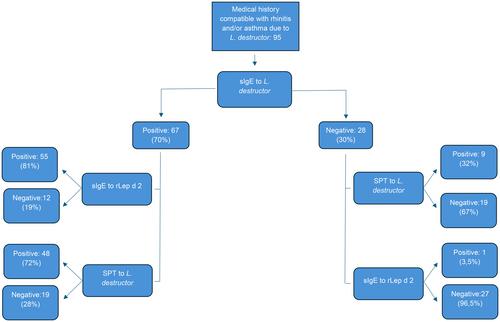
The sensitivity of sIgE to rLep d 2 was 71.64% (95% CI, 59.31–81.99), and specificity was 96.43% (95% CI, 81.65–99.91). PLR was 20.06 (95%CI, 2.91–138.28) and NLR 0.29 (95% CI, 0.20–0.43). The Receiver Operating Characteristic (ROC) curve for sIgE benchmarked against rLep d 2 had an area under the curve of 0.931 (Figure S2). The results are summarized in Figure 1.
This is the first study to examine the accuracy of the commercially available major allergen rLep d 2 in a population of patients allergic and non-allergic to L. destructor with rhinitis and/or asthma. Good sensitivity (71.64%), excellent specificity (96.43%), remarkable PLR (20.06) and NRL (0.29), and a noteworthy ROC result (0.931) were observed.
Data analysis showed a high correlation between sIgE to rLep d 2 and sIgE to L. destructor (0.94) (Figure S1A), much higher than that previously obtained by Johansson et al.,2 who used a non-commercial recombinant extract of Lep d 2, finding a correlation coefficient of .70. Additionally, the lack of correlation between sIgE to rDer p 2 and sIgE to L. destructor, with a correlation coefficient of .117 (Figure S1B), agrees with the lack of cross-reactivity between group 2 allergens of L. destructor and D. pteronyssinus.3 Therefore, most patients who test positive for rLep d 2 and rDer p 2 can be considered co-sensitized.
The sensitivity and specificity data for sIgE to rLep d 2 indicate that a positive result suggests sensitization to L. destructor. In contrast, a negative result does not necessarily rule out sensitization, as almost 30% of patients can still be sensitized to L. destructor. The PLR of 20.06 provides robust evidence for L. destructor allergy when rLep d 2 values are ≥0.35 kU/L. However, it is noteworthy that the ability to exclude L. destructor allergy is weaker when rLep d 2 values fall below that threshold.
Patients' test results (Figure 1) suggest that SPT and sIgE should be used when evaluating a patient with suspected allergy to L. destructor. In addition, 19 patients had sIgE positive to L. destructor but negative sIgE to rLep d 2. It could happen that some patients may have been sensitized to allergens other than Lep d 2. Accordingly, rLep d 2 should not be initially used when evaluating a patient with a suspected allergy to L. destructor. Notwithstanding, sIgE against Lep d 2 might be helpful before initiating specific immunotherapy with L. destructor.4
The novel recombinant allergen rLep d 2 exhibits excellent specificity, although its sensitivity is lower compared to specific IgE tests and skin prick tests using Lepidoglyphus destructor. Its additional diagnostic utility for respiratory allergies related to L destructor is minimal.
To conclude, despite an excellent specificity, determining sIgE to rLep d 2 does not seem to offer additional diagnostic value when compared with SPTs and/or sIgE to L. destructor.
Cristina Martin-Garcia: Project administration; writing—original draft and revisions; data curation; presentation; interpretation. Andrea Dionelly Murillo-Casas: Conceptualization; data presentation; writing—original draft. Milagros Lázaro-Sastre: Conceptualization; writing–review and editing. Miguel Estravis: Data analysis and presentation; develop-ment of methodology; writing—original draft and revisions. Francisco Javier Muñoz-Bellido: Conceptualization; writing—review and editing. Elena Mazoteras-Martinez: Conceptualization; writing—review and editing. Ignacio Dávila: Conceptualization; supervision; methodology; writing—original draft and revisions; review and editing. All authors contributed to text and letter manuscript including through revisions and edits. All authors approve of the content of the manuscript and agree to be held ac-countable for the work.
This study has not been funded.
The authors declare no conflict of interest in relation to this work.
期刊介绍:
Allergy is an international and multidisciplinary journal that aims to advance, impact, and communicate all aspects of the discipline of Allergy/Immunology. It publishes original articles, reviews, position papers, guidelines, editorials, news and commentaries, letters to the editors, and correspondences. The journal accepts articles based on their scientific merit and quality.
Allergy seeks to maintain contact between basic and clinical Allergy/Immunology and encourages contributions from contributors and readers from all countries. In addition to its publication, Allergy also provides abstracting and indexing information. Some of the databases that include Allergy abstracts are Abstracts on Hygiene & Communicable Disease, Academic Search Alumni Edition, AgBiotech News & Information, AGRICOLA Database, Biological Abstracts, PubMed Dietary Supplement Subset, and Global Health, among others.





 京公网安备 11010802042870号
京ICP备2023020795号-1
京公网安备 11010802042870号
京ICP备2023020795号-1

 分享
分享
 求助内容:
求助内容: 应助结果提醒方式:
 扫码关注我们
